
Family
Ericaceae, heath family.
Genus
Lyonia is named after John Lyon (1765-1814), a Scottish man who worked in the gardens of Pennsylvania and Tennessee.
Species
The species name, lucida, stems from the Latin word lucens, which means "glittering, shining, clear."
Common Names
Fetterbush, Shiny Lyonia
The common name "fetterbush" refers to the growth habit of this shrub, because it tends to restrict or "fetter" the movement of humans or animals when it grows in abundance. The name "shiny lyonia" refers to this plant's shiny leaves.
Description
This native evergreen shrub is found along margins of damp swamp lands and ponds as far north as Virginia, south to Florida, and west to Louisiana. It grows best in full sun to partial shade and can reach heights of 3 to 5 feet. The oval leaves are simple and alternately arranged with a leathery and glabrous texture, and smooth, entire margins. A major vein encircles each leaf just inside the edge, and a distinct ridge occurs around the lower side of the leaf margin. When young, leaves are a coppery color and as they mature become a darker green, reaching lengths of 1 to 2 inches. Twigs are brown and strongly angular, and plants usually grow with a multi-stemmed trunk. Flowers are bell-shaped, range in color from white to pink, and are approximately ½ inch long. Blooms are fragrant and appear as unbranched, elongated inflorescences that flourish in the late winter and early spring. Fruits are approximately 1/3-inch-long capsules that dry to brown and split open to release the seeds at maturity.
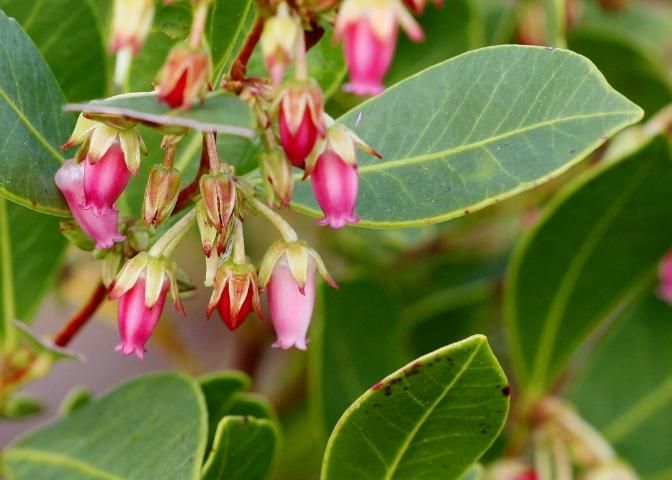
Credit: Mary Keim, CC BY-NC-SA 2.0
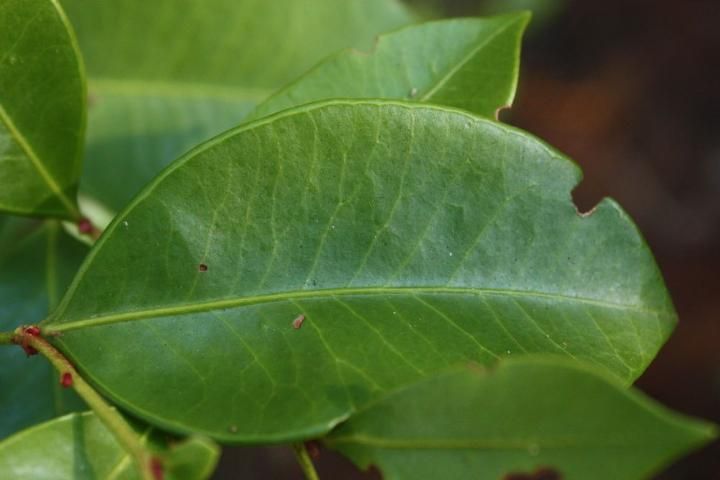
Credit: CA Floristics, CC BY-NC-SA 2.0
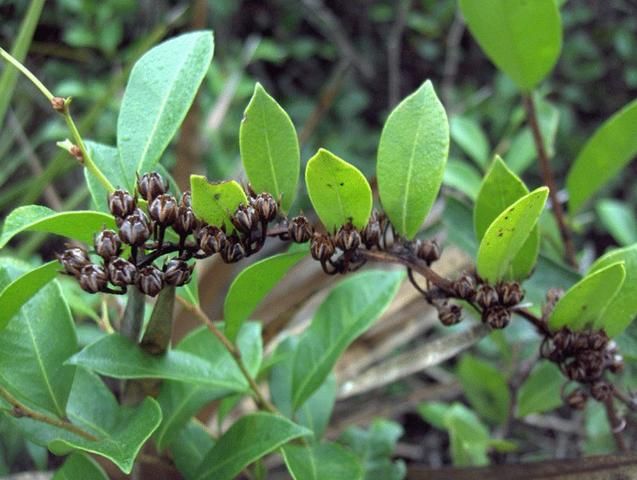
Credit: Homer Edward Price, CC BY 2.0
Allergen
While many plants in the Lyonia genus are poisonous if ingested, Lyonia lucida is not known to be poisonous. However, many Lyonia spp. can cause irritation or a rash if sap comes into contact with the skin. Therefore, most Lyonia spp. are considered moderately to highly allergenic.
Applications
Cultural
It has been documented that Seminole Indians used the wood of fetterbush to make bowls for their tobacco pipes.
Horticultural
This shrub makes a great addition to wetter landscapes. Its showy flowers add a splash of color in the late winter and early spring. In addition, shiny lyonia is easy to maintain, making it a desirable addition to the landscape.
Wildlife
Because many members of the genus Lyonia are poisonous, they should not be planted in or near areas used by livestock.
References
Austin, D. F. (2004). Florida ethnobotany. Boca Raton, FL: CRC Press.
Gledhill, D. (1989). The names of plants (2nd ed.). Cambridge: Press Syndicate of the University of Cambridge.
Godfrey, R. K. (1988). Trees, shrubs, and woody vines of Northern Florida and adjacent Georgia and Alabama. Athens, GA: The University of Georgia Press.
Haehle, R. J. and J. Brookwell. (2004). Native Florida plants: Low-maintenance landscaping and gardening. Lanham, MD: Taylor Trade Publishing.
Miller, J. H. and K. V. Miller. (2005). Forest plants of the Southeast and their wildlife uses (Revised ed.). Athens, GA: University of Georgia Press.
Nelson, G. (1994). The trees of Florida: A reference and field guide. Sarasota, FL: Pineapple Press.
Ogren, T. L. (2000). Allergy-free gardening: The revolutionary guide to healthy landscaping. Berkeley, CA: Ten Speed Press.
Osorio, R. (2001). A gardener's guide to Florida's native plants. Gainesville, FL: University Press of Florida.
USDA Natural Resources Conservation Service. (n.d.). PLANTS database. Retrieved from http://plants.usda.gov/index.html