
Note: Some sources refer to kumquat as Citrus spp.
Family
Rutaceae, citrus family
Genus
Fortunella is the name given to the kumquat genus in honor of Robert Fortune who in 1846 was the first person to import kumquats into Europe.
Common Name
Kumquat
The name "kumquat" is a synthesis of the Chinese words gam, meaning gold, + gwat, a term for tangerines.
Description
Credit: where-is-gali, CC BY-NC-SA 2.0, http://flic.kr/p/9AXp8r
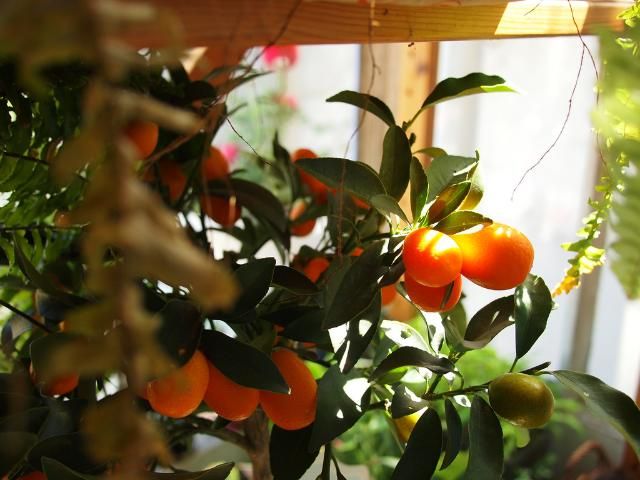
This evergreen tree is native to Southeast China and tropical Malaysia but is now cultivated throughout the Gulf Coast region of the United States. It is less sensitive to cold and frost than many other citrus varieties since it can handle temperatures as low as 10°F. Kumquats grow best in full sun, but they can tolerate some shade. They usually reach heights of 15 feet when planted in the open. Leaves are oval-to-spear shaped and are a darker green on the top of the leaf than on the bottom. The bark is brown and has a relatively smooth texture. Like other citrus, flowers are white and bloom in the spring, but blossoms are not as fragrant as those of other citrus varieties are. Kumquat fruits resemble miniature oranges that are round or oval in shape, and are generally not more than 2 inches in length or diameter. The fruit reaches maturity in October and the tree continues to produce fruits through March. Both the pulp and the rind are edible.
Allergen
Flowers from the kumquat tree are mildly allergenic.
Applications
Commercial/Practical
Kumquats are grown commercially for their fruits, although they are not as popular as other citrus varieties. The fruits may be eaten whole or made into preserves and jams.
Horticultural
Many people find kumquat trees attractive and useful yard specimens. Their dark green leaves and contrasting bright orange fruits give them ornamental quality, and their relatively small size makes them easy to care for once they're established. Because kumquats generally require less care than other citrus trees, they may be a good choice for gardeners with less time or experience, but who still desire an attractive and tasty citrus tree. If space is an issue, kumquats also do well in containers as long as they receive proper sunlight and watering.
Medicinal
Like all citrus fruits, kumquats contain large amounts of vitamin C, which is commonly recommended for maintaining a healthy immune system and warding off diseases associated with vitamin-C deficiency.
Additional References
Floridata.com (2008). Fortunella spp. Retrieved from http://www.floridata.com/ref/f/fort_mar.cfm.
Watkins, J. V., Sheehan, T. J., & Black, R. J. (2005). Florida Landscape Plants: Native and Exotic. (2nd ed). Gainesville, FL: University Press of Florida.