
Why do we need folate?
Folate is one of the B vitamins (B9). The synthetic form of this vitamin is folic acid used in supplements and fortified foods. Folate helps make DNA and amino acids. DNA is the genetic material found in all cells of the body, and amino acids are the building blocks of proteins.
Everyone needs folate. It is especially important for women who can become pregnant. Pregnant and nursing women need higher amounts of folate.
What happens if we don't get enough folate?
Without folate, your body cannot make DNA and amino acids. This is a concern for women who are pregnant and children as both are are rapidly making new cells. Eating high-folate foods may reduce your chances of developing anemia, stroke, and cancer (Chen et al. 2020; Thomas et al. 2015; Wang et al. 2019). Getting enough folate before becoming pregnant reduces a woman's risk of having a baby with certain birth defects (Atta et al. 2016; Feng et al. 2015).

Credit: fotostorm
How much folate do we need?
The recommended amounts for folate are given in dietary folate equivalents, or DFEs, which account for the difference in the amount of folate available for absorption between folate from food and synthetic folic acid. The following table lists recommended daily intakes of folate for adults and teens.
How can we get enough folate?
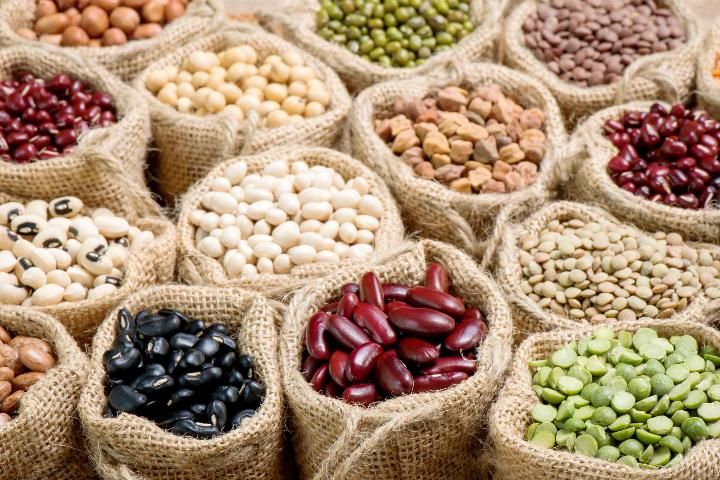
To get 400 mcg DFE every day, you can eat foods that are naturally high in folate. Some of the best food sources are green leafy vegetables, such as spinach, collards, and kale. Other foods that are high in folate are orange juice, legumes (dried beans and lentils), nuts, and peanuts.
Credit: Enrique Díaz/7cero
Getting enough folate can be easy if you eat foods that are fortified with folic acid, such as fortified grain foods like rice. Check food labels to see if folic acid has been added. Here is a sample ingredient list from a food label:
Ingredients: Apples, enriched wheat flour (contains niacin, reduced iron, thiamine mononitrate, riboflavin, and folic acid), partially hydrogenated soybean oil, water, sugar, modified food starch, salt, cinnamon, cornstarch.
How should foods be prepared to keep the folate content?
When cooking foods that contain folate, use as little water as you can and avoid overcooking. Steaming or cooking in a microwave minimizes folate loss for most foods.
What about supplements?
If you don't get enough folate from foods, you can take a multivitamin that contains folic acid. A folic acid supplement is recommended for people with a special need for folate. This includes all women who can become pregnant, who should get 400 mcg of supplemental folic acid every day in addition to folate from various foods. To avoid getting too much folic acid, keep intake from fortified foods and supplements below 1,000 mcg/day for adults 19 years and older and 800 mcg/day for teens between the ages of 14 and 18.
Where can I get more information?
Your local UF/IFAS Extension Family and Consumer Sciences agent may have written information and nutrition classes for you to attend. In Florida, find your local UF/IFAS Extension office at http://solutionsforyourlife.ufl.edu/find-your-local-office/. Your doctor or a registered dietitian nutritionist (RD or RDN) can also provide reliable information to you. Reliable nutrition information is available online at the following sites:
References
Atta, Callie AM, Kirsten M. Fiest, Alexandra D. Frolkis, Nathalie Jette, Tamara Pringsheim, Christine St Germaine-Smith, Thilinie Rajapakse, Gilaad G. Kaplan, and Amy Metcalfe. 2016. “Global Birth Prevalence of Spina Bifida by Folic Acid Fortification Status: A Systematic Review and Meta-Analysis.” American Journal of Public Health 106 (1): e24–34.
Chen, Yulin, Jian Zhan, Ying Wang, and Shiyu Chen. 2020. “Association between Dietary Intake of Folate and the Risks of Multiple Cancers in Chinese Population: A Dose-Response Meta-Analysis of Observational Studies.” Nutrition and Cancer, 1–13.
Feng, Yu, Song Wang, Runsen Chen, Xing Tong, Zeyu Wu, and Xuming Mo. 2015. “Maternal Folic Acid Supplementation and the Risk of Congenital Heart Defects in Offspring: A Meta-Analysis of Epidemiological Observational Studies.” Scientific Reports 5 (1): 1–8.
Institute of Medicine. 1998. “Dietary Reference Intakes for Thiamin, Riboflavin, Niacin, Vitamin B6, Folate, Vitamin B12, Pantothenic Acid, Biotin, and Choline.” Washington (DC). Accessed May 13, 2021. https://www.nap.edu/read/6015/chapter/1
Thomas, Deena, Jagdish Chandra, Sunita Sharma, Anju Jain, and Harish K. Pemde. 2015. “Determinants of Nutritional Anemia in Adolescents.” Indian Pediatrics 52 (10): 867–69.
U.S. Department of Agriculture and U.S. Agricultural Research Service. n.d. “FoodData Central.” n.d. Accessed May 13, 2021. https://fdc.nal.usda.gov/index.html
Wang, Yuan, Yang Jin, Yao Wang, Li Li, Yanhong Liao, Yun Zhang, and Dan Yu. 2019. “The Effect of Folic Acid in Patients with Cardiovascular Disease: A Systematic Review and Meta-Analysis.” Medicine 98 (37): e17095–e17095. https://doi.org/10.1097/MD.0000000000017095