
Soilless Media
Vegetable and small fruit crop production under protective structures, such as greenhouses, high tunnels, and shade houses, often requires using soilless media to mitigate the impact of soilborne diseases, nematodes, and weeds, and it helps with management of fertilization and irrigation. Media or substrates are organic and inorganic solid materials that can be used as a substitute for natural soil. Some of the most common soilless media include pine bark, peat moss, and sand. The basic principle of this technique is that the substrate supports the plant by serving as means for root development, protects the roots from light, and retains nutrients and moisture. This works with most species and varieties of vegetables because of its similarity to regular soil, but commercially it is recommended primarily for crops such as tomato, pepper, cucurbits (e.g., watermelon, melon, cucumber), leafy vegetables (e.g., lettuce, celery), beans, strawberry, potato, and onion. The successful production of vegetables grown in greenhouses, screen houses, and high tunnels depends largely on the chemical (e.g., cation exchange capacity, solubility) and physical (e.g., porosity, density, structure, particle size, water-holding capacity) properties of the substrates, crop type, irrigation frequency, and climatic conditions. Substrates may be used alone or in mixtures. Other parameters to consider include cost, availability, batch consistency, and stability of the substrate over time. Selecting the correct components of the substrate is critical for successful vegetable production.
Regardless of the nature and property of the media, they need to be held in some type of containers such as bags, pots, troughs, or boxes to avoid direct contact with the soil or to elevate plants above the ground. This requires purchasing such containers, which could represent a significant investment for large growers or small gardeners. Furthermore, in many cases, containers such as plastic bags cannot be reused after the growing season, thus requiring additional expense. An alternative to purchasing containers is building a soilless trench system (STS), which is presented below, for production of certain vegetables and small fruit crops.
Materials and Steps for Building a Soilless Trench System
The STS is based on using existing soil to prepare and form the shape of the containers or trenches that will hold the growing media or substrate. The suggested materials and tools to build one trench are as follows:
- Shovels
- Wheelbarrow
- Landscape fabric
- 4–6-inch hooks
- Measuring tape
- Stakes
- Ditch plow and tractor (optional)
- Growing media
- Rakes
- Drip tape or polyethylene tubing with irrigation emitters
The following steps are needed in order to build an STS for vegetable and small fruit crops:
- Select the structure and location. Depending on the type of structure and crop where the system will be established, the distance between trenches (rows) could vary from less than a foot to several feet. However, it is essential for the soil to be well drained so when rain runs off the roof of a high tunnel, for example, large water volumes do not flood the structure and the trenches. Therefore, in areas of intense rain and/or heavy soil, it is recommended to add drainage canals to the sides of each tunnel or to elevate the structure slightly above ground level.
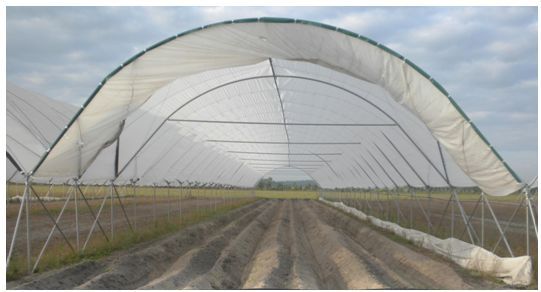
- Dig trenches. Mark the beginning and end of each trench with stakes and measure the separation between trenches with the measuring tape. Using shovels or a ditch plow, dig the trenches to a recommended depth (Figure 1). For tomato and pepper, trenches 8–10 inches deep and 1.5–2 feet wide have demonstrated excellent results. Trenches could be semicircular or rectangular. Remove the excess soil on the sides of trenches with wheelbarrows.
Credit: B. M. Santos, UF/IFAS
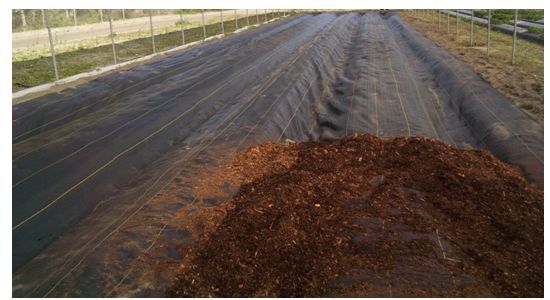
3. Set up the landscape fabric. After removing the excess soil, the fabric should be unrolled and laid on top of the trenches. Attach it to the soil with hooks. The sandier the soil, the longer the hooks should be to secure the fabric to the soil (Figure 2).
Credit: B. M. Santos, UF/IFAS
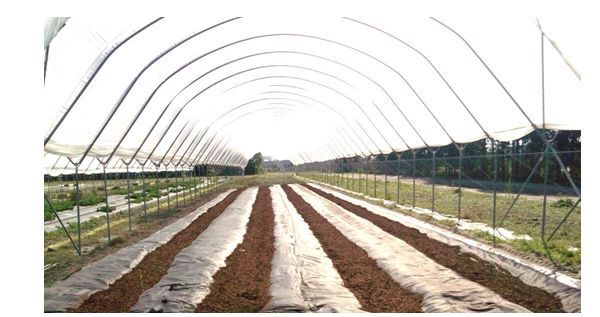
4. Fill the trenches. Use shovels and rakes to carefully fill up the trenches with the growing medium, making sure trenches are leveled (Figure 3). Trenches can be filled with a variety of growing media. In west central Florida, aged pine bark (0.5–1 inch in diameter) has provided excellent results growing tomato, pepper, and strawberry. The same medium has been used successfully for eight consecutive production cycles. When using pine bark, well-aged or composted bark wets relatively easily, however, bark that has not been aged sufficiently can be difficult to wet; therefore, only well aged pine bark should be used. Other media, such as coconut coir, have also been promising. Using different media effectively requires implicit knowledge of its physical and chemical properties. For instance, it is harder to wet pine bark than coconut coir because of the particle size and configuration. Therefore, before planting in pine bark, growers should thoroughly wet the media before transplanting. Low-volume sprinklers could be used to speed up the wetting process. Pine bark blended with compost is also an excellent growth medium. Compared with pure pine bark, it has higher water and nutrient retention and is easier to wet. For most vegetable crops, 50/50 blend is recommended.
Credit: B. M. Santos, UF/IFAS
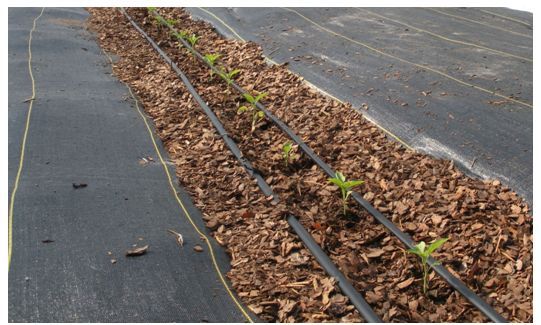
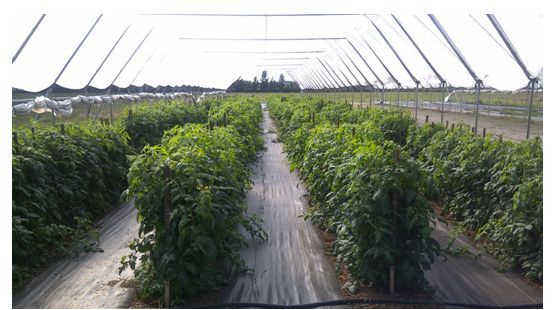
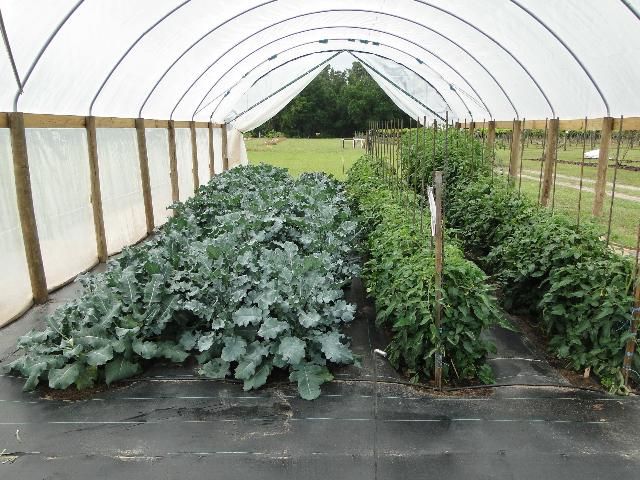
5. Grow vegetables in the trenches. Using a regular drip tape (0.12–0.45 gallons/100 feet row per minute with emitters no more than 12 inches apart) similar to those used in open fields provides excellent results for crops such as tomato and pepper (Figures 4 and 5). One or two drip tapes per trench could be used depending on the total water flow, however two provides a more complete wetting pattern of the width of the trough. The presence of nematodes and soilborne fungi and bacteria is unlikely because the landscape fabric underneath the medium acts as somewhat of a physical barrier for those organisms. Some growing media, such as pine bark that is not sufficiently aged and wood chips, may need to be enriched with nitrogen (N) fertilizer before planting to satisfy bacterial needs and render this nutrient available to plants. For instance, studies in west central Florida with tomato indicated that a preplant application of 50 lb/acre of N improved early transplant establishment and growth in comparison with the nonapplied medium. Most commercially available N sources can be used for this purpose. Conversely, it is recommended to apply 20–30 lb/acre of phosphorus (P) to aid early root development. Irrigation cycles using drip lines must match crop requirements and evapotranspiration, as described in this EDIS publication (https://edis.ifas.ufl.edu/hs172). It should be noted that evaporation inside a high tunnel could be higher than in open fields because of the higher temperatures, especially in late spring, summer, and early fall. Recent research at the Suwannee Valley Agricultural Extension Center in Live Oak showed several vegetables crops could be successfully grown in aged pine bark with no fertilizer added to the bed, but with immediate application of a complete hydroponic fertilizer solution through the drip irrigation system and following that method for the duration of the crop (Figure 6).
Credit: B. M. Santos, UF/IFAS
Credit: B. M. Santos, UF/IFAS
Credit: R. Hochmuth, UF/IFAS