
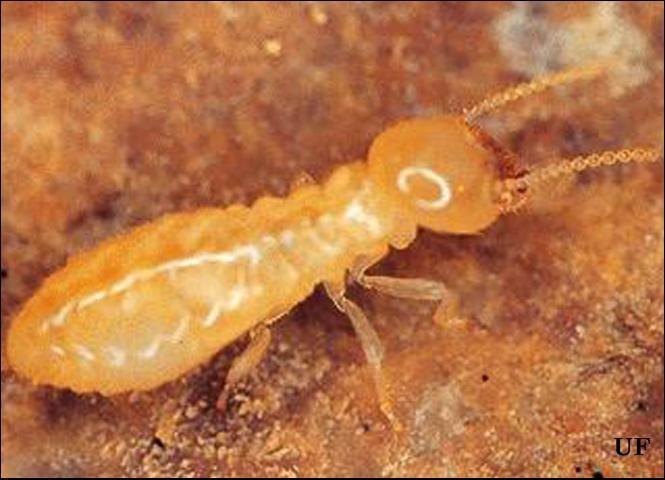
The three principal types of termites in Florida are subterranean, which nest in the soil; dampwood, which infest damp wood; and drywood termites, which infest dry wood. Subterranean termites (Figure 1) are the most destructive of the three species and infest wood from underground. These termites have become a burden to homeowners today because it is not until there is severe infestation that these hidden creatures are seen.
Credit: James Castner, University of Florida
Biology
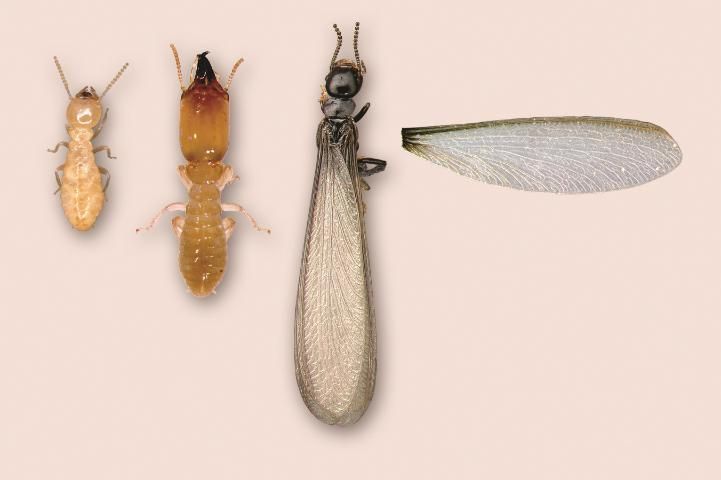
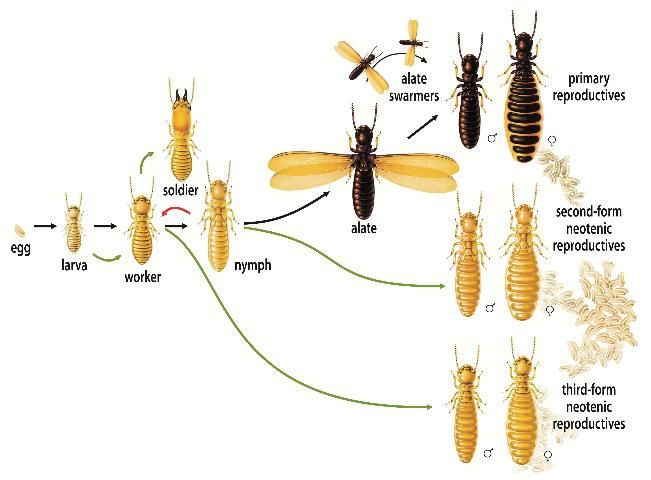
Subterranean termites live in cooperative societies known as colonies. These colonies can consist of millions of individuals that share resources, such as food and shelter, and cooperatively care for their young. These colonies consist mostly of workers but also include soldiers and reproductives (Figures 2 and 3).
Credit: University of Georgia
Workers are sexually immature males and females and are about 1/8 inch (3.2 mm) long, have no wings, and are cream-colored. Workers are typically the first caste seen when an infested log or active mud tube is disturbed. Most of the labor required by the colony is done by the workers, including searching for food, caring for the young, repairing the nest, building mud tubes, feeding, and grooming.
Soldiers are responsible for defending the colony and are wingless, sexually immature males and females. Their black jaws, or mandibles, are evolved to defend the colony and so they are dependent on the workers to feed them. Soldiers can be easily identified by their larger head, which is darker than their body. Depending on the species of subterranean termite, soldiers can comprise a different percentage of the colony. For example, Eastern subterranean termite colonies consist of 1–2% soldiers, and Formosan subterranean termite colonies consist of about 10% soldiers. A species similar to the Formosan subterranean termite, the Asian subterranean termite, was accidentally introduced into Southern Florida sometime before 1996.
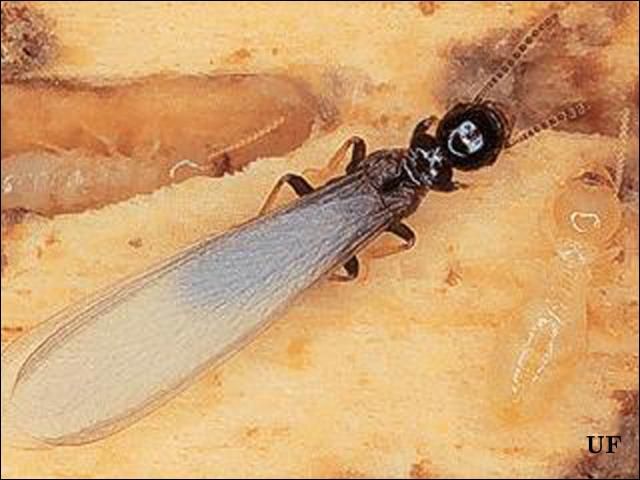
Adult winged termites are called alates or swarmers. This caste is the only one with fully functional wings and eyes. They are darker and have a thicker cuticle, which allows them to better prevent water loss. Once a swarmer lands, it sheds its wings, mates, and becomes a primary reproductive—king or queen—of the newfound colony. See Figure 3 for the termite life cycle.
When searching for food, termites usually follow a chemical or moisture gradient toward the food source. They may follow roots or abandoned tunnels previously excavated by ants or earthworms. Termites have protozoa in their digestive tracts that can convert cellulose into usable food, so subterranean termites feed on items that contain cellulose, such as paper, fiberboard, or fabrics derived from cotton or plant fibers, but they primarily feed on dead wood and wood by-products. However, in their search for food, termites also damage items that they do not feed on, such as insulation.
Subterranean termites nest in the soil to obtain moisture, but they also nest in wood that is often wet. This is important for their survival because they have a very thin cuticle, which causes them to easily desiccate in dry environments. They easily attack any wood in contact with the ground. If the wood does not contact the soil, they can build mud tunnels or tubes to reach wood several feet above the ground. These tunnels can extend for 50 to 60 feet to reach wood, and often enter a structure through expansion joints in concrete slabs or where utilities enter the house.
Detection of Termites
Termites remain hidden within wood and underground, which makes them often difficult to detect. A good way to determine if there is a subterranean termite infestation is to look for winged reproductives (or swarmers), shed wings, mud tubes, and wood damage.
Winged Reproductives
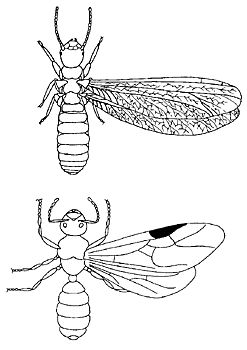
Winged reproductives emerge from colonies in large numbers in specific times of the year, depending on the species, but occur usually in the spring. Swarmers (Figure 4) are attracted to light so they can be found along window sills, doors, light fixtures, and vents. Often, the wings of the reproductives will be found on the floor, window sill, or even spider webs as an indication that a colony is nearby. This happens because shortly after their flight, reproductives break off their wings. Homeowners may find swarmers in their home days or weeks after termiticide treatment because colonies produce swarmers when conditions are unfavorable, such as after some pesticide application. Once the swarmers begin flight, they begin searching for a mate to form new colonies. A good way to distinguish these from flying ants is their thick waist, straight antennae, and wings of equal size (Figure 5).
Credit: James Castner, University of Florida
Winged termites emerging from the ground outdoors near the house does not necessarily mean the house is infested, but it is a good reason to check further. Termites in the wood of homes or other buildings usually come from colonies already established in the soil. Peak swarming periods for subterranean termites occur from January through May in Florida. They may also swarm to a lesser extent during the other months.
Mud Tubes
To protect themselves from drying out and predators, subterranean termites build mud tubes (Figure 6) that consist of soil, saliva, and excrement. Houses should be inspected at least once a year for evidence of tubes. If the house has a crawl space, the inside and outside of foundations should be inspected for tubes. If the house has a concrete slab floor, cracks in the concrete floors and places where pipes and utilities go through the slab should be closely examined. Cracks in concrete foundations and open voids in concrete block foundations are also hidden avenues for termite entry into structures. Mud tubes are known to have an earthlike appearance and usually are flattened. These tubes connect the ground to the wood and are a common sign of an infestation.
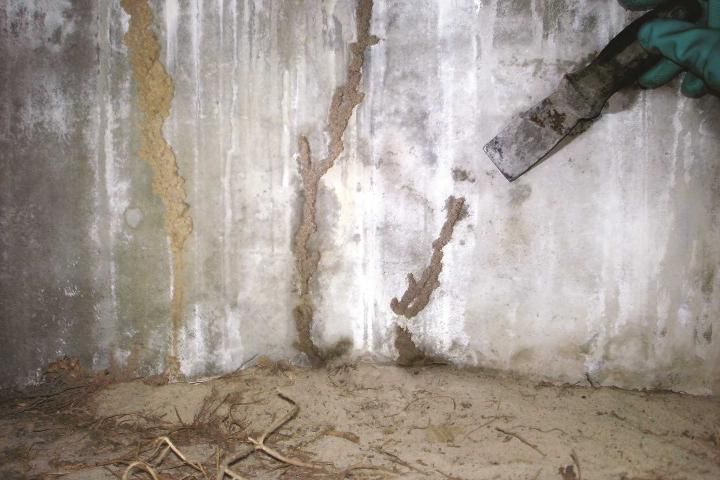
Places where mud tubes may be found include where the sill plate joins the foundation wall, where support beams meet the flooring, behind baseboards, in cracks and joints, and behind obstructions. The size of the mud tube can indicate the severity of the infestation. Although they are usually the thickness of a pencil, they can be inches wide if the foraging activity is heavy. Subterranean termites are capable of forming aerial nests with no ground contact. In this situation, termites construct the tubes without soil, which can be easily observed if taken apart.
Wood Damage
Wood damaged by subterranean termites is often not noticed because the exterior surface usually must be removed to see the damage. However, galleries can be detected by tapping the wood every few inches with the handle of a screwdriver. Damaged wood sounds hollow, and the screwdriver may even break through into the galleries.
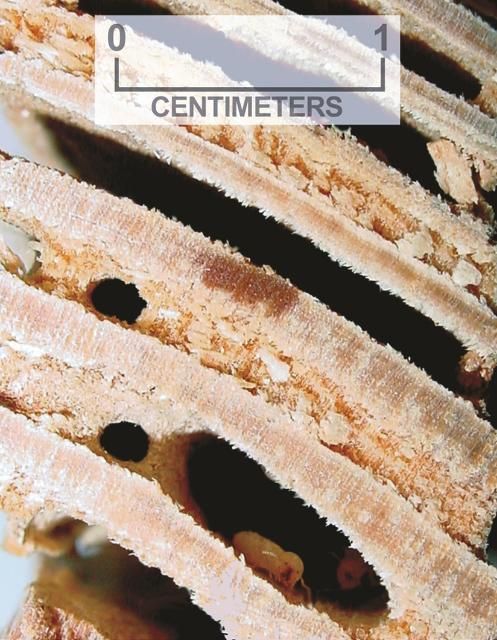
Subterranean termite feeding follows the grain of the wood, and only the soft springwood is attacked (Figure 7). Unlike drywood termites or other wood-boring insects, subterranean termites do not push wood particles or pellets (fecal material) to the outside, but rather use it in the construction of their tunnels. This debris, along with sand and soil particles, is used as a form of plaster.
Insulation Damage
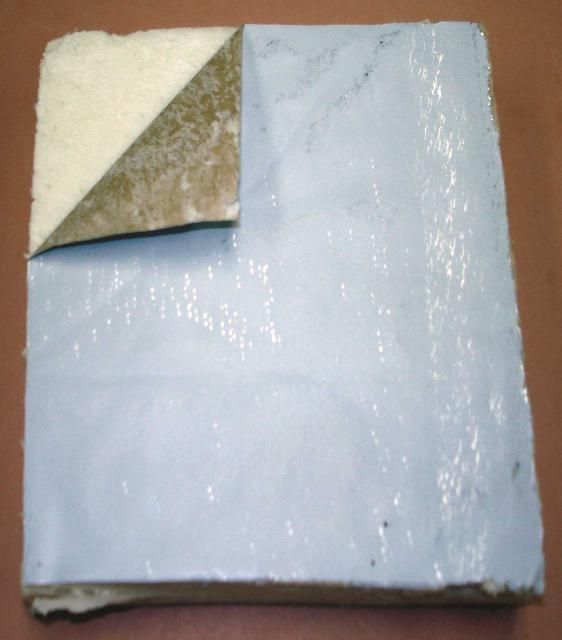
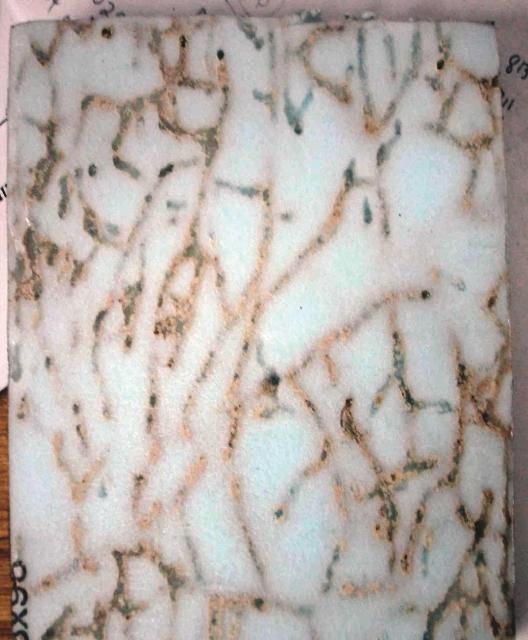
Aside from wood damage, subterranean termites are able to damage building insulation. Insulation products have an R-value, or thermal resistance, which measures the amount of heat that can pass through the insulation. The higher the R-value, the better the insulation can resist heat transfer. Also, some kinds of insulation have a paper cover, which termites use as food (Figure 8a, top). These paper covers contain a reflective lining that serves as a protection against heat transfer by radiation. Due to the softness of the insulation, termites easily tunnel through it (Figure 8b, bottom), diminishing the insulation R-value. Although termites do not eat the insulation because it is of no nutritional value to them, termite damage to insulation can cause significant increase to energy bills because insulation properties are lost. It is important to prevent termite infestations, because termite-damaged insulation causes higher energy bills long after subterranean termites are eliminated.
Identification
It is important to correctly identify the pest you are dealing with because different species require different control methods. Wings of alates and soldiers can be identified at your local UF/IFAS Extension office. It is almost impossible to identify the species from worker or immature samples because individuals from different termite species are very similar. When services of an experienced pest control operator are needed, contact at least two or three reputable firms in your area for inspections and estimates for treatment.
Subterranean Termite Prevention and Control
The best way to control termites is to prevent the infestation before it happens. Treating a building and the area around it before construction provides the best protection against termites. Prevention should include:
- Remove stumps, roots wood and similar materials from the building site before beginning construction, in addition to removing all foam boards and grade stakes used in construction. This helps remove preexisting termite colonies that can potentially infest the structure.
- To prevent termites from finding a food source, there should be no contact of building woodwork with the soil or fill. Exterior woodwork should be a minimum of 6 inches above ground, and beams in crawl spaces at least 18 inches (46 cm) above ground, to provide ample space for future inspections.
- Ventilation openings in foundations should be designed to prevent dead air pockets. These openings should be of sufficient size to assure frequent changes of air to keep the ground dry and unfavorable for termites—at least 2 square feet (0.2 m2) per 25 linear feet of outside foundation wall.
- Landscape plants and irrigation should not be placed within 2 feet (0.6 m) of the foundation.
- Annual inspections should consist of searching for mud tubes, winged adults, shed wings, or wood damage to discover evidence of an active termite infestation.
- Any wood that contacts the soil, such as fence posts, poles and general foundation structures, should be commercially pressure treated, and should not be attached to the house.
Preconstruction Soil Treatment of Structures
Control subterranean termites by preventing the termite colony in the soil from entering the structure. It is practically impossible to build structures so termites cannot cause damage. Therefore, a thorough preconstruction treatment should be applied to protect the structure for at least five years.
There are two general categories of termiticides that are differentiated by how termite tunneling is affected when they encounter an effective soil treatment. The first category is referred to as a "repellent termiticide." All of the synthetic chemicals classified as repellent termiticides are pyrethroids. The term repellent termiticide is ambiguous; the chemical properties of the soil treatment only repel termites from the structure. Although repellent termiticides could kill termites, when these products are applied to soil, the termites are able to detect the presence of the soil treatment. If gaps exist in the treatment, termites are able to find them. Since the termites are able to detect the treated soil, they do not tunnel into the treated soil barrier.
The other category is referred to as a "nonrepellent termiticide." Termite tunneling is not affected by a nonrepellent termiticide soil treatment because the termites are unable to detect the treated soil. Since they continue to tunnel freely through the treated soil they are exposed to the nonrepellent termiticide by contact or ingestion and are killed. Both repellent and nonrepellent termiticides have proven satisfactory for making effective barriers when applied properly.
The integrity of the soil treatment is a key factor in providing protection to the structure. A repellent termiticide properly applied to the soil will provide protection to the structure unless the barrier is disturbed. A termiticide barrier composed of a nonrepellent termiticide allows more flexibility and will provide protection even if the integrity of the barrier is disturbed.
Preconstruction Treatment of Foundation Wall and Piers
After the footings are poured and the foundation walls and/or piers have been constructed, apply the insecticide to a trench in the soil. The soil along the side of the foundation should be treated to prevent termites from building tubes up the foundation wall. The amount of termiticide required to apply depends on the depth of the foundation footing. However, labels generally specify to apply 4 gallons (15 liters) of the termiticide per 10 linear feet (3 meters) per foot (30 cm) of depth. Sloping the trench toward the foundation allows the termiticide to seep down close to the wall, creating maximum protection. The insecticide must be applied to both the inside and outside of the foundation and also around piers, chimney bases, pipes, conduits, and any other structures in contact with the soil. The trench should be as deep as the top of the footing. The insecticide should be mixed with water as recommended on the pesticide label and applied at the rate of 4 gallons (15 liters) per 10 linear feet (3 meters) of trench. The insecticide should be mixed with the soil as it is being replaced.
Preconstruction Treatment of Concrete Slabs
The most common type of construction in Florida is concrete slab resting on the soil. Often the slabs crack or shrink away from the foundation wall, allowing termites to infest the wood above.
The soil underneath and around the concrete slab should be treated with insecticide before the concrete slab is poured. The chemical should be applied after all the subslab fill and reinforcement rods are in place. Apply diluted spray to the fill at the rate of 1 gallon (15 liters) per 10 square feet (1 m2). Along both sides of foundation walls and interior foundation walls and plumbing (critical areas), apply diluted insecticide at the rate of 4 gallons (15 liters) per 10 linear feet (3 linear meters). Treat all hollow masonry units of foundations with 4 gallons (15 liters) of diluted spray per 10 linear feet (3 linear meters). Apply the insecticide to reach the footing.
Postconstruction Treatment of Structures
Crawl Space Treatment
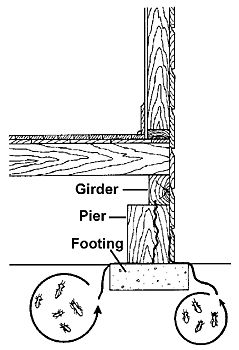
Dig narrow trenches along both the inside and outside of foundation walls (Figure 9) and around piers and chimney bases, and apply diluted spray as described above. Also, be sure to trench and treat around sewer pipes, conduits, and all other structural members in contact with the soil. Apply the insecticide to the trenches. The insecticide must be applied to both the inside and outside of the foundation and also around piers, chimney bases, pipes, conduits, and any other structures in contact with the soil. The trench should be as deep as the top of the footing. Mix the insecticide with water as recommended on the pesticide label. Apply the diluted spray at the rate of 4 gallons (15 liters) per 10 linear feet (3 linear meters) of trench. Mix the insecticide with the soil as it is being replaced.
Credit: University of Florida
Concrete Slab Construction
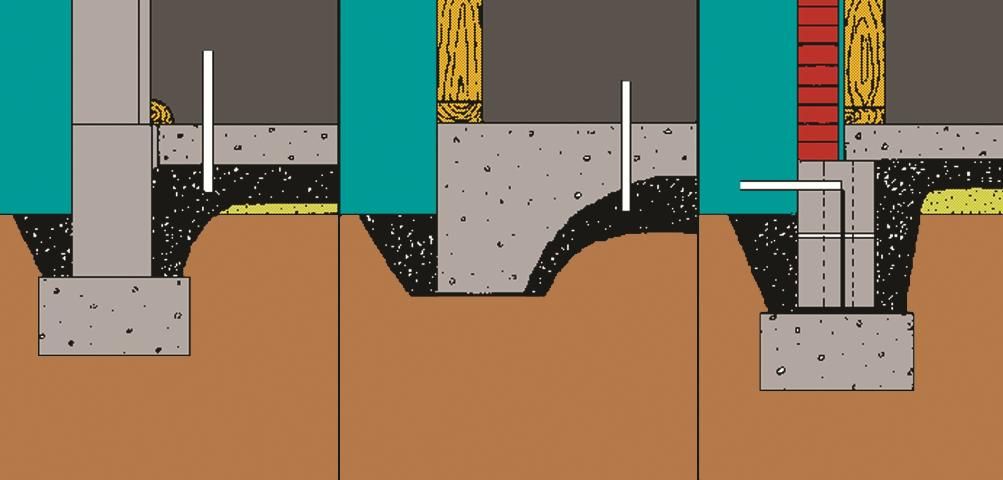
It is possible to trench and treat around the outside of a slab after it has been poured, as described above. Most homeowners do not have the right equipment or know how to treat under slabs after the slab foundation is completed. Usually a professional pest control operator is needed to do subslab chemical injections (Figure 10).
Termite Baits
Termite baits can be used to reduce the number of subterranean termites around the structure by killing the termites or diverting their foraging activity. Toxic termite baits use a small amount of insecticide to eliminate populations in and around the structure. They consist of paper, cardboard, or other termite food source, combined with a slow-acting insecticide. Because the pesticide is slow-acting, homeowners should be advised that this is an effective but lengthy baiting process. This type of control relies on the termite's foraging activity to locate the bait and distribute the toxicant to the rest of the colony.
The more below-ground baits that are installed, the better the chances of baits being located by termites. Planning, patience, and persistence are requisites for successfully using below-ground termite baits. There are three basic methods of baiting for subterranean termites.
- The first involves a monitoring station, which is used to detect the presence of an active colony. Once the colony is confirmed, the monitoring station is replaced with a baiting station.
- The second method skips the monitoring process and places baits before checking for an active colony.
- The third looks for an infestation such as wood damage or mud tubes and places bait stations where infestations are visible. Typically, the stations are installed directly in the path of active termite tunnels after the mud tubes have been broken.
Termite baits may also be installed above ground in known areas of termite activity. Effects tend to be more rapid with above-ground baiting because the procedure does not depend upon random termite encounters with the stations.
Deciding On Baits or Termiticide Barriers
Buildings with hard-to-treat construction or chronic retreatment histories are logical candidates for termite baits. Some structures have construction features that interfere with conventional soil treatment methods, such as wells, cisterns, plenums, drainage systems, and inaccessible crawl spaces. With baits, gaining access for treatment is seldom a problem since foraging termites are as likely to encounter belowground bait stations around the foundation exterior as well as beneath the structure.
Homeowners who do not want floors drilled and furniture, stored items, or carpeting moved are good candidates for baits. Baiting requires fewer disruptions than does conventional barrier treatment. Installation and subsequent monitoring of bait stations generally does not even require the technician to come indoors. Noise, drill dust, and similar disruptions associated with conventional treatment are avoided.
Homeowners who are averse to the use of pesticides around their home are good candidates for baits. Although conventional liquid termiticides pose no significant hazard to humans, pets, or the environment when applied according to label directions, some individuals are still apprehensive. Chemically averse homeowners may find the concept of baiting more attractive. With baits, the total amount of pesticide applied is small in comparison to the high gallonages needed to achieve a thorough and effective soil barrier treatment.
Property owners with a serious termite problem or those involved in a real estate transaction are good candidates for termiticide barriers. They may not be able to wait two to six months (sometimes longer) for baits to suppress or eliminate the infestation.
People living in attached housing (condos, attached residences) where the entire structure cannot be baited are good candidates for termiticide barriers.
Baits typically require an annual maintenance fee for the regular inspections. Some contracts may specify that, If the fee is not paid, the bait system may be removed. With soil treatments, the termiticide remains in the soil, regardless of whether or not an annual inspection contract is retained.