
Sweet potatoes are widely grown in Florida, especially on small farms. In addition to the traditional moist, orange-fleshed varieties, a dry, white-fleshed type, the Cuban sweet potato or boniato, is extensively grown in south Florida. Both types are the same species (Ipomoea batatas), and their pest problems are similar. Popular varieties grown in Florida include Beauregard, Covington, and Georgia Jet, which are well-suited to the state's climate and soil conditions. This article aims to provide information on the insect pests of sweet potato and their management for growers, Extension agents, and anyone interested in the topic.
Foliar pests, such as leafminers, whiteflies, and armyworms, are generally of minor concern. Due to their minor economic impact on sweet potatoes, it is not recommended to spray insecticides to conserve natural enemies and pollinators.
The most serious pests are the immature stages of some insects feeding on roots: the sweetpotato weevil, wireworms, banded cucumber beetles, pale-striped flea beetles, and sweetpotato flea beetles. In south Florida, Diaprepes spp. weevils and white grubs, including larvae from the Cuban May beetle, are recurrent pests. Other white grubs will also feed on sweet potato roots. A table of pesticides labeled for sweet potato can be found in the updated annual UF/IFAS Vegetable production Handbook.
Sweetpotato Weevil Cylas formicarius
http://edis.ifas.ufl.edu/IN154
Eggs are oval, white or pale yellow, and are inserted in the vine or fleshy roots. The larvae are found in small holes on the surface of the potato. They can also be found in the vine. Development takes 1 month, and the adults can live up to 4 months. Adults are easily recognizable with their black heads and elongated snouts (Figure 1). The antennae, thorax, and legs are reddish-brown to orange, and the abdomen and elytra are metallic blue. Larvae are 1/3 inch in length, legless, and white (Figure 2).
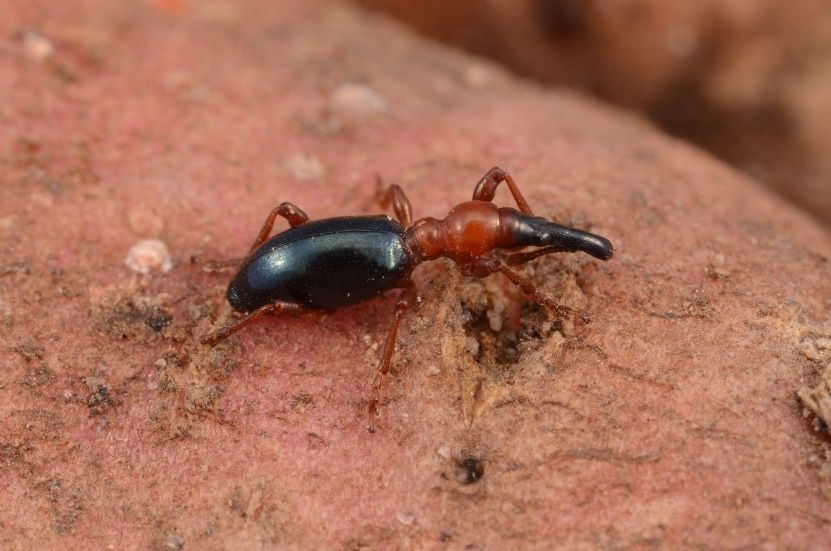
Credit: Lyle Buss, UF/IFAS
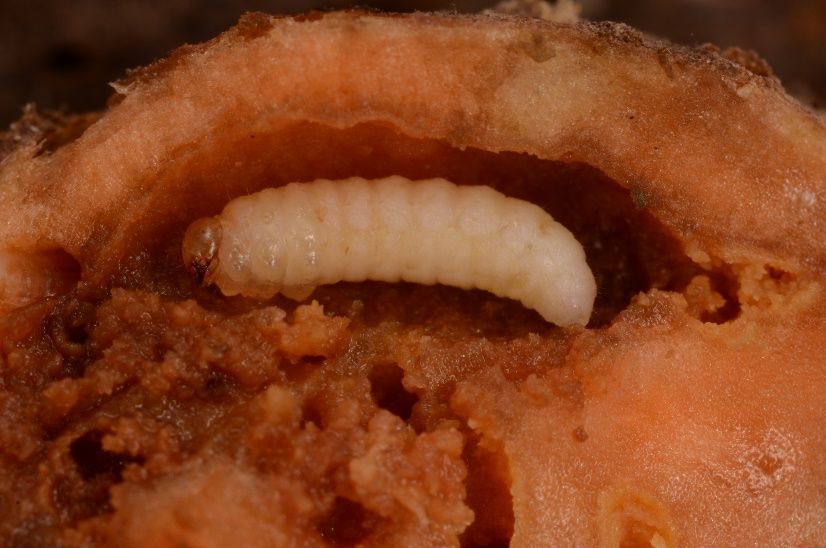
Credit: Lyle Buss, UF/IFAS
Sweet potato weevil is the most serious pest of sweet potatoes. Even minor damage by weevil larvae induces the production of terpenes that give the tuber an extremely bitter taste, making it unmarketable. Some varieties of sweet potato (Regal, for instance) have some resistance to the weevil and other beetle pests, but the most popular, orange-fleshed variety, Beauregard, is highly susceptible.
In areas of the state where weevils are not common, it is very important to use only certified slips or transplants from weevil-free areas to avoid introducing weevils. The adult weevil does not have wings, and the larval stages are most often moved by transporting infested plants or storage roots (potatoes).
Cultural practices can help reduce insect problems. Ideally, soil should be turned two to three months before planting. Weeds that weevils can use for overwintering should be controlled. Hot and dry conditions increase the risk of sweet potato weevil damage; therefore, irrigation significantly reduces the number of sweet potato weevils and decreases damage. During the growing season, keeping storage roots covered with soil helps reduce damage by preventing female weevils from laying eggs directly in roots. Crop rotation is also important: avoid growing sweet potatoes in the same field two years in a row. New fields should be at least a mile from old fields. Remove and destroy crop residues and culls immediately after harvest. Empty and clean potato storage areas thoroughly at least a month before harvesting the new crop.
Control of sweet potato weevil can be achieved with insecticides, most notably systemic insecticides applied at planting. Growth regulator-based insecticides have also been described as efficient for controlling sweet potato weevils. The female sex pheromone of the sweet potato weevil has been described and can be used either for mass trapping of males or pheromone disruption. Pheromone-baited traps are found to be effective in reducing weevil numbers and damage resulting from sweet potato weevil. Biological control agents include parasitoids and the fungus Beauvaria bassiana that can be applied to the crops. Interestingly, fire ants are a good predator of sweet potato weevil, and colonies within sweet potato crops should be conserved when possible.
Wireworms Conoderus rudis and Conoderus scissus
http://entnemdept.ufl.edu/creatures/veg/beetle/conoderus_scissus.htm
http://entnemdept.ufl.edu/creatures/veg/beetle/conoderus_rudis.htm
Wireworms are the larvae of click beetles (Elateridae family) (Figure 3). They damage sweet potatoes by feeding directly on the potato, where they make a circular hole at the surface. Two wireworm species are prone to attack sweet potato in Florida: Conoderus rudis and Conoderus scissus (Figure 4). Eggs are deposited just below the soil surface. The larvae of both species are hard, chestnut brown, smooth, and vary from 1/3 to 1 1/10 inches in length. Young larvae need live vegetable material to survive and grow.
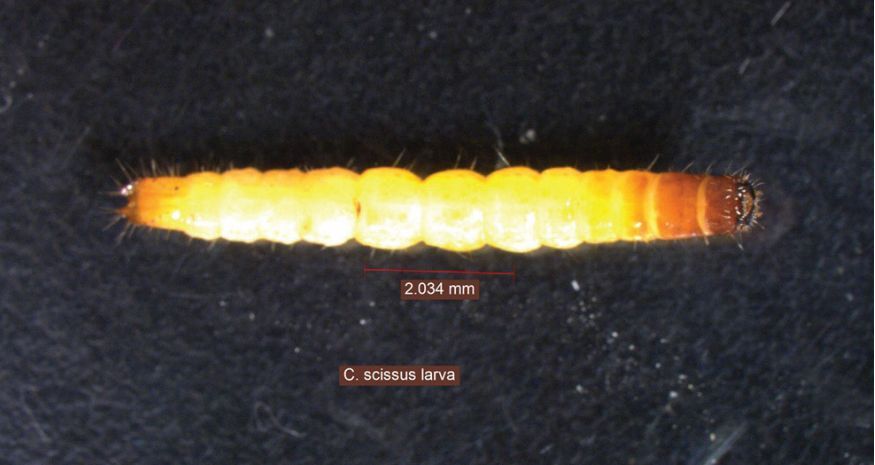
Credit: Dak Seal, UF/IFAS
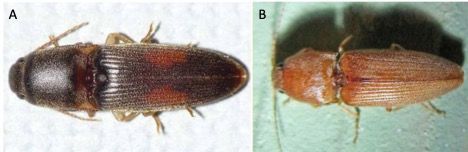
Credit: Dak Seal, UF/IFAS
Cultural practices include sanitation of sweet potato crops and removal of field debris. Previous cropping history and crop rotation can affect the level of wireworm infestation. Crops such as sorghum or soybeans grown in the preceding season increase the risks of damaging wireworm infestations; conversely, winter wheat results in a significantly lower infestation. If using a cover crop during the summer, late planting also reduces wireworm densities. As insecticide treatments for wireworms must be applied at planting, the wireworm population must be assessed in advance. Wireworms can be monitored with bait traps or with the shovel method. Preventive treatment is recommended for an average of 4 or more wireworms per 20 shovelfuls (10 inches deep and 6 inches in diameter) of soil.
Banded Cucumber Beetle Diabrotica balteata
https://edis.ifas.ufl.edu/publication/in250
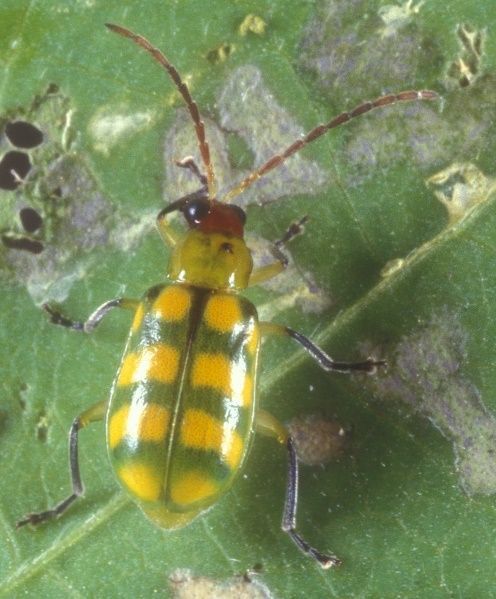
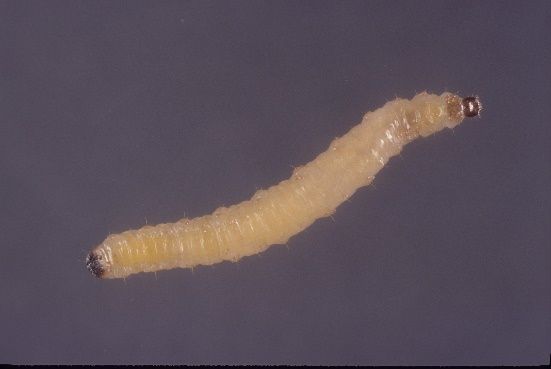
The banded cucumber beetle is a chrysomelid beetle. The adult (Figure 5) is green and yellow with a red head. While the adults can defoliate sweet potatoes, the major damage is caused by the larvae (Figure 6) below ground. Banded cucumber beetle larvae damage sweet potato roots by feeding. The larval body is white to yellow and 1/10 to 1/3 inch long.
Credit: Lyle Buss, UF/IFAS
Credit: Lyle Buss, UF/IFAS
Banded cucumber beetles can be controlled with granular insecticides applied at the time of planting. Of the varieties currently grown in Florida, Jewel is the only one with some resistance to this beetle.
White Grubs Phyllophaga spp.
EENY-045/IN202: White Grubs, Phyllophaga spp. (Insecta: Coleoptera: Scarabaeidae)
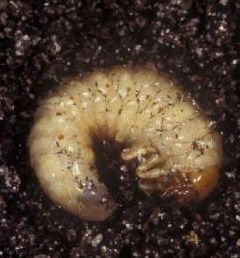
True white grubs are larvae of May and June beetles (Phyllophaga spp.) that encompass 18 species across Florida. Eggs are laid in the soil where the larvae develop for up to 3 years. Adults emerge between May and June to feed, mate, and lay eggs. Larvae are creamy white, between ¾ to 1¼ inches, and C-shaped with a brown to reddish head and 3 pairs of brown legs (Figure 7). In older larvae, the hind of the abdomen is enlarged and darkened. White grubs feed on decaying vegetation but also on roots and can damage sweet potato tubers.
Credit: Lyle Buss, UF/IFAS
Sampling for white grubs involves taking soil samples to a depth of 1 foot, examining the samples, and counting the larvae. Treatment is recommended when there are over four white grubs per foot. The easiest cultural practice is to harrow the soil before planting the sweet potato slip to expose the larvae to predators.
Links
Vegetable Production Handbook of Florida—Potato Production: https://edis.ifas.ufl.edu/pdffiles/cv/cv13100.pdf