
The Featured Creatures collection provides in-depth profiles of insects, nematodes, arachnids and other organisms relevant to Florida. These profiles are intended for the use of interested laypersons with some knowledge of biology as well as academic audiences.
Introduction
The cycad aulacaspis scale insect, Aulacaspis yasumatsui, was originally described from specimens collected on a Cycas sp., in Bangkok, Thailand, in 1972 (Takagi 1977). In Thailand, this armored scale is considered a pest of cycads, but is usually maintained in low densities by parasitoids (Tang et al. 1997). Aulacaspis yasumatsui was found in Miami, Florida, in 1996, infesting cycads grown as ornamentals. King-sagos, Cycas revoluta Thunberg, the most popular cycad planted in this area, were highly infested with Aulacaspis yasumatsui. Fairchild Tropical Garden and Montgomery Botanical Center, both of which have important world collections of cycads, were within the initially infested area. The rampant increase and spread of this scale insect in these collections threatened the survival of several rare and endangered species. An additional concern was the threat posed to a large concentration of nurseries in southern Florida that grow and ship cycads throughout the US and abroad.
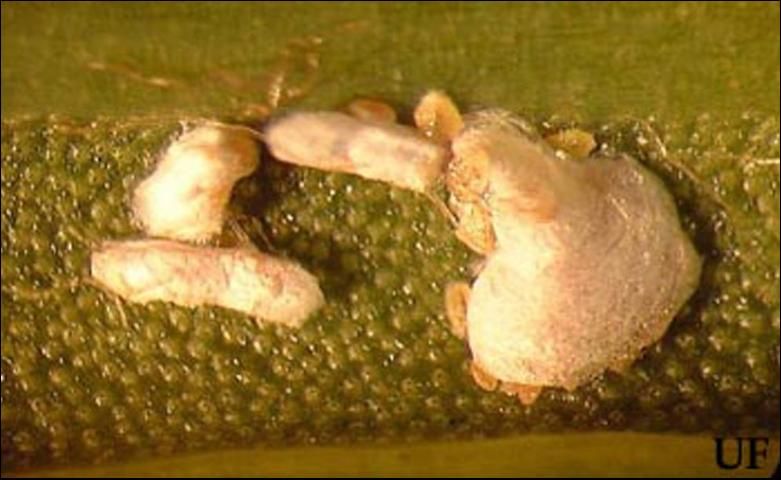
Credit: F. W. Howard, UF/IFAS
Distribution
The cycad aulacaspis scale has spread throughout the state of Florida (Howard and Buss 2003), the Southeastern United States, California, Hawaii, and Puerto Rico (Bográn et al. (2006)). Although scale insects may be spread short distances by wind dispersal of crawlers, we surmise that the long distance spread of this scale insect is by transport of infested plants. The cycad aulacaspis scale insect has also spread to other localities outside of the USA including China, Singapore, Hong Kong, and the Cayman Islands (Howard and Buss 2003).
Description
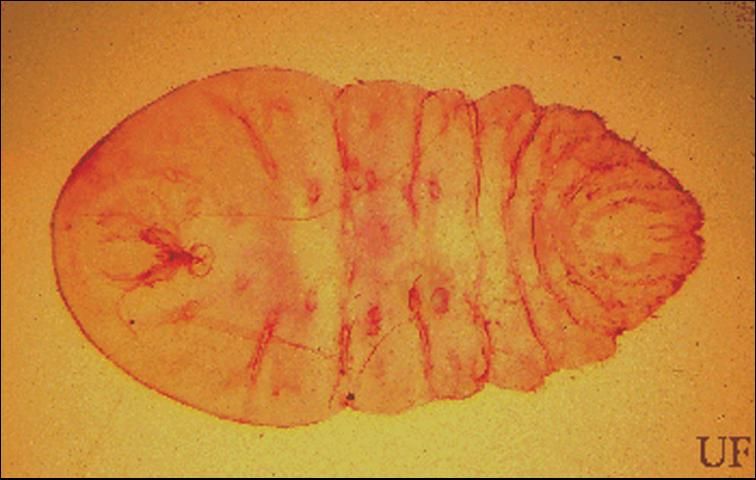
The scales of mature Aulacaspis yasumatsui females are white, 1.2 to 1.6 mm (1/32–1/16 in) long and highly variable in form. They tend to be pear-shaped but are often irregularly shaped, conforming to leaf veins, adjacent scales, and other objects. The scale of the male is 0.5 to 0.6 mm (< 1/32 in) long, white, and elongate.
Credit: R. Scheffrahn, UF/IFAS
Upon casual observation in the field, the scale of Aulacaspis yasumatsui females resembles that of the magnolia white scale, Pseudaulacaspis cockerelli (Comstock), which is also common on cycads in Florida. However, the color of the insect body and of the eggs of Aulacaspis yasumatsui is orange, except for recently molted individuals, which are yellow. The eggs and all stages of Pseudaulacaspis cockerelli are yellow. In addition, scales of Aulacaspis yasumatsui are usually on the lower surface of leaves, while those of Pseudaulacaspis cockerelli are on the upper surface. The scale of Pinnaspis strachani (Cooley) (snow scale) females also resemble that of Aulacaspis yasumatsui, but Pinnaspis strachani is far less common on cycads than the other two scale insect species in south Florida.
Biology
The bionomics of the cycad aulacaspis scale insect was studied by Howard et al. (1999). Females go through three instars, and the average time from egg hatch to adult is 28 days. Females can lay more than 100 eggs, which hatch in eight to 12 days at 25°C. Most females do not live longer than 75 days.
The cycad aulacaspis scale is unusual in that it also infests the roots of its host plant at depths of up to 60 cm in the soil. Only a few other species of armored scale insects infest roots, and they are generally located near the soil surface.
Host Range
See Table 1.
Damage
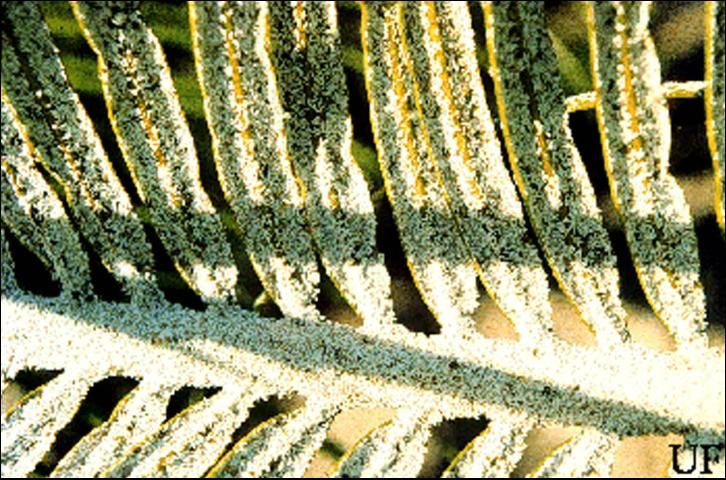
Damage initially appears as chlorotic spots, but most of the fronds eventually become brown and desiccated. Highly infested cycads are almost completely coated with a white crust that includes scales of live and dead insects. The scale insects are consistently more numerous on the lower than on the upper surfaces of leaflets, and in light infestations they occupy the lower leaf surfaces exclusively. Scales of males, which are less than half the length of scales of females, are nearly always more numerous than those of females. Crusts composed of several layers of scales of males are common on rachides, where up to 500 scales per cm2 have been observed.
Credit: F. W. Howard, UF/IFAS
Roots of containerized and planted cycads have been observed infested with Aulacaspis yasumatsui males and females. In containerized cycads, the scale insects usually aggregate on primary roots (about 10 mm (3/8 in) in diameter) and singly or in groups of a few individuals on secondary roots (about 2 mm (1/16 in) in diameter) near the container sides, i.e., near the soil-air interface. However, several scale insects have been observed on roots at 15 cm (6 in) depth and several cm inward from the container sides. In the landscape, the scale insects have been observed at different depths on primary (3 cm (1 1/8 in) in diameter) and secondary roots in groups of a few to several individuals from near the soil surface to a maximum depth of 60 cm (2 1/3 in).
In addition to the injury caused, the scales of Aulacaspis yasumatsui males and females are remarkably persistent. The dead scales detract from the appearance of ornamental plants. Cycads continue to appear to be highly infested after most of the scale insects have been killed because the scales do not readily drop off. Old scales are not easily removed by mechanical means, e. g., with brushes or high-pressure water sprays. Soaking cut fronds in soapy water overnight may loosen them, but similar solutions sprayed on cycad plants do not seem to have the same effect. A practical treatment that loosens old scales of armored scale insects would be a welcome development in horticulture and plant protection.
Management
The unusually dense populations and rapid spread of the cycad aulacaspis scale insect suggests that it was imported without natural enemies. Occasionally ladybird beetle adults can be observed crawling on cycads infested with Aulacaspis yasumatsui, but feeding has not been observed. Possibly, Aulacaspis yasumatsui sequesters defensive chemicals from its cycad hosts, which could be a deterrent to generalist predators.
Application of conventional insecticides have been effective in controlling this scale insect in some instances, but we have encountered situations in which these insecticides did not kill the pest. We suspect cycads may undergo periods when their metabolic activity decreases and they do not absorb systemic insecticides, but this is not proven.
So far, we have found that the most consistently effective treatment for controlling the cycad aulacaspis scale insect has been spraying them with oils, like fish oil emulsion (1 part oil to 100 parts of water) or petroleum-based horticultural oils. The cycad aulacaspis scale insect infests mostly the lower surfaces of the fronds, so the spray must be directed there. A single cycad can be treated using a 1-quart hand sprayer or even a small squeeze bottle. The scale insects also commonly infest the stem, so spray it as well as the fronds.
As mentioned above, the scale itself is highly persistent, clinging to the leaf surface long after the insect beneath it is dead and dried up. For this reason, people often keep spraying plants long after they have killed all of the scales. Generally, old scales become infested with fungi and fall off gradually, and at the end of several months the plants are clean. Frequent spraying with a garden hose may help wash off some of the old, dead scales.
Cycad aulacaspis scale insects have a high potential to spread to new areas via plant movement, because one to a few fecund females hidden on the fibrous stem or on roots can easily escape detection. Once established, persistence will be required to keep populations managed.
Selected References
Bográn CE, Boris A, Ludwig S. (2006). The cycad aulacaspis scale, a pest of sago palms in Texas. Texas A&M Extesnio Entomology factsheet. https://extensionentomology.tamu.edu/publications/the-cycad-aulacaspis-scale-a-pest-of-sago-palms-in-texas-2/
Hodges G, Howard FW, Buss EA. (2004). Update on Management Methods for Cycad aulacaspis scale. (22 April 2020)
Howard B, Meerow AW, Weissling TJ. Progress in controlling cycad scale in Miami, April 1999. UF/IFAS Fort Lauderdale REC. (no longer available online)
Howard FW, Buss EA. 2003. Update on management methods for cycad aulacaspis scale. Pest Alert DACS-P-01648. FDACS. https://ccmedia.fdacs.gov/content/download/103954/file/CycadAulacaspisScale_1648.pdf
Howard FW, Hamon A, McLaughlin M, Weissling T. 1999. Aulacaspis yasumatsui (Homoptera: Sternorrhyncha: Diaspididae), a scale insect pest of cycads recently introduced into Florida. Florida Entomologist 82: 14–27.
Takagi S. 1977. A new species of Aulacaspis associated with a cycad in Thailand (Homoptera: Cocoidea). Insecta Matsumurana New Series 11: 63–72.
Tang W, Yang S-L, Vatcharakorn P. 1997. Cycads of Thailand. Nong Nooch Tropical Garden and the Cycad Conservation Company, Bangkok. 34 pp.