
The Featured Creatures collection provides in-depth profiles of insects, nematodes, arachnids, and other organisms relevant to Florida. These profiles are intended for the use of interested laypersons with some knowledge of biology as well as academic audiences.
Introduction
The ash whitefly, Siphoninus phillyreae (Haliday), is a pest of numerous ornamental and fruit crops, including citrus. It causes severe damage to pear and apple in Europe. Most ash whiteflies in California were found on pomegranate, ash tree, pear, apple, loquat, and citrus. Heavy infestations cause leaf wilt, early leaf drop, and smaller fruit (Bellows et al. 1990).
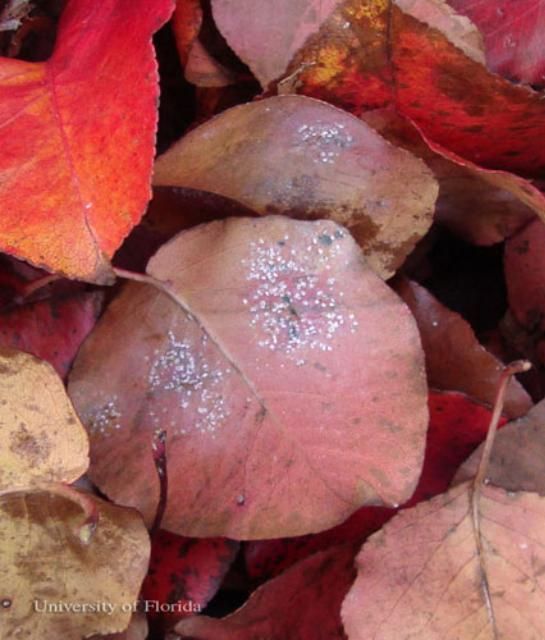
Credit: Lyle J. Buss, UF/IFAS
Discovered in Florida in 2010, if it becomes established it could become a pest of ornamental plants and possibly other crops.
Synonymy
The ash whitefly, Siphoninus phillyreae, was described as Aleyrodes phillyreae by Haliday (1835), on Phillyrea latifolia collected in Dublin, Ireland. It has several synonyms listed in Mound and Halsey (1978).
Distribution
Native to Europe, the Mediterranean and northern Africa, the ash whitefly is found in numerous countries, including:
Africa: Cameroon, Egypt, Ethiopia, Libya, Morocco, Sudan
Asia: India, Iran, Israel, Pakistan, Saudi Arabia, Syria
Europe: Austria, Corsica, Czech Republic, Cyprus, England, France, Germany, Hungary, Ireland, Italy, Poland, Romania, Spain, Switzerland, Yugoslavia
North America: United States (California, Florida)
Oceania: Australia (New South Wales, South Australia, Queensland, and Victoria)
(Mound and Halsey 1978, Bellows et al. 1990, Raymond Gill personal communication, Chris Baptista personal communication, Stocks and Hodges 2010).
In the United States, ash whitefly was first collected in Los Angeles County, California, in 1988, and then spread to other counties. It was later discovered in Arizona, Nevada, and New Mexico. It appeared in Raleigh, North Carolina, in 1993. It is also reported from Arizona, Georgia, Nevada, New Mexico, South Carolina, and Texas. A successful biological control program using a parasitic wasp reduced infestations to undetectable levels (western states) or possibly eliminated the infestation (North Carolina). In 2010, it was discovered in central (Lake Buena Vista) and northwestern (Panama City) Florida (Stocks and Hodges 2010).
Description and Biology
Adult
The adult appears much like a typical whitefly with a light dusting of white wax. Depending on temperature, females live from 30 to 60 days, while males live an average of nine days. This rapid development time, without the presence of the parasitoid, initially produced numerous generations per year in California, whereas only two to three generations were reported in Egypt. Plus, the ability of all life stages to overwinter on non-deciduous hosts allows a rapid build-up in population at the start of the season (Stocks and Hodges 2010). Winged females lay eggs on the underside of the leaves. When the nymphs emerge, they rarely move far and feed on the plant sap until pupation (Gillespie 2000).
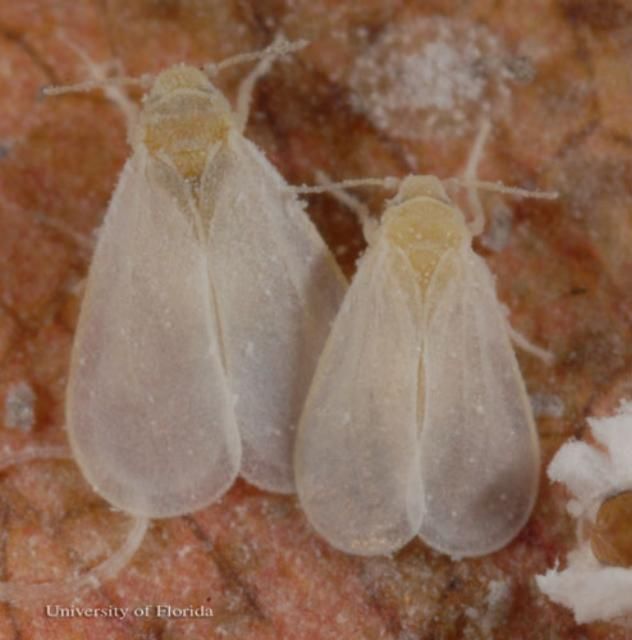
Credit: Lyle J. Buss, UF/IFAS
Pupa
On first observation, the pupal case appears similar to the white armor of a male snow scale. Closer observation with a hand lens reveals a whitefly pupal case with two longitudinal tufts of white wax. The vasiform orifice is surrounded by dark brown derma (inner, thicker layer of the cuticle), with the anal area appearing as a dark brown spot. Lateral areas of the pupal case are light beige. Depending on the age, lesser or greater amounts of white wax will be present. The dorsal surface has 40 to 50 long, glassy tubercles similar to the cornicles found on aphids. These tubercular structures produce a droplet of glassy wax, and this gives the pupal case an unusual appearance. The longitudinal white tufts of wax obscure some glassy tubercles (R.J. Gill, personal communication). The pupal case size is 0.8 to 1.0 mm (1/16 in) long by 0.55 to 0.7 mm (< 1/16 in) wide and is tan or beige in color (Mound 1966, Stocks and Hodges 2010).
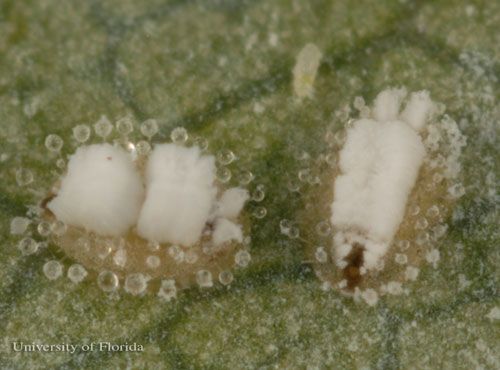
Credit: Lyle J. Buss, UF/IFAS
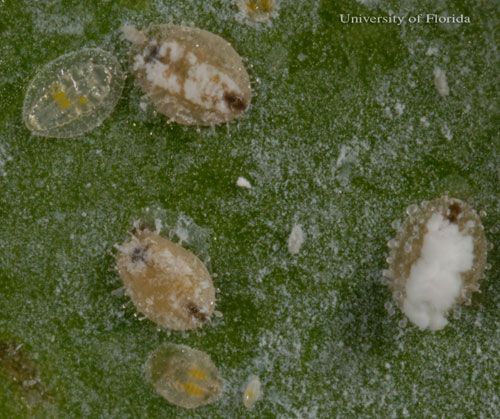
Credit: Lyle J. Buss, UF/IFAS
Host Plants
The ash whitefly is a polyphagous species found on several plant families (modified from Bellows et al. 1990), including:
Bignoniaceae:
- Catalpa X chilopsis, catalpa hybrid
Leguminosae:
- Afzelia sp., pod mahogany
- Cercis occidentalis, western redbud; C. siliquastrum, Judas tree
Lythraceae:
- Lagerstroemia indica, crape myrtle
Magnoliaceae:
- Liriodendron tulipifera, tulip tree
- Magnolia stellata, star magnolia
Oleaceae:
- Fraxinus excelsior, European ash; F. latifolia, Oregon ash; F. ornus, flowering ash; F. syriaca, Syrian ash; F. uhdei, Shamel ash; F. uhdei 'Tomlinson', Tomlinson ash; F. velutina 'Modesto', Modesto ash; F. velutina var. glabra, Arizona ash; F. velutina var. coriacea, western ash
- Ligustrum spp., privets
- Olea africana (=O. chrysophylla), wild olive; O. europaea, common olive
- Phillyrea latifolia (=P. media), a phillyrea
- Syringa X hyacinthiflora, a common lilac; S. laciniata, cut-leaf lilac; S. vulgaris, common lilac
Punicaceae:
- Punica granatum, pomegranate
Rhamnaceae:
- Rhamnus alaternus, buckthorn
- Ziziphus spina-christi, crown of thorns
Rosaceae:
- Amelanchier denticulata, serviceberry
- Chaenomeles X speciosa, flowering quince
- Crataegus mollis, hawthorn; C. monogyna, English hawthorn; C. laevigata (=C. oxyacantha), hawthorn
- Cydonia oblonga, quince
- Eriobotrya deflexa, golden loquat
- Heteromeles arbutifolia, California Christmas berry
- Malus domestica, apple; M. floribunda, Japanese flowering crab; M. fusca, Oregon crabapple; M. 'Hopa', a crabapple; M. 'Red Jade', a crabapple; M. X scheideckeri, Scheidecker crabapple
- Mespilus sp., mespilus
- Prunus armeniaca, apricot; P. X blireiana, blue plum hybrid; P. persica, peach; P. salicina, Santa Rosa plum; P. virginiana var. melanocarpa, choke cherry
- Pyracantha sp., pyracantha
- Pyrus calleryana, ornamental pear; P. communis (=P. sativa), pear; P. kawakamii, flowering pear; P. pyrifolia, Japanese sand pear
Rubiaceae:
- Cephalanthus occidentalis var. californicus, buttonbush
Rutaceae:
- Citrus sp., tangerine; C. limon, lemon; C. sinensis, navel orange; C. sinensis, Valencia orange
- Fortunella sp., kumquat.
Natural Enemies
Ash whitefly has the potential to become a serious pest in new environments. However, it has several natural enemies that can control its populations to under economic thresholds. These natural enemies include (Stocks and Hodges 2010):
Predators
- Clitostethus arcuatus (Rossi)
- Menochilus sexmaculatus (Fabricius)
- Scymnus pallidivestis Mulsant
Parasites
- Coccophagus eleaphilus Silvestri
- Encarsia inaron (Walker), E. partenopea Masi, E. formosa Gahan, E. galilea Rivnay, E. punicae Hayat, E. pseudopartenopea Viggiani and Mazzone, E. siphonini Silvestri
- Eretmocerus corni Haldeman, E. siphonini Viggiani and Battaglia
The California Department of Food and Agriculture imported Encarsia sp. from Israel and Italy, and the coccinellid beetle Clitostethus arcuatus for the control of ash whitefly in California (Bellows et al. 1990). Encarsia inaron was discovered in the ash whitefly infestation in central Florida, while an unidentified parasitoid was associated with the infestation in northwestern Florida.
Selected References
Bellows TS, Paine TD, Arakawa KY, Meisenbacher C, Leddy P, Kabashimo J. 1990. Biological control sought for ash whitefly. California Agriculture 44: 4–6.
Haliday AH. 1835. Aleyrodes phillyreae. Entomology Magazine 2: 119–120.
Huffman D, Kidd KA. (January 2010). Ash whitefly in North Carolina. North Carolina State University Insect Notes. https://content.ces.ncsu.edu/ash-whitefly (21 September 2010).
Mound LA. 1966. A revision of the British Aleyrodidae (Hemiptera: Homoptera). Bulletin of the British Museum of National History, Entomolgy 17: 419–420.
Mound LA, Halsey SH. 1978. Whitefly of the World. A Systematic Catalogue of the Aleyrodidae (Homoptera) with Host Plant and Natural Enemy Data. British Museum of Natural History and John Wiley and Sons, New York, NY. pp. 192-193.
Paine T, Bellows T, Hoddle M. (May 2009). Ash whitefly. Center for Invasive Species Research. http://cisr.ucr.edu/ash_whitefly.html (21 September 2010).
Pickett CH, Pitcairn MJ. 1999. Classical biological control of ash whitefly: factors contributing to its success in California. Biocontrol 44: 143–158.
Stocks I, Hodges G. (September 2010). Ash whitefly, Siphoninus phillyreae (Haliday), a new exotic whitefly (Hemiptera: Aleyrodidae) in central Florida, and Encarsia inaron, its parasitoid (Hymenoptera: Aphelinidae). Division of Plant Industry. https://ccmedia.fdacs.gov/content/download/68334/file/Pest%20Alert%20-%20Siphoninus%20phillyreae,%20Ash%20Whitefly.pdf (November 2023).
Viggiani G, Mazzone P. 1980. Encarsia pseudopartenopea n.sp., parassita di Siphoninus phillyreae (Haliday) (Hom. Aleyrodidae). Bollettino el Laboratorio di Entomologia Agraria 'Filippo Silvestri' 37: 9–12.
Viggiani G, Battaglia D. 1983. Le specie italiane del genere Eretmocerus Hald. (Hymenoptera: Aphelinidae). Bolletino del Laboratorio di Entomologia Agraria 'Filippo Silvestri' 40: 97–101.