University of FloridaSolutions for Your Life

Download PDF
Publication #IPM-204

Common Pepper Cultivars for Florida Production1

G. McAvoy and M. Ozores-Hampton2

This list includes a number of varieties currently popular with Florida growers; it is by no means a comprehensive list of all varieties that may be adapted to the state. At present 4-5 cultivars probably constitute 80-90% of commercial production in Florida.

(See Table 1 for Key to Abbreviation)
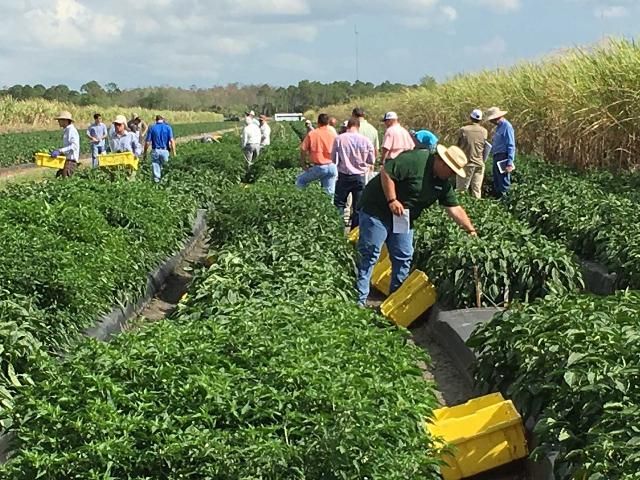
Figure 1. 

Pepper harvesting from a Randomized Complete Block Experimental Design during 2009 winter season in Delray Beach. Fl. Credits: Monica Ozores-Hampton.


[Click thumbnail to enlarge.]

Figure 2. 

Allegiance - Vigorous, medium to tall plant with good leaf cover. High yielding with extended harvest. Fruits highly uniform, dark green, blocky 4-lobed thick walled fruit. R to Xcv 1-5, PVY, TM. Harris Moran Seed Company.


Credit:

Monica Ozores-Hampton


[Click thumbnail to enlarge.]

Figure 3. 

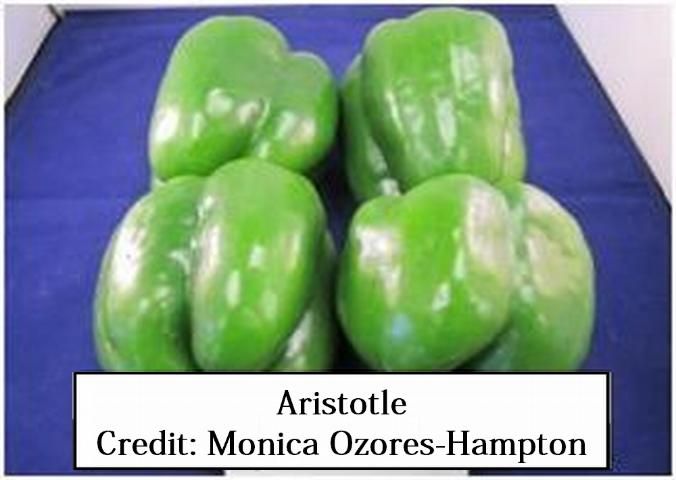
Aristotle – Dark green anthocyanin less fruits, heavy set, thick walls, large fruit size. Matures red. R to Xcv 1-3 (X3R®), PVY 0, Tobamo P0 (R). Seminis.


Credit:

Monica Ozores-Hampton


[Click thumbnail to enlarge.]

Figure 4. 

Classic - Thick-walled with smooth, flat shoulders and even lobes. Approaches greenhouse quality in the field.  Green to red bell pepper. R to Xcv 1-3. Sakata Seed America, Inc.


Credit:

Sakata Seed America, Inc.

[Click thumbnail to enlarge.]

Figure 5. 

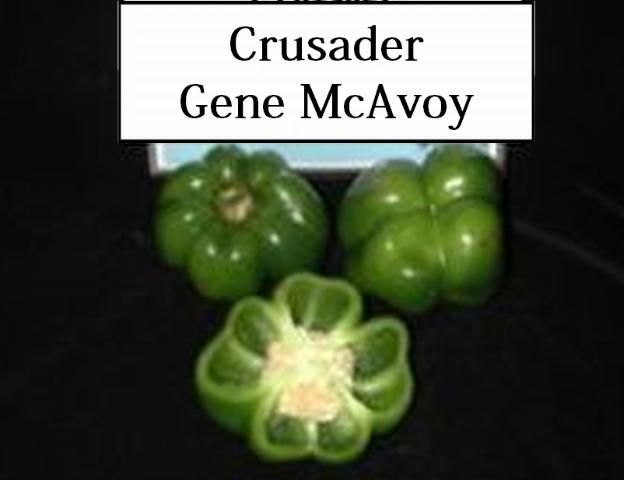
Crusader – Erect, good cover, extra-large fruit stay firm at mature red stage. R to Xcv 1-3, PVY, S, PepMo, TM. Rogers Syngenta Seeds, Inc.


Credit:

Gene McAvoy


[Click thumbnail to enlarge.]

Figure 6. 

Excursion II – Medium size plant, green to red blocky bell. R to Xcv 1-3, PVY, TM. Abbott and Cobb.


Credit:

Gene McAvoy


[Click thumbnail to enlarge.]

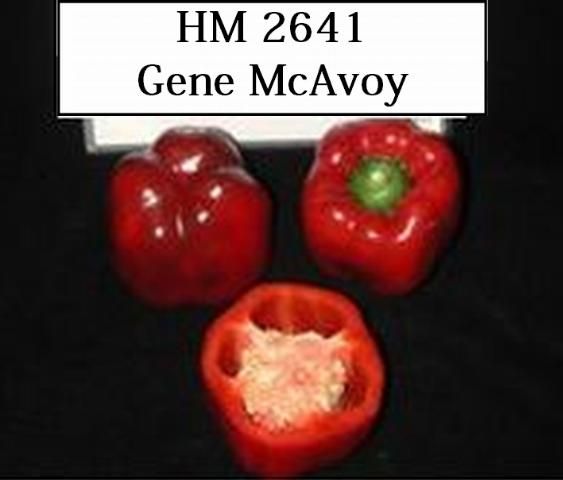
Figure 7. 

HM 2641 - Tall erect vigorous plant with good leaf coverage suited for warm weather production. Glossy dark green extra-large and large sized fruit over an extended production period R to, Xcv 1-4 and TM.  Harris Moran Seed Company.


Credit:

Gene McAvoy


[Click thumbnail to enlarge.]

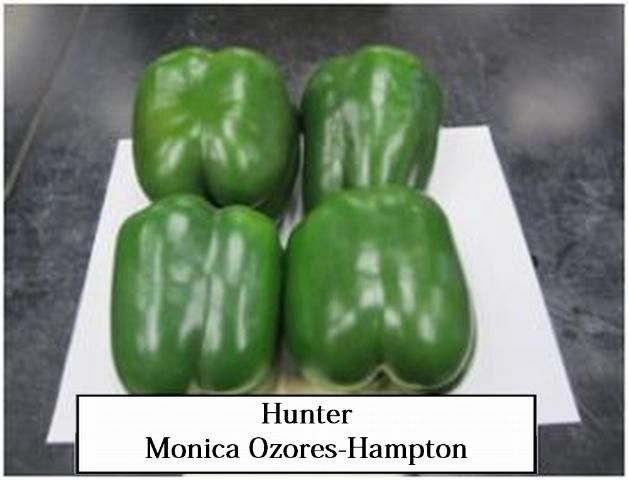
Figure 8. 

Hunter - Early maturity.  Medium size plant produces smooth, four-lobed, blocky dark green glossy fruit.  Produces a large percentage of extra large fruit. R to Xcv 1-5, TE, TM. Rogers Syngenta Seeds, Inc.


Credit:

Monica Ozores-Hampton


[Click thumbnail to enlarge.]

Figure 9. 

Intruder - Mid-season. Medium tall plant.  Smooth, firm fruit.  Good disease package with R to Xcv 1-3 TE, TM and IR to Pc. Rogers Syngenta Seeds, Inc.


Credit:

Rogers Syngenta Seeds, Inc.


[Click thumbnail to enlarge.]

Figure 10. 

Myakka - Vigorous plant with good cover. Large, high quality, dark green fruits. R to Xcv 1-4, TM. Enza Zaden.


Credit:

Monica Ozores-Hampton


[Click thumbnail to enlarge.]

Figure 11. 

Polaris – Uniform blocky green to red fruit. R to Xcv 1-3. Western Seed Company Ltd.


Credit:

Sunbelt Seeds, Inc.


[Click thumbnail to enlarge.]

Figure 12. 

PS 9922815 – Mainly for Georgia and North Florida. R to Xcv 1-6 and TSW. Seminis.


Credit:

Monica Ozores-Hampton


[Click thumbnail to enlarge.]

Figure 13. 

PS 9927141 - Main-season. Large robust plant with a continuous fruit set green-to-red blocky bell pepper with large, dark-green, smooth fruit. R to Xcv 1-5 (X5R®) and Tobamo P0 (R). Seminis.


Credit:

Monica Ozores-Hampton


[Click thumbnail to enlarge.]

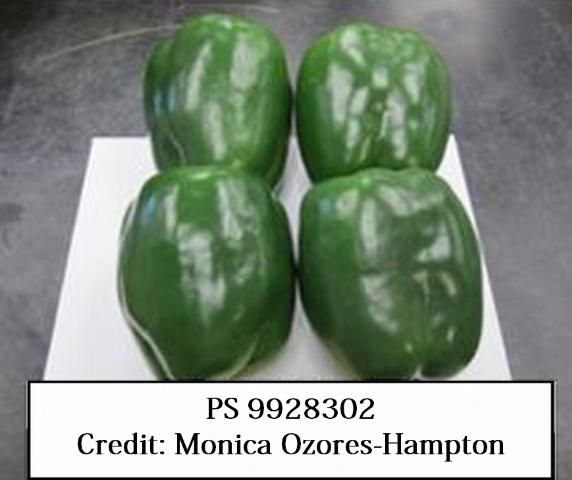
Figure 14. 

PS 9928302 - Large robust plant with large, uniform anthocyaninless dark-green fruits that mature to a firm red.  Fruits with good size, shape, uniformity and color. R to Xcv 1-5 (X5R®) and Tobamo P0 (R). Seminis


Credit:

Monica Ozores-Hampton


[Click thumbnail to enlarge.]

Figure 15. 

Red Bull -  Med-large plants with excellent canopy. Firm, blocky, smooth, and thick-walled, 4-lobed large fruit with excellent shipping qualities. R to Xcv 1-3. Sakata Seed America, Inc.


Credit:

Monica Ozores-Hampton


[Click thumbnail to enlarge.]

Figure 16. 

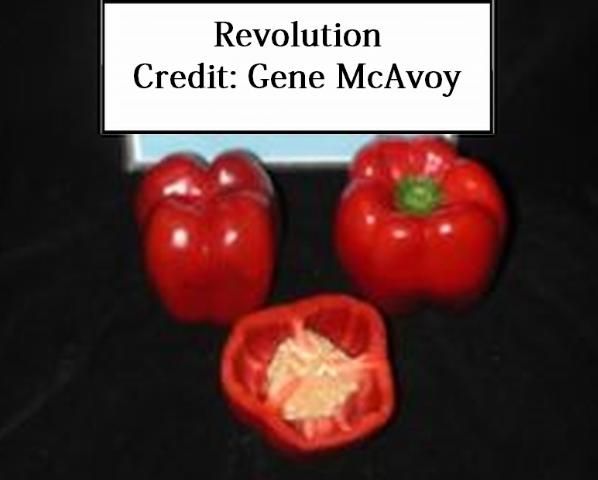
Revolution – Cold tolerance, concentrated early set, firm, uniform, extra large green to red fruits. R to Xcv 1,2,3,5 and IR to CM and Pc. Harris Moran Seed Company.


Credit:

Gene McAvoy


[Click thumbnail to enlarge.]

Figure 17. 

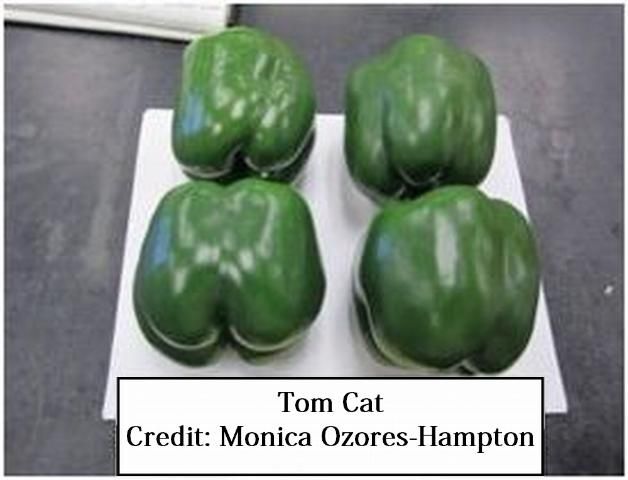
Tom Cat – Early maturing. Medium plant size and a concentrated set that yields a high percentage of extra large and large size fruit.  Blocky, dark green color.  R to Xcv 1-5, TE, and ToM. Rogers Syngenta Seeds, Inc.


Credit:

Monica Ozores-Hampton


[Click thumbnail to enlarge.]

Figure 18. 

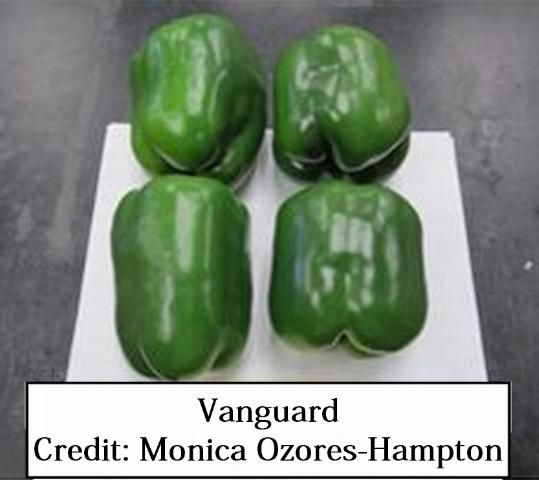
Vanguard – Medium plant with good foliage, dark green, blocky, extra-large fruits, 4-lobed, firm, with thick walls. Early maturity with concentrated harvest. R to PepMo, ToM, and Xcv 1-5. Harris Moran Seed Company.


Credit:

Monica Ozores-Hampton


[Click thumbnail to enlarge.]

Other Sweet Pepper

Figure 19. 

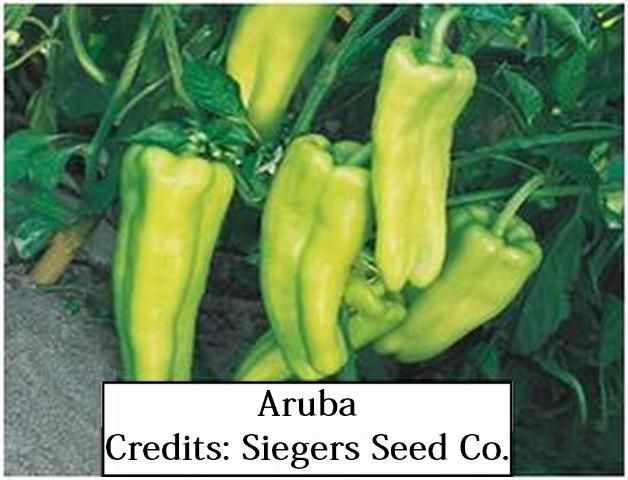
Aruba – Cubanelle type, early-maturing, erect plant, 3 – 4 lobed, elongated fruit, matures from a pale lime green to a bright red. Rogers Syngenta Seeds, Inc.


Credit:

Siegers Seed Co.


[Click thumbnail to enlarge.]

Figure 20. 

Grenada – Cubanelle type, maturing from pale green to red.  Very smooth, attractive fruit.  R to Xcv 1-3.  Sakata Seed America, Inc.


Credit:

Monica Ozores-Hampton


[Click thumbnail to enlarge.]

Note – while this list includes a number of varieties currently popular with Florida growers, it is by no means a comprehensive list of all varieties that may be adapted to the state.

Tables

Table 1. 

Key to Abbreviation

CMV

Cucumber mosaic

PepMo

Pepper mottle

PVY

Potato virus Y

Pc

Phytophthora root rot – Phytophthora capsici

ToM

Tomato mosaic virus

TM

Tobacco mosaic

TE

Tobacco Etch

TSW

Tomato spotted wilt

Tobamo P0 (R)

Tobamo virus – Tobamo virus Po

S

Stip –Physiological disorder

Xcv 1, 2, 3, 4, 5, 6

Bacterial spot – Xanthomonas campestris pv. vesicatoria

R

Resistant

IR

Intermediate Resistance

T

Tolerant

Note – while this list includes a number of varieties currently popular with Florida growers, it is by no means a comprehensive list of all varieties that may be adapted to the state.

Footnotes

1.

This document is IPM-204 (IN757), one of a series from the Grower's IPM Guide for Florida Tomato and Pepper Production by the Entomology and Nematology Department, Florida Cooperative Extension Service, Institute of Food and Agricultural Sciences, University of Florida. Published: December 2007. Revised January 2011. Please visit the EDIS website at http://edis.ifas.ufl.edu.

2.

G. McAvoy, county extension director and regional vegetable extension agent, M. Ozores-Hampton, assistant professor, Southwest Florida REC - Immokalee. Institute of Food and Agricultural Sciences, University of Florida.


The Institute of Food and Agricultural Sciences (IFAS) is an Equal Opportunity Institution authorized to provide research, educational information and other services only to individuals and institutions that function with non-discrimination with respect to race, creed, color, religion, age, disability, sex, sexual orientation, marital status, national origin, political opinions or affiliations. For more information on obtaining other extension publications, contact your county Cooperative Extension service.

U.S. Department of Agriculture, Cooperative Extension Service, University of Florida, IFAS, Florida A. & M. University Cooperative Extension Program, and Boards of County Commissioners Cooperating. Nick T. Place, Dean.