
Introduction
This publication presents management recommendations for Florida residents contending with the emergence of freshwater midges from ponds and lakes. While these midges are not disease-causing insects, they have been known to emerge from ponds and lakes in tremendous numbers posing problems for property owners because of the sheer numbers covering structures. They are typically unsightly, difficult to manage and can negatively impact quality of life of the residents living around these water bodies. The recommendations provided in this publication may result in varying levels of relief from midges on a seasonal basis.
General Background
Freshwater aquatic midges are mosquito-like Diptera belonging to the families Chironomidae and Chaoboridae (Koehler 2003). Chironomidae are commonly referred to as "Blind Mosquitoes," and Chaoboridae are commonly referred to as "Phantom Predatory Midges" (Figure 1). Midge eggs, larva, and pupa are found in storm water retention ponds and lakes, and their larvae can thrive in low oxygen zones. These larvae are often referred to as wrigglers, and sometimes as "bloodworms" because some are bright red in color (Figure 2). The adult midges do not bite, suck blood, or carry diseases, and are sometimes called "blind mosquitoes." Adult midges become a problem when they emerge from ponds in large numbers, primarily in the warm summer months (Figure 3).
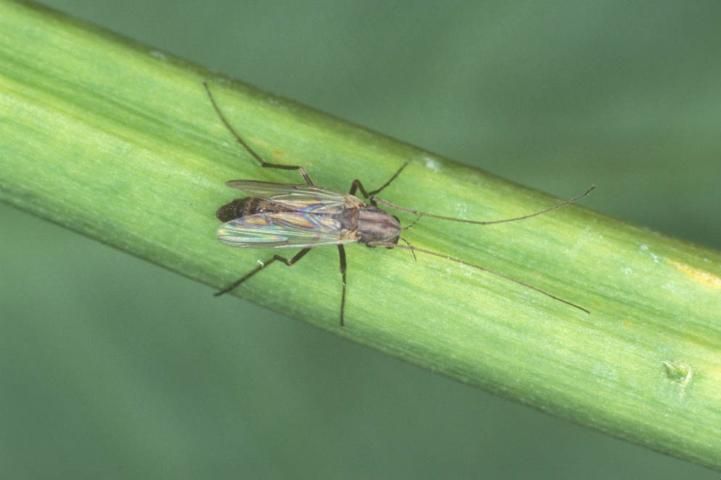
Credit: James Castner, UF/IFAS
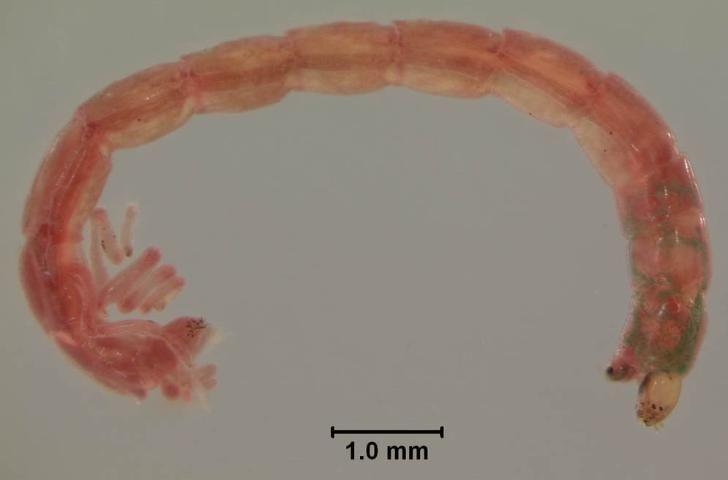
Credit: Lyle Buss, UF/IFAS
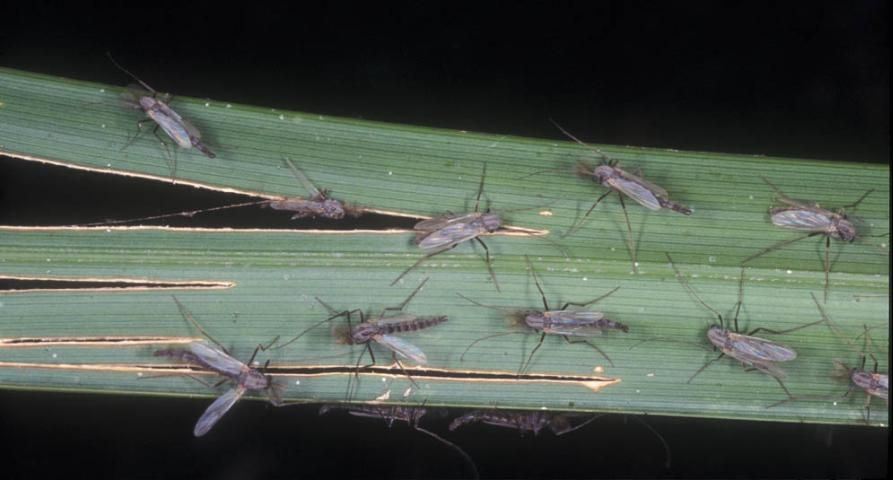
Credit: Lyle Buss, UF/IFAS
Unfortunately, the emergence of large numbers of these aquatic midges impacts the quality of life of the residents living around many storm water retention ponds and lakes in communities throughout Florida. Adult midges prefer to rest in shady areas in the day and are often found in large numbers under eaves, on patio screens, and in foyers. These midges can also find their way inside homes as residents enter and exit the structure. In addition, people have reported damage to paint finishes, airplanes, allergies, and discouraged tourism.
A Freshwater Aquatic Midge Integrated Pest Management (FAM IPM) Plan has been devised by the University of Florida to help residents tackle these midge problems. IPM plans are described as a coordinated use of multifaceted pest control strategies. The FAM IPM Plan features the coordinated use of algae control strategies, insectivorous fish, light traps, and insect growth regulators. It should be noted that while this plan may provide varying levels of relief, people may need to implement elements of this plan on a season basis. Limiting factors such as size of the water body being treated, and costs might make adoption of this plan in its entirety impractical.
Healthy Ponds
Residents’ concept of what constitutes a healthy, desirable pond can be considered when designing a local FAM IPM Plan. These considerations may include fertilizer and pesticide-free buffers between turf and ponds edge; clean, clear water with reduced algae and low turbidity; irregular shaped ponds with appropriate native, low maintenance vegetation; and adequate fish and wildlife.
Aquatic Midge IPM Plan
The first strategy in the FAM IPM plan involves the use of algae control. Larval Chironomidae graze on algal detritus that settles to the bottom of ponds and lakes. These waterbodies can be treated with algaecides, such as those containing copper, to control algae. A nutrient abatement strategy should also be helpful. Property managers, residents, and landscape maintenance personnel can follow UF/IFAS’s recommendations for Florida-Friendly Landscape Practices in their communities. Guidelines for hiring Florida-friendly landscape professionals can be found online https://edis.ifas.ufl.edu/publication/EP614 (Momol et al 2022).
The second strategy in the FAM IPM plan involves the use of insectivorous fish to biologically control aquatic midges in ponds. Ponds can be stocked with fish to aid in management of nuisance aquatic insects while also providing recreational fishing opportunities. The Florida Fish and Wildlife Conservation Commission maintains an online list of producers for fish stocking purposes https://myfwc.com/fishing/freshwater/stocking/ (FWC 2022). Stocking in the summer is not recommended as high temperatures can potentially stress the fish (Cichra 1995).
The third strategy in the FAM IPM plan involves the use of light traps to control adult midges (Ali et al., 1994). Some light traps can trap or kill midges to reduce their numbers. Lights can be used in upland buffers adjacent to the infested ponds to divert midges from houses.
The fourth strategy in the FAM IPM plan involves the use of insect growth regulators (IGRs) to prevent Chironomidae and Chaoboridae midge larvae from pupating normally and developing into the adult stage. An IGR labeled for the control of aquatic midges contains (S)- Methoprene and is sold as pellets. (S)-Methoprene can effectively stop the formation of midge pupae in the water (Ali 1991). Always read and follow label directions.
Conclusion
Implementation of the FAM IPM Plan can result in a reduction of pestiferous freshwater aquatic midge emergences from ponds and lakes. An integrated use of algae control strategies, insectivorous fish, light traps, and insect growth regulators can provide some relief, but it should be noted that implementation of the entire IPM strategy may be impractical given the size of the infestation, size of the water body being treated and cost considerations.
References
Ali, A. (1991). "Perspectives on management of pestiferous Chironomidae (Diptera), an emerging global problem". J. Am. Mosq. Control Assoc. 7:260-281.
Ali, A., Ceretti, L. Barbato, G. Marchese, F. D'Andrea, & B. Stanley. (1994). "Attraction of Chironomus salinarius (Diptera: Chironomidae) to artificial light on an island in the saltwater lagoon of Venice, Italy". J. Am Mosq. Control Assoc. 10:35-41.
Cichra, C. (1995). Managing Florida Ponds for Fishing. Gainesville: University of Florida Institute of Food and Agricultural Sciences. Circular 802.
Florida Fish and Wildlife Conservation Commission. 2007. "Producers of fish for stocking purposes". Retrieved April 27, 2022, from https://myfwc.com/fishing/freshwater/stocking/
Koehler, P. (2003). Blind Mosquitoes (Aquatic Midges). Gainesville: University of Florida Institute of Food and Agricultural Sciences. https://ufdcimages.uflib.ufl.edu/IR/00/00/27/57/00001/IG09200.pdf
Momol, E., Lewis, C., Wichmann, T., Cash, E., Marvin, J., Atkinson, M., McConnel, J., Mcintyre, K., Marble, C., Unruh, B., Barber, L., Greco, S., Bolusky, B., Mott, M., Irwin, D., McGill, B., Harris, C., Brown, E., Scheinkman, M., and Peck, A. (2022). Guidelines for Hiring a Florida-Friendly Landscape Professional. UF EDIS Publication ENH1350 https://edis.ifas.ufl.edu/publication/EP614