
The Featured Creatures collection provides in-depth profiles of insects, nematodes, arachnids, and other organisms relevant to Florida. These profiles are intended for the use of interested laypersons with some knowledge of biology as well as academic audiences.
Introduction
The palmetto scale, Comstockiella sabalis Comstock, is probably native to the southern United States, and is not normally a significant pest as long as appropriate parasitoids are present. When palmetto scale arrived in Bermuda as an invasive species in the 1920s, parasitoids were not present and severe damage as well as tree death occurred for a native palm species, Bermuda palmetto, Sabal bermudana. Management of palmetto scale was achieved by introducing parasitized palmetto scales from Florida to populations on heavily infested Bermuda host plants. The identity of the parasitoids was not confirmed at the time (Evans and Pedata 1997).
Credit: Avas Hamon, FDACS-Division of Plant Industry
Distribution
Palmetto scale is distributed throughout the southern United States, Mexico, the Caribbean, and may be found in greenhouses on appropriate host plant material in more temperate regions (Evans and Pedata 1997, Miller and Gimpel 2009).
Description
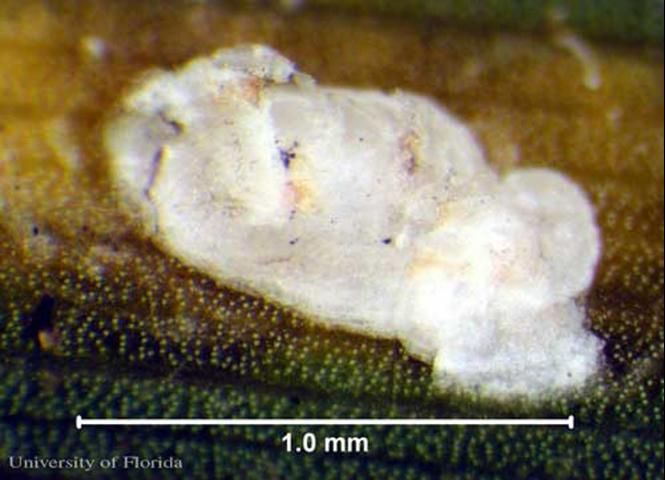
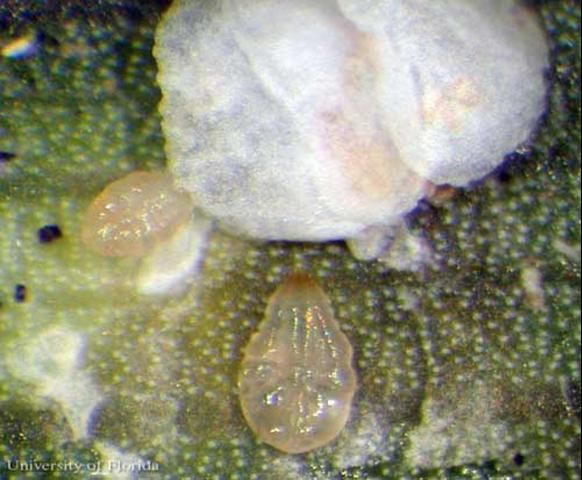
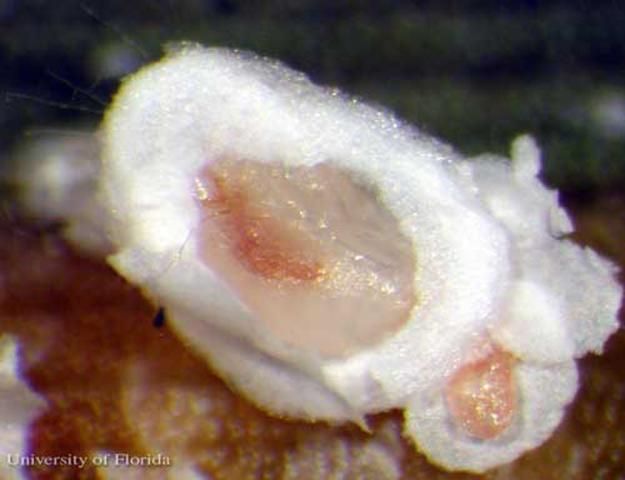
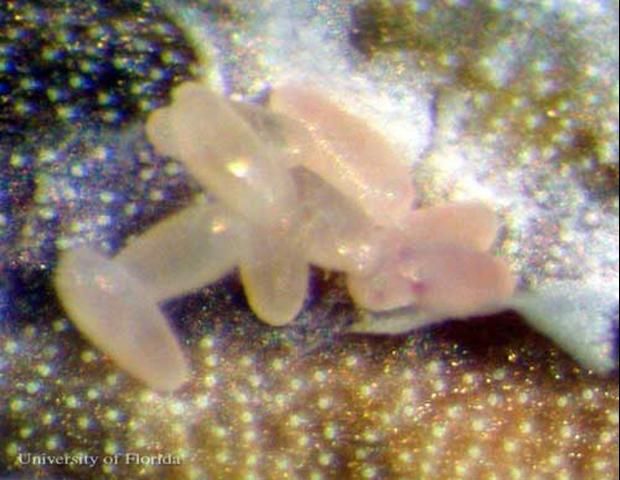
Females are light pink to reddish brown, have an almost circular but irregular shape, and are between 0.039–0.059 inches (1–1.5 mm) in diameter. Their exuviae, or shed skin, is white, covered with yellow wax, and is slightly off-center to the body of the scale. Eggs are light pink or cream. The male puparia is light pink or cream in color, wingless, very similar to the female but it is smaller and more elongated. Similar to other male scales, adults (if known to be present) are winged, rarely seen, and short-lived (Comstock 1883, Dekle 1965, Ferris 1938, Miller and Davidson 2005).
Credit: Avas Hamon, FDACS-Division of Plant Industry
Credit: Avas Hamon, FDACS-Division of Plant Industry
Credit: Avas Hamon, FDACS-Division of Plant Industry
Life Cycle
Details specific to the palmetto life cycle are unknown, but it is reportedly often associated with a fungus (Miller and Davidson 2005).
Hosts
Palmetto palm is fairly host-specific and reported damage has focused on palms. An exception to its palm-focused host range includes reported infestation of globe daisy (Globulariasalicina, family Globulariaceae) (Miller and Gimpel 2009).
Reported palm (family Palmae) hosts include the following:
Cocos spp., coconut palm
Erythea spp., Mexican blue palm, San Jose hesper palm
Sabal spp., cabbage palm or sabal palm, dwarf palmetto
Serenoa repens, saw palmetto
Washingtonia robusta, Mexican fan palm
General Plant Damage
Palmetto scale is commonly found on leaves of its hosts but may be found on the trunk or the fruit particularly with high infestations. Feeding damage is evident as yellow leaf splotches or an appearance of chlorosis (Miller and Davidson 2005).
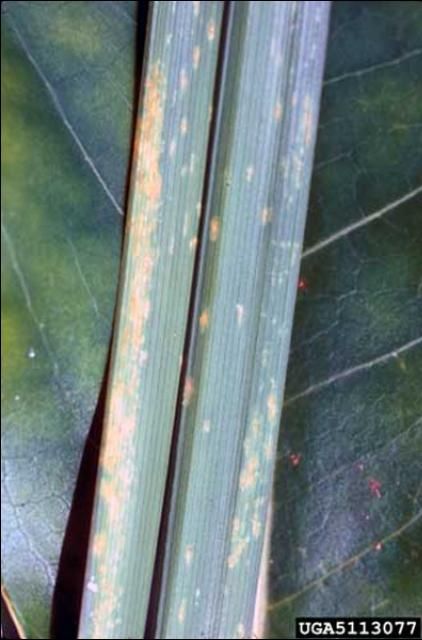
Credit: US National Collection of Scale Insects Photographs Archive, USDA, www.insectimages.org
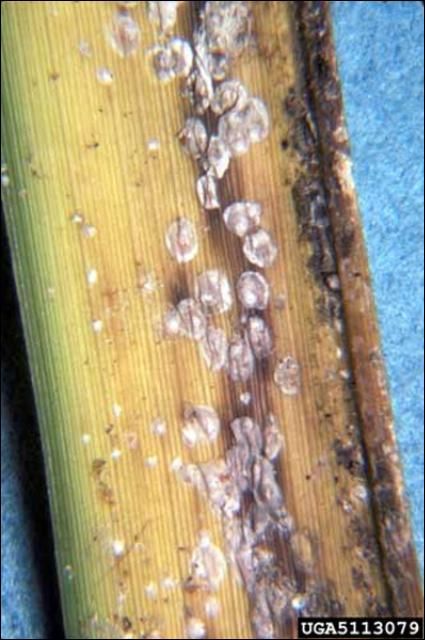
Credit: US National Collection of Scale Insects Photographs Archive, USDA, www.insectimages.org
Management
Evans and Pedato (1997) described a new species Coccobius donatellae Pedata and Evans (Hymenoptera: Aphelinidae) as the primary parasitoid of palmetto scale. Originally, literature mentioned two species as responsible for controlling palmetto scale in Bermuda, "Physcus sp." and Encarsia portoricensis. Based on surveys of parasitoids in Bermuda, Evans and Pedato (1997) suggest that these species were misidentified as the female and male specimens of C. donatellae. Although C. donatellae in believed to be the primary parasitoid of palmetto scale, other Aphelinidae parasitoids confirmed in Florida include Aphytis fuscipennis Howard and Encarsia citrina (Craw).
Selected References
Comstock JH. 1883. Second report on scale insects, including a monograph of the sub-family Diaspinae of the family Coccidae and a list, with notes of the other species of scale insects found in North America. Department of Entomology Report, Cornell University Agricultural Experiment Station 2: 47-142.
Dekle GW. 1965. Arthropods of Florida and Neighboring Land Ares: Florida Armored Scale Insects. Vol. 3. Florida Department of Agriculture, Division of Plant Industry. Gainesville, FL.
Evans GA, Pedata PA. (1997). Parasitoids of Comstockiella sabalis (Homoptera: Diaspididae) in Florida and description of a new species of the genus Coccobius (Hymenoptera: Aphelinidae). Florida Entomologist, 80: 328-334. https://journals.flvc.org/flaent/article/view/59314/56993 (1 March 2022).
Ferris GF. 1938. Atlas of the scale insects of North America. Series 2. Stanford University Press, Palo Alto, California.
Miller DR, Davidson JA. 2005. Armored Scale Insect Pests of Trees and Shrubs (Hemiptera: Diaspididae). Cornell University Press. Ithaca, NY. 456 pages.
Miller DR, Gimpel ME. (April 2009). Diaspididae: Diaspidinae and Leucaspidinae. ScaleNet. https://scalenet.info/ (18 September 2009).