
Spotted wing drosophila, Drosophila suzukii (Matsumura) (Diptera: Drosophilidae), is an invasive pest that was introduced into Florida in 2009 after having been detected in California in 2008. As of June 2015 it had spread to most of the fruit-producing states in the United States and 30 counties in Florida. The highest numbers in Florida have been found in Citrus, Alachua, Marion, Orange, and Hillsborough Counties.
Originally from East Asia, the fly resembles common Drosophila flies that accumulate on over-ripe bananas, flats of strawberries left without refrigeration, old fallen citrus, discarded watermelon rinds, and other fruit beginning to decompose. Drosophila flies are small (1/8 inch or 2–3 mm) and have prominent red eyes. The male spotted wing drosophila can be recognized by a single, dark spot on the wings that is lacking in most other Drosophila flies. (Fig. 1a).
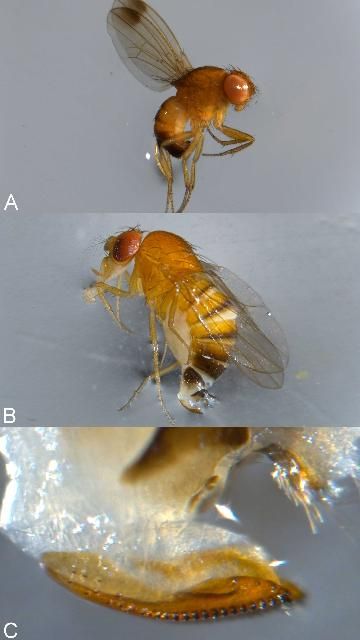
Credit: L. E. Iglesias, Department of Entomology and Nematology, University of Florida, Gainesville, FL.
The female spotted wing drosophila possesses a dark, serrated ovipositor (egg-laying device) that is used to cut into ripe, undamaged fruit in order to lay eggs inside (Fig. 1b and c). Other common Drosophila flies lack this modification and are limited to laying eggs in soft over-ripe or rotting fruit. Spotted wing drosophila eggs (Fig. 2a) that hatch produce white maggots that feed on soft fruit tissues before harvest (Fig. 2b). Infested fruit can go unnoticed until the fruit are in consumers' hands.
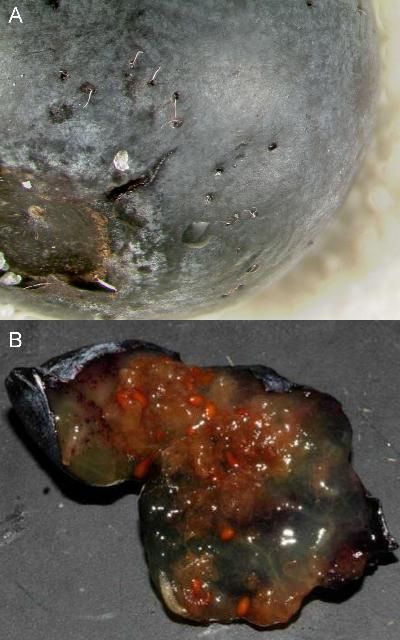
Credit: T. W. Nyoike, BASF Corporation, Research Triangle Park, NC. Used with permission.
Drosophilids (family Drosophilidae) are often called pomace, vinegar, or fruit flies, but "fruit flies" in this case is confusing because that name also applies to larger fly species belonging to the family Tephritidae. These flies include the banded winged flies such as the problematic Mediterranean fruit fly, blueberry maggot fly, Caribbean fruit fly, Oriental fruit fly, Mexican fruit fly, and others often reported in the news media. Drosophilid flies are not closely related to tephritid flies, and management of the two groups is different. For instance, rare outbreaks of Mediterranean fruit flies in Florida have been managed in part with mass releases of sterilized male Mediterranean fruit flies, but so far spotted wing drosophila cannot be managed by releasing sterilized males.
Spotted wing drosophila survives well under Florida's climatic conditions. In 2014, losses to berry crops in Florida were estimated at $35 million. Losses are due to maggot-infested fruit, which is unacceptable for the fresh berry market, and/or puncture holes in the fruit from egg-laying females that lead to secondary infection by fungal and/or bacterial pathogens. Due to increased pressure from spotted wing drosophila, management plans are being established. Currently, no action thresholds are available and therefore correct identification of spotted wing drosophila is essential. Detailed identification information and recommended management practices for spotted wing drosophila in blueberries can be found at https://edis.ifas.ufl.edu/in998 (Liburd and Iglesias 2013). Presence of spotted wing drosophila on a farm can be determined by observing adult flies captured in strategically placed traps baited with a yeast and sugar water mixture. Traps may be constructed using 32-oz clear plastic cups with small 0.16-inch (4 mm) holes (Fig. 3a, Iglesias et al. 2013) or 32-oz jars with red tape and large 0.71-inch (18 mm) holes covered with drywall mesh (Fig. 3b, Renkema et al. 2014). These traps can be hung in strawberry field margins as well as the center of the field so that trap entry holes are level with the canopy (Fig. 4a). In blueberries and caneberries, traps can be hung throughout the field and along the field border, in the center of the bush in the shade and away from the morning sun (Fig. 4b). Monitoring for spotted wing drosophila should start as the fruit begins to ripen.
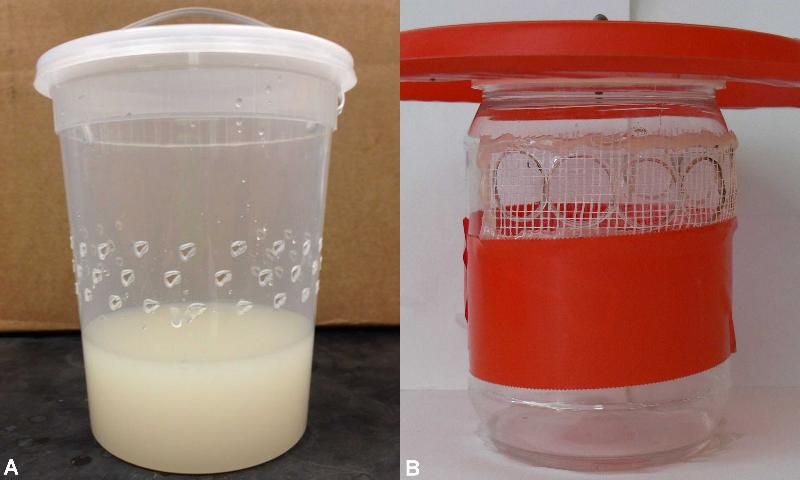
Credit: L. E. Iglesias and J. M. Renkema, Department of Entomology and Nematology, University of Florida, Gainesville, FL.
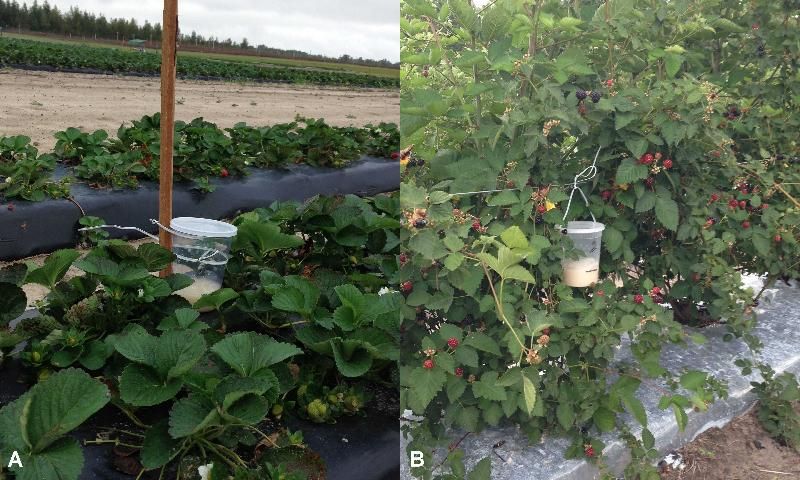
Credit: L. E. Iglesias, Department of Entomology and Nematology, University of Florida, Gainesville, FL.
Cultural techniques that reduce spotted wing drosophila breeding sites include short harvest intervals (every 2–3 days) and properly disposing of unmarketable fruit. Unmarketable fruit should be buried or sent to municipal disposal sites. It is important to bury fruit at least 6 inches (15 cm) deep in order to reduce spotted wing drosophila emergence from the soil (Rodriguez-Saona 2012). Exclusion netting has been effective at preventing spotted wing drosophila access to ripening fruit. However, netting may impact environmental conditions surrounding the plants (increase temperature and humidity, reduce light) (Kawase and Uchino 2005, Schattman et al. 2015).
Applications of registered insecticides should be made when spotted wing drosophila is detected. Again, no action thresholds have been established yet for this pest. Table 1 lists registered insecticides for use against spotted wing drosophila. These insecticides target adult flies; there are no insecticides available for egg or larval control inside fruit. If flies are absent as indicated by a rigorous monitoring program, sprays for spotted wing drosophila should be reduced.
Since its first detection in Florida in 2009, the spotted wing drosophila has spread to over 30 fruit-producing counties in the state. Surveys of this pest from 2012–2015 indicate that the pest is active throughout the year with peak activity from April to June when blueberry and blackberry production is highest. As a result, losses have almost doubled since 2012. Spotted wing drosophila is also being trapped in strawberries, persimmons and grapes. Organic growers are at a higher risk of spotted wing drosophila infestation due to the limited number of chemical tools available for its control. Insecticides should be applied using all recommended rates and in rotation with different classes to delay insecticide resistance. Research is ongoing to develop new management tactics to assure long-term control and to reduce the negative impacts associated with the frequent use of broad-spectrum insecticides. Research initiatives include evaluation of the role and management of wild host plants, blueberry varietal preference, cultural control tactics, and the use of host volatiles for improved monitoring and detection.
Sources and Additional Information
Bolda, M. 2008. "New fruit fly pest in strawberries and caneberries." http://ucanr.edu/blogs/blogcore/postdetail.cfm?postnum=821, viewed 12 Jan 2016.
Bolda, M. 2009. "Update on the cherry vinegar fly, Drosophila suzukii, now known as the spotted wing Drosophila." University of California, Agriculture and Natural Resources Blogs, Strawberries and Caneberries, July 9, 2009, http://ucanr.edu/blogs/blogcore/postdetail.cfm?postnum=1483%20, viewed 21 Jan 2016.
Bolda, M. 2009. "Drosophila suzukii update." University of California, Agriculture and Natural Resources Blogs, Strawberries and Caneberries, June 3, 2009. http://ucanr.edu/blogs/blogcore/postdetail.cfm?postnum=1351, viewed 21 Jan 2016.
Cline, H. 2009. "CVF causing widespread damage." Western Farm Press, 6 July 2009, http://westernfarmpress.com/management/cvf-causing-widespread-damage, viewed 21 Jan 2016.
Delfinado, M. D. & D. E. Hardy. 1977. A catalog of the Diptera of the oriental region. Vol III Suborder Cyclorrhapha. The University Press of Hawaii, Honolulu. x + 854 pp
eFly SWD Working Group. 2012. Spotted wing drosophila impacts in the eastern United States. http://www.sripmc.org/index.cfm/linkservid/C930E4B6-39EC-43D7-8C0324891BF13386/showMeta/0/
Iglesias, L. E., N. W. Nyoike, and O. E. Liburd. 2013. "Effect of trap design, bait type and age on trap captures of spotted wing drosophila, Drosophila suzukii (Matsumura)." J. Econ. Entomol. 107: 1508–1518.
Kaneshiro, K. Y. 1983. "Drosophila (Sophophora) suzukii (Matsumura)." Proceedings Hawaiian Entomological Society 24: 179.
Kanzawa, T.1936. "Studies on Drosophila suzukii Mats." Journal of Plant Protection (Tokyo) 23: 66–70. 127–132, 183–191. Abstract in Review of Applied Entomology 24: 315.
Kanzawa, T.1939. "Studies on Drosophila suzukii Mats." Kofu, Yamanashi Agric. Exp. Sta. 49 pp. Abstract in Review of Applied Entomology 29: 622.
Kawase, S. and K. Uchino. 2005. "Effect of mesh size on Drosophila suzukii adults passing through the mesh." Ann. Rep. Kanto-Tosan Plant Prot. 52: 99–101.
Liburd, O. E. and L. E. Iglesias. 2013. Spotted wing drosophila: pest management recommendations for southeastern blueberries ENY-869. Gainesville: University of Florida Institute of Food and Agricultural Services. https://edis.ifas.ufl.edu/in998
Renkema, J.M., R. Buitenhuis, and R.H. Hallett. 2014. "Optimizing trap design and trapping protocols for Drosophila suzukii (Diptera: Drosophilidae)." J. Econ. Entomol. 107: 2107–2118.
Rodriguez-Saona, C. 2012. "Spotted wing drosophila (Drosophila suzukii): a new pest of blueberries in New Jersey." Spotted Wing Drosophila Working Group of the Northeastern IPM Center, 31 October and 1 November, Geneva, NY.
Schattman, R. E., V. Izzo, and Y. H. Chen. 2015. "Exclusion netting for managing spotted wing drosophila on berry farms in the Northeastern United States." Agroecology and Rural Livelihoods Group research brief no. 3, University of Vermont. Burlington, VT.
Schetelig, M. F. and A. M. Handler. 2013. "Germline transformation of the spotted wing drosophilid, Drosophila suzukii, with a piggyBac transposon vector." Genetica. 141: 189 – 193.
Steck, G.J., W. Dixon, & D. Dean. 2009. "Spotted wing drosophila, Drosophila suzukii (Matsumura) (Diptera: Drosophilidae), a fruit pest new to North America." Pest Alert. Florida Dept. Agric. and Consumer Services, Div. of Plant Industry. http://www.freshfromflorida.com/Divisions-Offices/Plant-Industry#pagecontent, viewed 12 Jan 2016.
Uchino, K. 2005. "Distribution and seasonal occurrence of cherry Drosophila, Drosophila suzukii (Diptera: Drosophilidae), injurious to blueberry in Chiba Prefecture." Ann. Rep. Kanto-Tosan Plant Prot. 52:95–97.
University of California Cooperative Extension, Mariposa County. "Be on the lookout for spotted wing Drosophila." http://ipm.ucdavis.edu/PMG/PESTNOTES/pn74158.html, viewed 21 Jan 2016.