- Topics: Plant Pathology | Peres, Natalia A | Rose Pest Management

Jozer Mangandi and Natalia A. Peres2
Black spot is, a fungal disease that affects nearly all rose cultivars worldwide. It is a frequent problem for roses grown outdoors and reduces the quality and life span of the plants. However, the poor performance of roses in Florida can also be associated with various factors such as inadequate fertilization and water deficiency during the warm season, as well as the use of root stocks and scions not well-adapted to Florida's conditions.
The black spot pathogen, Marssonina rosae (Diplocarpon rosae, sexual stage), is a parasite specific to roses and is considered the most serious disease of roses in Florida. The disease was first reported in Sweden in 1815 and in the United States in 1830. Since then, it has been reported in South America, Canada, Australia, and China, among other countries.
Different genotypes or races of M. rosae, i.e., isolates that infect a specific cultivar or group of cultivars, have been identified. Certain species of roses and cultivars of old garden roses are considered more resistant to the disease than modern cultivars. Modern roses and especially the popular hybrid teas are not only more susceptible to the disease, but also considered high maintenance roses in Florida requiring more attention to disease control, fertilization, and irrigation.
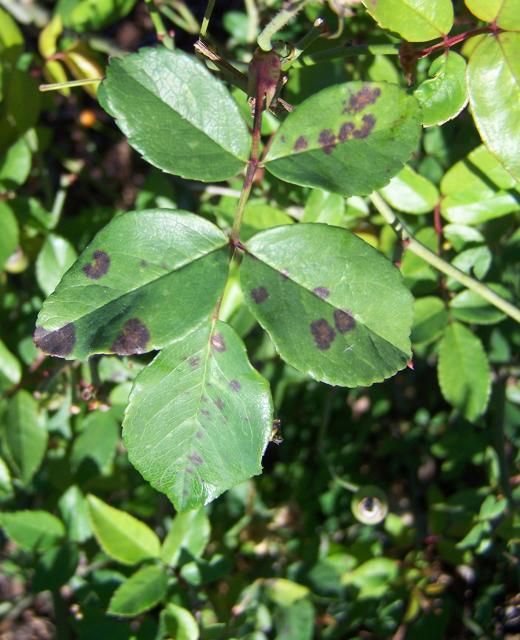
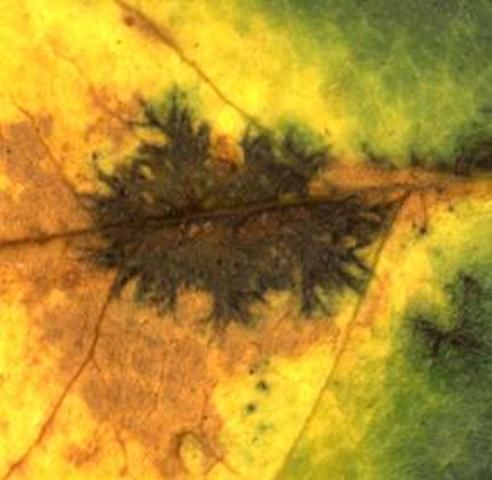
M. rosae produces black spots of about two to 12 mm in diameter usually in the upper surface of the leaves (Fig. 1a). Often, those spots may have irregular, radiate, feathery borders (Fig. 1b). In older lesions, black spore-bearing structures, called acervuli, can be observed as well as white, slimy masses of conidia (Fig. 2a). Yellowing around the lesions on infected leaves can occur and severe defoliation occurs in the most susceptible cultivars. While leaves are the most susceptible part of the plant, stipules and pedicels can also be infected. Spots can also be found also in peduncles, fruits, and sepals. Symptoms of black spot are usually confused with those of Cercospora leaf spot (See EDIS publication Cercospora Leaf Spot of Rose at http://edis.ifas.ufl.edu/PP267).
Leaves of 'Old Blush' rose infected with Marsonina rosae.
J. Mangandi, UF-GREC
Typical lesion of black spot on a rose leaf.
J. Mangandi, UF-GREC
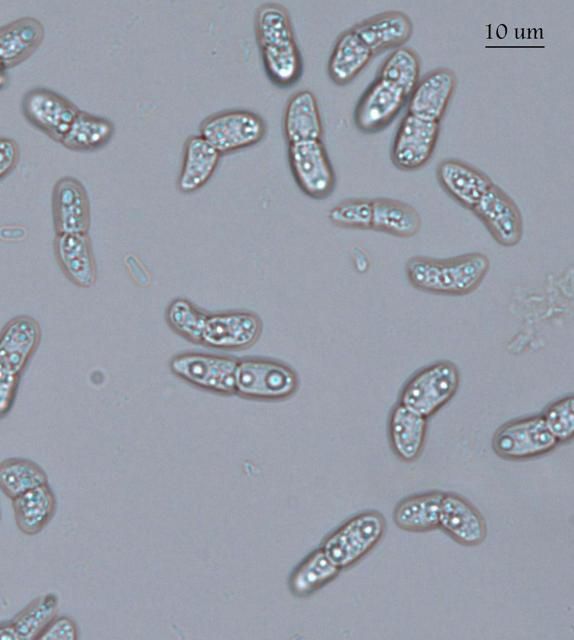
The infection cycle starts when spores are spread by rain or overhead irrigation from leaves or canes infected from the previous season. The conidia must be wet for several hours to infect plant tissues. Symptoms begin to appear in three to 16 days after infection. Mature conidia can be produced 10 to 18 days after infection and initiate a new cycle. Conidia are colorless and two-celled (Fig. 2b). A temperature of 64°F is optimal for black spot development, but conidia germination still occurs from 59 to 81°F. This wide temperature range allows the disease to continue to develop as long as the moisture is adequate during the season.
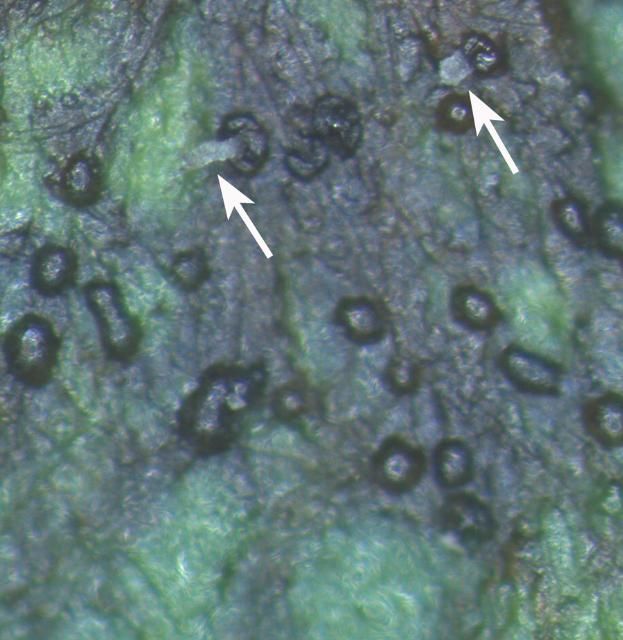
Black acervuli on a lesion caused by Marsonina rosae. Note the white masses of conidia (arrows), 50x.
J. Mangandi, UF-GREC
Microscopic view of two-celled conidia of Marsonina rosae, 400x.
J. Mangandi, UF-GREC
Black spot can be controlled by planting cultivars with resistance to the disease such as WEKcisbako (HomeRun®) or RADrazz (Knock Out®). These cultivars are, however, susceptible to Cercospora leaf spot. Old garden roses 'Mrs. B.R. Cant' and 'Spice' have shown good levels of resistance to both diseases in our trials. Sanitation practices, such as removal and burning of fallen leaves and pruning of canes late in the winter before new shoots are produced, help reduce the amount of inoculum. Plants should not be allowed to remain wet for long periods of time and overhead irrigation should be avoided or minimized. If this is not possible, plants should be irrigated early in the morning to allow leaves to dry.
For chemical control, an initial application of a protectant fungicide should be made at bud break, followed by bimonthly applications until leaves are completely expanded. During the summer, applications every 7-14 days may be necessary to successfully manage the disease. Fungicides labeled for the control of black spot of roses in Florida are listed in Tables 1 and 2. For managing fungicide resistance, the best strategy is to rotate among products with different modes of action. All fungicides within the same group (with the same number or letter) have the same active ingredient or a similar mode of action. Fungicide resistance is usually low with multi-site inhibitor fungicides group (M).
Fungicide products marketed for use by professional pesticide applicators for control of black spot on roses
Active ingredient |
Fungicide group |
Trade name |
Copper ammonium compex |
M1 |
Copper-Count®- N |
Copper hydroxide |
M1 |
Champ® Dry Prill, Champ® Formula 2, Kentan® DF |
Copper hydroxide + Copper oxychloride |
M1 |
Badge® SC, Badge® X2 |
Copper oxychloride |
M1 |
Agri Star® COC DF, Agri Star® COC WP |
Copper oxychloride + Copper sulfate |
M1 |
C-O-C-S® WDG |
Sulfur |
M2 |
Arysta Sulfur 6L, Cosavet-DF®, Kumulus® DF, Stoller® THAT® flowable sulfur, Thiolux Jet, Wettable sulphur, Micro Sulf®, Microthiol® Disperss® |
Mancozeb |
M3 |
Dithane® 75DF Rainshield®, Fore™ 80WP Rainshield®, Koverall™, Penncozeb™ 75DF |
Maneb |
M3 |
Maneb 75DF, Maneb 80WP |
Ziram |
M3 |
Ziram 76DF |
Captan |
M4 |
Captan 50WP, Captan 50W, Captec 4L® |
Chlorothalonil |
M5 |
Daconil Ultrex® Turf Care®, Daconil Weatherstik®, Echo® 720 T&O, Echo® Zn T&O, Ensign™ 720, Ensign® 82.5% T&O, Initiate® 720, Prokoz Mainsail™ 6.0 F, Prokoz Mainsail™ WDG |
Chlorotalonil + thiophanate-methyl |
M5+1 |
Spectro™ 90WDG T&O |
Thiophanate-methyl |
1 |
3336® F, Nufarm T-Methyl SPC 4.5 F, Nufarm T-Methyl SPC 50 WSB, Quali-Pro® TM 85 WDG |
Myclobutanil |
3 |
Eagle® 20EW, Prokoz, Quali-Pro® Myclobutanil 20 EW T&O |
Propiconazole |
3 |
AmTide Propiconazole 41.8% EC, Banner Maxx®, Banner Maxx® II, Fitness™, Nufarm Propiconazole SPC 14.3 MEC, Procon-Z™, Prokoz® Hoist™, Propensity® 1.3ME T&O, Quali-Pro® Propiconazole 14.3 |
Tebuconazole |
3 |
Clearscape T&O, Quali-Pro® Tebuconazole 3.6F, Monsoon® Turf, Offset™ 3.6F, Torque™ |
Azoxystrobin |
11 |
Heritage® |
Trifloxystrobin |
11 |
Compass® Fungicide, Compass® O 50WDG |
Thiophanate-methyl + Iprodine |
1 + 2 |
Nufarm TM+IP SPC |
Bacillus subtilis |
NC |
Cease® |
Clove oil+ Rosemary Oil+ Thyme oil |
NC |
Sporan™, Sporatec® |
Mineral Oil |
NC |
Tritek™ |
Parafinic Oil |
NC |
JMS Stylet-oil® |
Petroleum Oil |
NC |
Saf-T-Side® |
Potassium bicarbonate |
NC |
Milstop® |
Reynoutria sachalinensis |
NC |
Regalia® |
Neem Oil |
NC |
Trilogy® |
Fungicide Group (FRAC Code): Numbers (1-37) and letters (M) are used to distinguish the fungicidal mode of action groups. All fungicides within the same group (with same number or letter) indicate same active ingredient or similar mode of action. This information must be considered in making decisions about how to manage fungicide resistance. M=Multi-site inhibitors, fungicide resistance is low; NC= not classified. Source: http://www.frac.info/ (Fungicide Resistance Action Committee, FRAC). Always read a current product label before applying any chemicals. |
||
Fungicide products marketed toward homeowners for control of black spot on roses
Active ingredient |
Fungicide group |
Trade name |
Copper hydroxide |
M1 |
Hi-Yield ® Copper |
Copper Sulfate |
M1 |
Bonide® Copper Dust |
Copper Octanoate |
M1 |
Bonide® Liquid Copper, Natural Guard Copper Soap, Ortho® Disease B Gon® Copper Fungicide |
Sulfur |
M2 |
Bonide® Sulfur Dust, Ferti-lome® Dusting Sulfur, Green Light, Hi-Yield® Dusting Wettable Sulphur, Ortho® Bug-B-Gon® Rose & Flower Care |
Mancozeb |
M3 |
Bonide® Mancozeb |
Captan |
M4 |
Bonide® Captan 50WP, Hi-Yield® Captan 50W Fungicide |
Chlorothalonil |
M5 |
Bonide® Fungonil, Ferti-lome® Broad Spectrum, Hi-Yield® Vegetable, Flower, Fruit and Ornamental Fungicide, Monterey, Ortho® Disease B Gon™ Garden Fungicide , Monterey Fruit Tree, Vegetable & Ornamental Fungicide |
Myclobutanil |
3 |
Spectracide Immunox® Multi-Purpose Fungicide |
Propiconazole |
3 |
Ferti-lome® Liquid Systemic Fungicide, Monterey Fungi-Fighter |
Tebuconazole |
3 |
Bayer Advanced™ Disease Control for Roses, Flowers & Shrubs |
Tebuconazole + Imidacloprid |
3 + |
Bonide® Rose RX Systemic Drench, Feti-lome® 2-N-1 Systemic |
Triforine |
3 |
Ortho® RosePride® Disease Control |
Calcium Polysulfide |
NC |
Hi-Yield® Lime Sulfur Spray |
Neem Oil |
NC |
Bonide® RX 3 in 1, Green Light® Neem Concentrate, Green Light® Rose Defense®, Monterey |
Acetamiprid + Triticonazole |
NC + 3 |
Ortho® Bug B Gon® Insect & Disease Control |
Acephate + Resmethrin + Triforine |
NC + NC + 3 |
Ortho® RosePride® Insect, Disease & Mite Control |
Fungicide Group (FRAC Code): Numbers (1-37) and letters (M) are used to distinguish the fungicidal mode of action groups. All fungicides within the same group (with same number or letter) indicate same active ingredient or similar mode of action. This information must be considered in making decisions about how to manage fungicide resistance. M=Multi-site inhibitors, fungicide resistance is low; NC= not classified. Source: http://www.frac.info/ (Fungicide Resistance Action Committee, FRAC). Always read a current product label before applying any chemicals. |
||
This document is PP268, one of a series of the Plant Pathology Department, Florida Cooperative Extension Service, Institute of Food and Agricultural Sciences, University of Florida. Original publication date May 2009. Revised July 2012. Visit the EDIS website at http://edis.ifas.ufl.edu.
Jozer Mangandi, graduate student, Department of Horticultural Sciences; Natalia A. Peres, associate professor, Department of Plant Pathology, Gulf Coast Research and Education Center (REC)--Balm; Florida Cooperative Extension Service, Institute of Food and Agricultural Sciences, University of Florida, Gainesville, FL 32611.
The use of trade names in this publication is solely for the purpose of providing specific information. UF/IFAS does not guarantee or warranty the products named, and references to them in this publication does not signify our approval to the exclusion of other products of suitable composition. All chemicals should be used in accordance with directions on the manufacturer's label.
The Institute of Food and Agricultural Sciences (IFAS) is an Equal
Opportunity Institution authorized to provide research, educational
information and other services only to individuals and institutions
that function with non-discrimination with respect to race, creed,
color, religion, age, disability, sex, sexual orientation, marital
status, national origin, political opinions or affiliations.
For more information on obtaining other extension publications,
contact your county Cooperative Extension service.
U.S. Department of Agriculture, Cooperative Extension Service,
University of Florida, IFAS, Florida A. & M. University Cooperative
Extension Program, and Boards of County Commissioners Cooperating. Nick T. Place,
Dean.