The pindo or jelly palm was formerly known by the scientific name Butia capitata. However, recent research has shown that the correct name for this palm should be B. odorata. This small, single-stemmed, feather-leaved palm is widely grown in warmer parts of the US due to its unusual cold tolerance. It is considered hardy down to about 10°F or USDA zone 8A (see http://planthardiness.ars.usda.gov/PHZMWeb/), but can survive in protected sites in zone 7B. While they survive in south Florida, pindo palms grow much better in cooler, less humid climates. They are considered to be intolerant of salt spray. This species has not been assessed for invasiveness by the UF/IFAS Assessment of Non-native Plants in Florida’s Natural Areas.
The palm is slow-growing, eventually reaching 15–20 feet, making it suitable for planting under power lines (Figure 1). Its gray-green recurved leaves are about 4–6 feet long and have leaflets attached to the petioles in a deep V shape. The petioles have spines along their margins. The leaf bases are strongly persistent and give the trunk a distinctive knobby appearance (Figure 2). The 3–4-foot-long flower stalks eventually produce edible 1-inch-diameter yellow to orange fruits. Pindo palm seeds are notoriously slow and difficult to germinate, but research has shown that simply cracking the stony seed endocarps in a bench vise or commercial nut cracker and planting the 1–3 seeds enclosed therein in a warm, moist environment (95–105°F) can result in excellent germination in as little as 3 months.
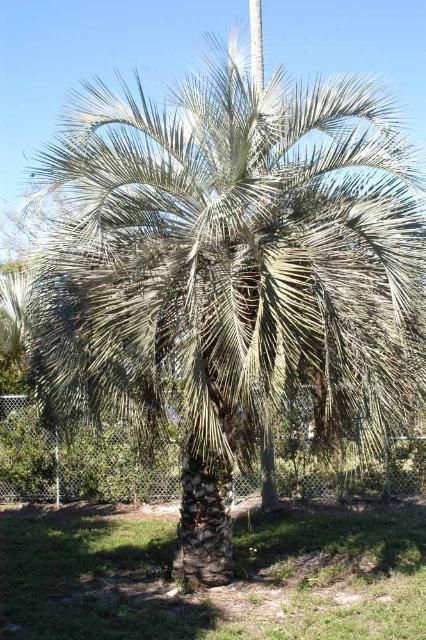
Credit: T. K. Broschat, UF/IFAS
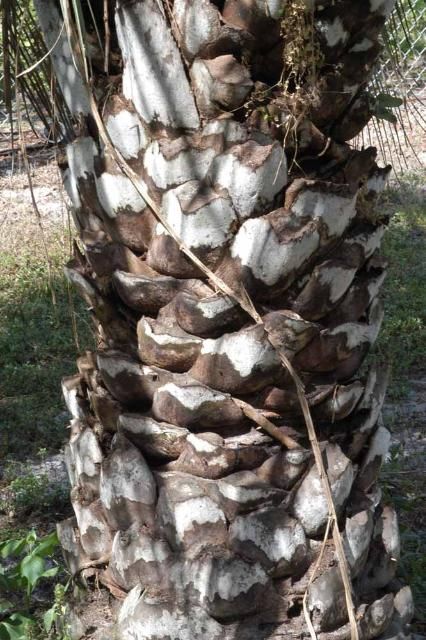
Credit: T. K. Broschat, UF/IFAS
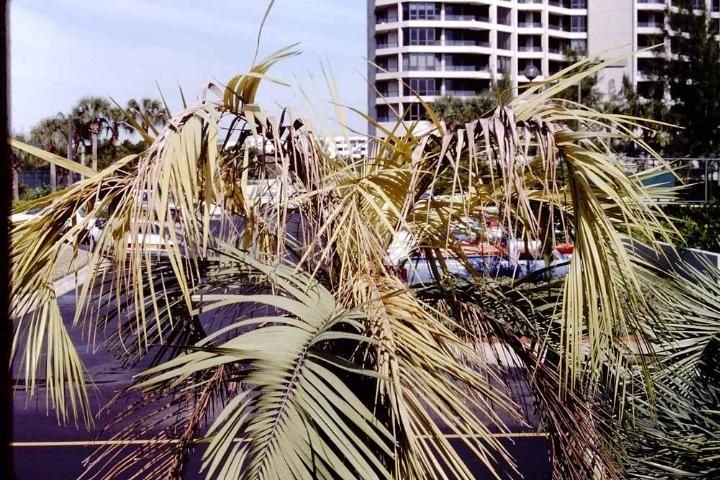
Pindo palms can hybridize with the related queen palm (Syagrus romanzoffiana). The offspring, known as mule palms (xButiagrus nabonnandii), are popular for their cold hardiness, larger size, and dark green foliage. Pindo palms grow on a wide range of soils, including very dry and alkaline soils. Although they are susceptible to potassium (K) deficiency (see Potassium Deficiency in Palms, https://edis.ifas.ufl.edu/ep269), as are most palms, the gray, necrotic leaflet tip symptoms are not as conspicuous as in other species due to the natural gray color of the foliage. Occasionally, translucent yellow-orange and necrotic speckling can also be seen toward the tips of the oldest leaves (Figure 3). Since K deficiency causes premature leaf loss in palms, the best measure of K deficiency severity in this species is the number of leaves in the canopy. Healthy specimens with no K deficiency should have round, 360° canopies with no visual symptoms on the oldest leaves. Although it is not common, manganese (Mn) deficiency (see Manganese Deficiency in Palms, https://edis.ifas.ufl.edu/ep267) has been observed in pindo palms. Symptoms appear as necrotic tips on basal leaflets of newly emerging leaves (Figure 4). No other nutrient deficiencies have been documented in this species.
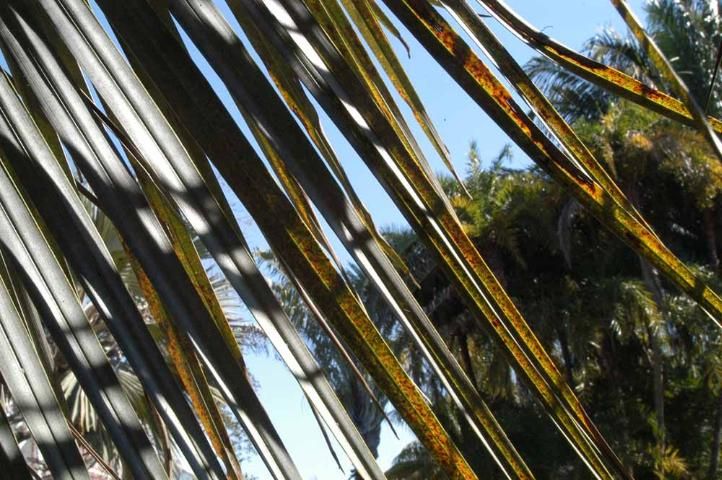
Credit: T. K. Broschat, UF/IFAS
Credit: T. K. Broschat, UF/IFAS
To prevent or correct nutrient deficiencies in pindo palms, 3 (4 in south Florida) applications per year of a controlled release 8N-2P2O5-12K2O-4-Mg plus micronutrients fertilizer are recommended. For more information about fertilizing landscape palms in Florida see Fertilization of field-grown and landscape palms in Florida (https://edis.ifas.ufl.edu/ep261).
Pindo palms are remarkably disease resistant, with no documented cases of phytoplasma diseases such as lethal yellowing (see Lethal Yellowing (LY) of Palm, https://edis.ifas.ufl.edu/pp146) or Lethal Bronzing Disease (see Lethal Bronzing Disease (LB), https://edis.ifas.ufl.edu/pp163), or Fusarium wilt. However, mule palms are known to be susceptible to Fusarium wilt, a disease that typically causes a one-sided death of older leaves and, ultimately, death of the entire palm. Although it is rarely observed, pindo palms are likely susceptible to Ganoderma butt rot (see Ganoderma Butt Rot of Palms, https://edis.ifas.ufl.edu/pp100), a soil-borne fungus that causes decay of the lower part of the trunk in mature palms. A brown and white shelf-like mushroom called a conk may or may not be observed before the palm wilts and dies.
References
Broschat, T.K. 1998. "Endocarp Removal Enhances Butia capitata Seed Germination." HortTechnology 8:589–587.
Elliott, M. L., T. K. Broschat, J. Y. Uchida, and G. W. Simone. 2004. Compendium of Ornamental Palm Diseases and Disorders. St. Paul, MN: American Phytopathological Society Press.
Meerow, A. W. 2006. Betrock's Landscape Palms. Hollywood, FL: Betrock Information Systems.
Noblick, L. R. 2011. "The Validation of the Name Butia odorata." Palms 55:48–49.