
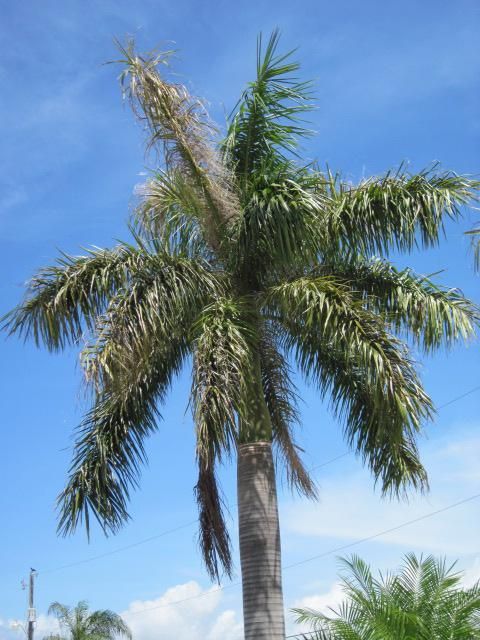
The royal palm is a large, majestic palm that is native to south Florida and Cuba. It is considered cold hardy to about 28°F or USDA Cold Hardiness Zone 10A. This species quickly grows to heights of 50–70 ft., with a spread of 20–25 ft., and has a smooth light gray trunk up to 2 ft. in diameter (Figure 1). It is ideal for landscaping streets, parks, and commercial properties, but becomes too large for typical residential landscapes. The bases of royal palm leaves are tightly overlapping and form a smooth green five-foot-high region above the trunk called the "crownshaft." Royal palms are considered self-cleaning: naturally dying old leaves will cleanly drop off by themselves, at a rate of about one leaf per month. While this eliminates the need to trim off old dead leaves, the sheer size (10–15 ft. long) and weight (up to 50 lb. when fresh) of these leaves can cause injury to people and damage to property when they fall. Inflorescences consisting of hundreds of tiny cream-colored flowers are followed in late summer by dark red to black fruits that are readily consumed by birds and thus widely dispersed.

Credit: Stephen Brown, UF/IFAS
If the seed is to be planted, the fleshy fruit pulp should be removed, and the seeds rinsed thoroughly in water. Always wear rubber gloves when handling fruits of royal palms, since the pulp contains calcium oxalate crystals that are highly irritating to exposed skin. The seeds should be sown in a well-drained, uniformly moist potting soil and kept warm (95°F is ideal). Royal palm seeds appear to have immature embryos at the time that the fruit falls and thus will not germinate for 5–8 months after planting. The grass-like seedlings should be transplanted into containers after the second leaf emerges. For more information about palm seed germination, see BUL274/EP238 Palm Seed Germination.
Royal palms are moderately tolerant of salt spray, but they are intolerant of high salt concentrations in their root zone (Figure 2). They grow well in wet soils yet are quite drought tolerant once they become established. The species is prone to potassium (K), manganese (Mn), and boron (B) deficiencies, especially on calcareous native or fill soils. Potassium deficiency symptoms in royal palms appears as leaflet tip necrosis and curling (frizzling) that is most severe on the oldest leaves (Figure 3). Potassium deficiency also causes premature leaf loss and reduces the number of leaves a palm can support. In severe cases of K deficiency, affected palms may have only a couple of stunted, off-color, and frizzled leaves. Such palms may also show a tapering of the trunk (pencil-pointing), and they often die from the deficiency (Figure 4). For more information about K deficiency, see ENH1017/EP269 Potassium Deficiency in Palms.
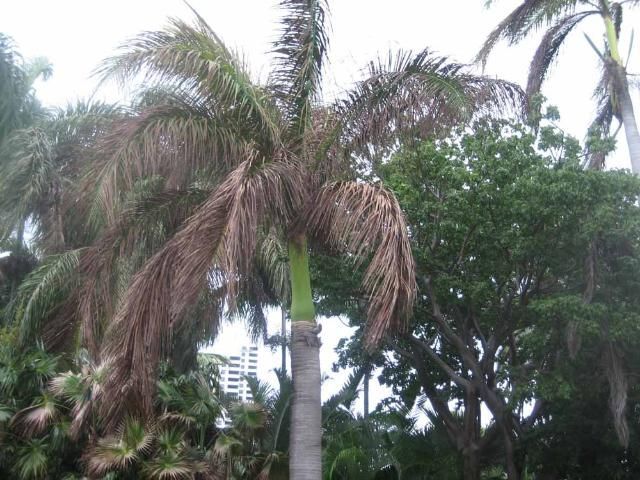
Credit: M. L. Elliott, UF/IFAS
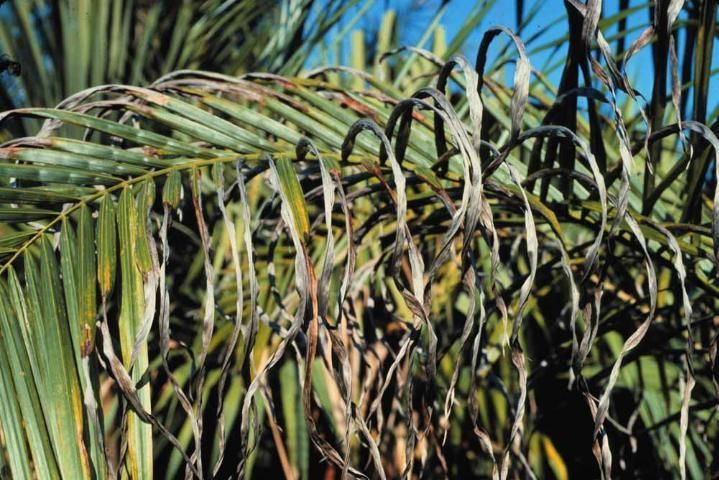
Credit: T. K. Broschat, UF/IFAS

Credit: T. K. Broschat, UF/IFAS
Symptoms of manganese deficiency can easily be confused with those of K deficiency, since both cause leaflet tip frizzling. However, Mn deficiency symptoms appear on newly emerging leaves and are most severe toward the base of the leaf, while K deficiency symptoms are most severe toward the tips of the oldest leaves (Figure 5). Severely Mn-deficient royal palms may die if not treated with manganese sulfate. For more information about Mn deficiency in palms, see ENH1015/EP267 Manganese Deficiency in Palms.
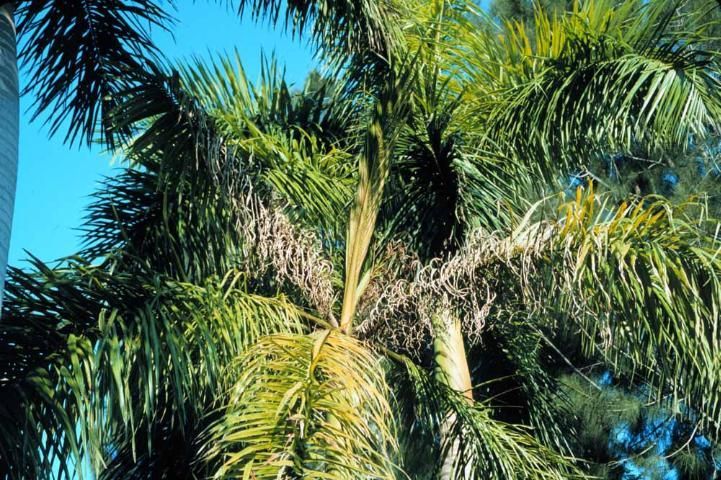
Credit: T. K. Broschat, UF/IFAS
Boron deficiency causes stunting or distortion of newly emerging leaves, and in some cases, the entire crown may begin to grow sideways or even downwards (Figure 6). Boron deficiency in royal palms can be fatal, but often is chronic. For more information about B deficiency in palms, see ENH1012/EP264 Boron Deficiency in Palms.
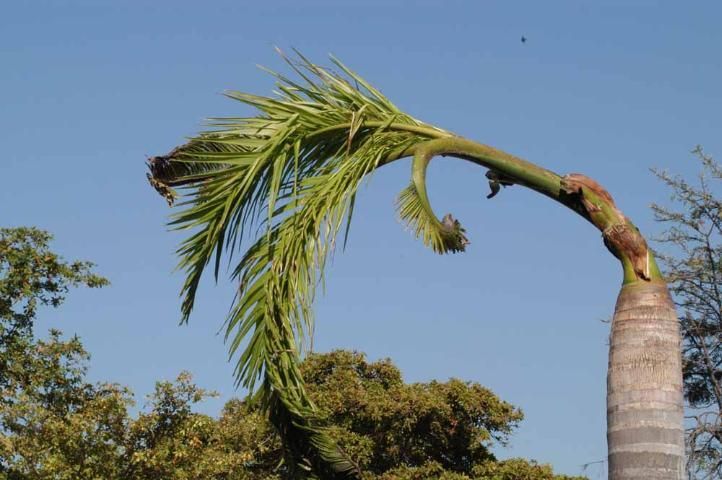
Credit: T. K. Broschat, UF/IFAS
Regular fertilization with a controlled release fertilizer having an analysis of 8-2-12-4 Mg (or 8-0-12-4 Mg) plus micronutrients can correct and prevent nutrient deficiencies in these palms. See ENH1009/EP261 Fertilization of Field-grown and Landscape Palms in Florida for more information about palm fertilization.
Royal palms have few serious insect pests, but one that is often severe and closely mimics K or Mn deficiencies is the royal palm bug (Xylastodoris luteolus). This tiny, pale green, elongated bug infests newly emerging leaves as they unfold. Their feeding, primarily during the spring months, causes leaflets to appear chlorotic, then grayish-brown and frizzled (Figure 7). These leaves are typically frizzled throughout their length and are most apparent in mid-canopy leaves during mid-summer. This helps distinguishes royal palm bug damage from K and Mn deficiencies, which affect older and younger leaves, respectively. See EENY097/IN254 Royal Palm Bug for more information about this pest.
Credit: T. K. Broschat, UF/IFAS
Compared to other palm species, royal palms are relatively disease resistant, being susceptible primarily to two trunk rotting fungal diseases. Ganoderma butt rot, caused by Ganoderma zonatum, infects the central portion of the bottom three feet of the trunk. A cross section through the trunk will reveal discoloration of the decayed, but not soft, wood. After about 85% of the cross-sectional area of the trunk has been killed by the fungus, wilt symptoms may appear in the canopy and the palm will die shortly thereafter. The fruiting structure of the fungus, called a conk, may or may not appear on the outside of the lower trunk prior to palm death. Once a conk or wilt symptoms have been observed, the palm should be removed immediately as it could fall without warning and cause serious injury or property damage (Figure 8). For more information about this disease, see PP-54/PP100 Ganoderma Butt Rot of Palms.
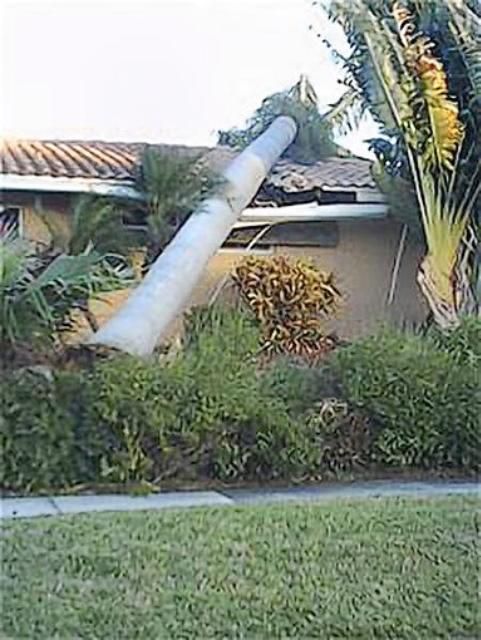
Credit: Jason Conner
Another lethal disease that is occasionally seen on royal palms is Thielaviopsis trunk rot. This fungus requires a wound in the upper, softer portion of the trunk for infection to occur. Pulling off leaves prematurely is one way to create such a wound. Once infection occurs, the fungus causes a wet soft rot through the trunk. When most of the cross-sectional area of the trunk has been rotted, the entire crown will topple over without warning (Figure 9). Although there is no control for this disease, it can be prevented by avoiding wounding the upper portion of the trunk. For more information about this disease, see PP-219/PP143 Thielaviopsis Trunk Rot of Palm.
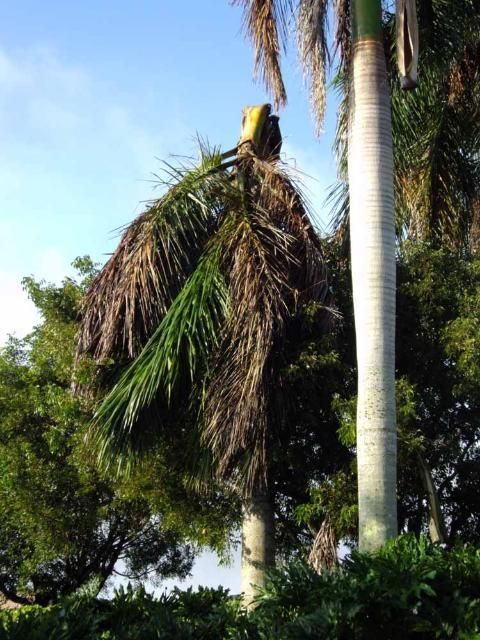
Credit: M. L. Elliott, UF/IFAS
References
Broschat, T.K. and W.G. Latham. 1994. Oxalate content of palm fruit mesocarp. Biochem. Syst. Ecol. 22:389–392.
Broschat, T.K. and H. Donselman. 1987. Effects of fruit maturity, storage, presoaking, and seed cleaning on germination in three species of palms. J. Environ. Hort. 5:6–9.
Elliott, M.L., T.K. Broschat, J.Y. Uchida, and G.W. Simone. 2004. Compendium of Ornamental Palm Diseases and Disorders. Amer. Phytopath. Soc., St. Paul, MN.
Howard, F.W., D. Moore, R.M. Giblin-Davis, and R.G. Abad. 2001. Insects on Palms. CABI, Oxon, UK.
Meerow, A.W. 2006. Betrock's Landscape Palms. Betrock Info. Syst., Hollywood, FL.