
Introduction
Pink trumpet tree produces a wonderful specimen tree, reaching a height of 50 feet and is covered with terminal panicles of pink to rose-purple, two-inch-wide, showy blossoms in spring. There are few, if any, other flowering trees which can match the beauty of this tree in bloom! Flowers stand out nicely because there are no leaves on the tree during flowering. They contrast nicely against the light grey bark. The palmately compound leaves bear five leaflets, each about two-and-one-half inches long.
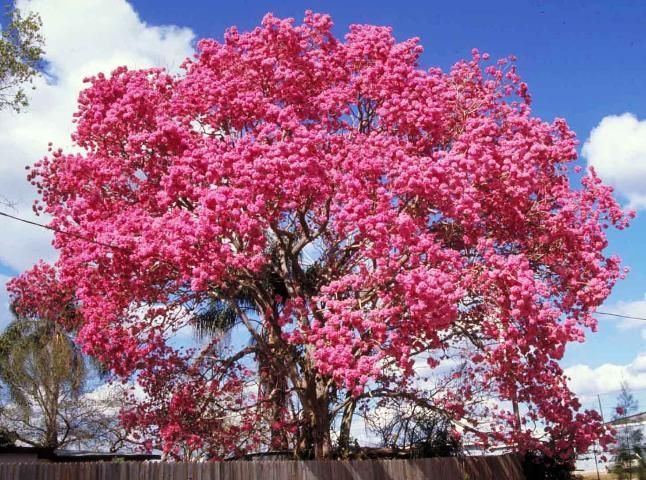
Credit: Ed Gilman, UF/IFAS
General Information
Scientific name: Handroanthus heptaphyllus
Pronunciation: hand-ro-ANTH-us hep-tuh-FILL-us
Common name(s): Pink trumpet tree
Family: Bignoniaceae
USDA hardiness zones: 9B through 11 (Figure 2)
Origin: not native to North America
Invasive potential: not considered a problem species at this time, may be recommended (North, Central, South)
Uses: specimen; street without sidewalk; parking lot island < 100 sq ft; parking lot island 100–200 sq ft; parking lot island > 200 sq ft; tree lawn 4–6 feet wide; tree lawn > 6 ft wide; highway median; shade
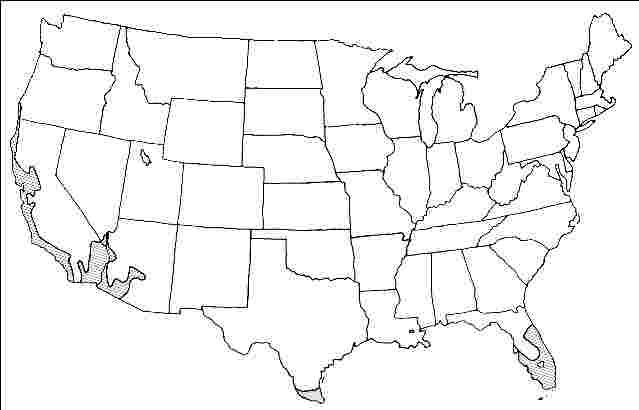
Credit: UF/IFAS
Description
Height: 40 to 50 feet
Spread: 35 to 50 feet
Crown uniformity: symmetrical
Crown shape: round, vase
Crown density: moderate
Growth rate: fast
Texture: medium
Foliage
Leaf arrangement: opposite/subopposite (Figure 3)
Leaf type: palmately compound
Leaf margin: entire, undulate
Leaf shape: oblong, elliptic (oval)
Leaf venation: pinnate
Leaf type and persistence: semi-evergreen, deciduous
Leaf blade length: 2 to 4 inches
Leaf color: green
Fall color: no color change
Fall characteristic: not showy
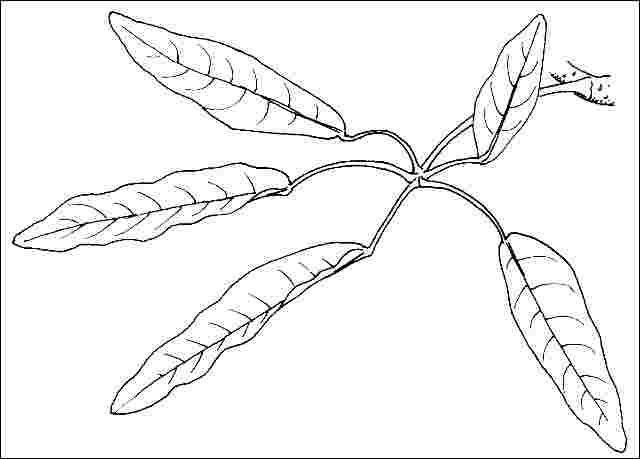
Credit: UF/IFAS
Flower
Flower color: pink
Flower characteristics: very showy
Fruit
Fruit shape: pod or pod-like, elongated
Fruit length: 3 to 6 inches, 6 to 12 inches
Fruit covering: dry or hard
Fruit color: brown
Fruit characteristics: does not attract wildlife; showy; fruit/leaves not a litter problem
Trunk and Branches
Trunk/bark/branches: branches don't droop; not showy; typically one trunk; thorns
Pruning requirement: needed for strong structure
Breakage: resistant
Current year twig color: brown
Current year twig thickness: medium
Wood specific gravity: unknown
Culture
Light requirement: full sun
Soil tolerances: clay; sand; loam; alkaline; acidic; well-drained
Drought tolerance: high
Aerosol salt tolerance: unknown
Other
Roots: not a problem
Winter interest: no
Outstanding tree: yes
Ozone sensitivity: unknown
Verticillium wilt susceptibility: unknown
Pest resistance: free of serious pests and diseases
Use and Management
Pink trumpet tree would make a nice tree for planting along a boulevard or residential street where there is plenty of soil space for root development. Prune major limbs so they remain about one-half the diameter of the trunk so they remain well secured to the trunk. This is a tree you will want to keep around, once you see it in flower.
Pink trumpet tree should be grown in full sun or partial shade on rich, well-drained soil.
Propagation is by seed, cuttings, or layering. Trees flower at an early age.
Pests and Diseases
No pests or diseases are of major concern.
Literature Cited
University of Florida, Institute of Food and Agricultural Sciences. 2018. "Assessment of Non-native Plants in Florida's Natural Areas" (https://assessment.ifas.ufl.edu, 4/29/2019) Gainesville, FL, 32611-4000, USA.