


Best Management Practices for Siting Honey Bee Colonies: Good Neighbor Guidelines
Introduction
Beekeeping is becoming increasingly popular in Florida. Commercial beekeepers maintain hundreds if not thousands of colonies for honey production and to provide pollination services to crops, while the typical urban or backyard beekeeper maintains one to five colonies. Backyard beekeeping traditionally has provided honey for home consumption and general enjoyment for those who practice the craft.
Keeping honey bees requires responsible management so that the bees do not become a nuisance. Additionally, the presence of Africanized honey bees in Florida places more pressure on beekeepers to maintain their colonies properly (for information about Africanized honey bees, see: https://entnemdept.ufl.edu/honey-bee/beekeeper-resources/african-bees/).
This document is intended as a reference for honey bee management in Florida, with emphasis on siting apiaries in sensitive locations. It is intended that these recommendations form a prescription for harmonious cooperation between beekeepers, neighbors, and landowners.
Definitions
As used in this document, the following words and terms have the meanings noted in this section, unless the context of their usage clearly indicates another meaning:
-
Apiary means the assembly of one or more colonies of bees at a single location.
-
Beekeeper means a person who owns or has charge of one or more colonies of bees.
-
Beekeeping equipment means anything used in the operation of an apiary, such as hive bodies, supers, frames, top and bottom boards, and extractors.
-
Colony or hive means an aggregate of bees consisting principally of workers, but having, when perfect, one queen and, at times, many drones, brood (immature honey bees—eggs, larvae, pupae), combs, honey, and the receptacle inhabited by the bees.
-
Honey bee means all life stages of the common Western honey bee, Apis mellifera.
Requirement to Register
People keeping bees (any number of colonies) in Florida are required by law to register with the Florida Department of Agriculture and Consumer Services, Division of Plant Industry (FDACS-DPI— https://www.fdacs.gov/Agriculture-Industry/Bees-Apiary/Apiary-Inspection). Renewal forms are sent annually to previously registered beekeepers for return to the FDACS-Division of Plant Industry (DPI) along with the appropriate annual fee specified in the fee schedule. Beekeepers who change addresses are requested to notify the Department. For more information on registering bee colonies in Florida, see: https://www.fdacs.gov/Agriculture-Industry/Bees-Apiary/Beekeeper-Registration.
Hive Type
All honey bee colonies should be kept in removable-frame hives such as Langstroth-type hives or similar. The hives should be kept in sound and usable condition.
Fencing of Flyways
In instances where colonies are situated within close proximity (~25 feet) to a public or private property line of the land upon which the apiary is situated, it is advisable, though not always necessary, to establish and maintain a flyway barrier. The ideal barrier is at least 6 feet high and consists of a solid wall, fence, dense vegetation or combination thereof and extends 10 or more feet beyond the colony(ies) in each direction. This will force the bees to fly at an elevation of at least 6 feet above ground level over the property lines in the vicinity of the apiary. This flight path will minimize human/bee traffic interactions.
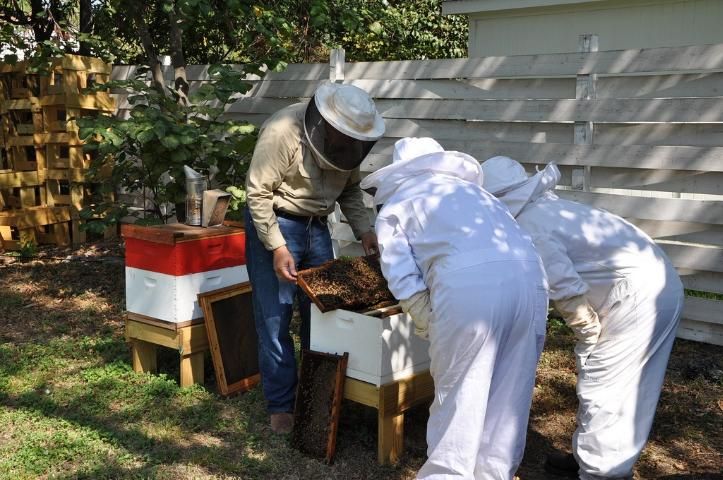
Credit: Thien Gretchen https://www.flickr.com/photos/tgretchen/
Water
A convenient source of water should be available to the bees at all times during the year so that the bees will not congregate at swimming pools, pet watering bowls, or other watering sources where they may contact humans, birds, or domestic pets. Some sources of water that beekeepers can provide include: (1) a tub of water with wood floats to prevent the bees from drowning, (2) a faucet in the apiary that is left to drip steadily, or (3) Boardman entrance feeders (quart jars with holes in the lids) filled with water and placed on the colony(ies). If using tubs of water, change the water periodically to avoid stagnation and mosquito breeding.
General Maintenance
No bee comb or other materials should be left on the grounds of the apiary site. Upon their removal from the hive, all such materials should be disposed of promptly in a sealed container or placed within a building or other bee-proof enclosure.
Beekeepers must follow Florida's Beekeeper Compliance Agreement—Best Management Requirements for Maintaining European Honey Bee Colonies produced by FDACS-DPI (see references). These must be followed by all registered beekeepers, even if the honey bee colonies are located on county or state property or are used for educational purposes. No honey bee colonies may be placed on public lands, including schools, parks, and other similar venues, except when a special permit letter is issued by the director of the FDACS-DPI and written consent of the property manager is acquired. In order to get the special permit letter, a beekeeper must have FDACS-DPI Apiary Inspectors perform a site visit to ensure the potential apiary site meets compliance criteria. Following this, the director of the FDACS-DPI, the head of the Apiary Inspection Section, and the regional apiary supervisor will meet to discuss the site. The director of the FDACS-DPI will issue a permit if the site is deemed suitable to host an apiary.
Queens
All colonies ideally should be maintained with marked European honey bee queens produced by breeders following "Best Management Practices for Producing Honey Bee Queens in Florida" (see references) or similar best management practices if produced by breeders from other states. When a colony exhibits unusual defensive characteristics by stinging or attempting to sting without due provocation, the beekeeper should requeen the colony with another marked European honey bee queen.
Miscellaneous
In compliance with the State of Florida Apiary Inspection Law regarding identification of honey bee hives, the beekeeper should post a sign at the apiary, which conspicuously sets forth his/her name and phone number.
To protect public safety and reduce beekeeping liability, apiaries should not be sited in proximity to tethered or confined animals, students, the elderly, the general public, drivers on public roadways, sites that attract visitors, or any area where animal/bee and people/bee interactions may have a high likelihood of occurring.
Beekeepers should take every precaution possible to limit unnecessary public/bee interactions. Using "common sense" will help reduce negative interactions between the public and honey bees, thus making beekeeping safe, enjoyable, and possible for the beekeeper.
Selected References
Jamie D. Ellis and Amanda Ellis. 2012. African honey bee, Africanized honey bee, killer bee, Apis mellifera scutellata Lepeletier (Insecta: Hymenoptera: Apidae). EENY 429. Gainesville: University of Florida Institute of Food and Agricultural Sciences. https://edis.ifas.ufl.edu/publication/in790.
H. Glenn Hall, Catherine Zettel-Nalen, and James D. Ellis. 2014. African honey bee: what you need to know. ENY 114. Gainesville: University of Florida Institute of Food and Agricultural Sciences. https://sfyl.ifas.ufl.edu/sarasota-docs/ipm/need-to-know.pdf.
M. K. O'Malley, J. D. Ellis, and A. S. Neal. 2012. Frequently asked questions about the Africanized honey bee in Florida. ENY 140. Gainesville: University of Florida Institute of Food and Agricultural Sciences. https://ipm.ifas.ufl.edu/resources/grants_showcase/fruit/IN73800.pdf.
Florida Department of Agriculture and Consumer Services Division of Plant Industry. 2013. Best Management Requirements for Producing Honey Bee Queens in Florida. http://www.freshfromflorida.com/content/download/24006/486787/bmp_hbq.doc.
Florida Department of Agriculture and Consumer Services Division of Plant Industry. 2013. Beekeeper Compliance Agreement—Best Management Requirements for Maintaining European Honey Bee Colonies https://www.fdacs.gov/content/download/71086/file/08418%20cleaned%20up.pdf.


