
The genus Ficus (Latin for fig) is a member of the family Moraceae and contains over 800 species. Figs are woody trees, shrubs, or vines native to Asia, Australia, and Africa. Cultivated species either produce edible fruit or possess ornamental value. This article describes common species and cultivars in the foliage plant industry (see Table 2), provides guidelines for their culture and interior use, and lists physiological problems that may be encountered during production and interiorscape use (see Table 3).
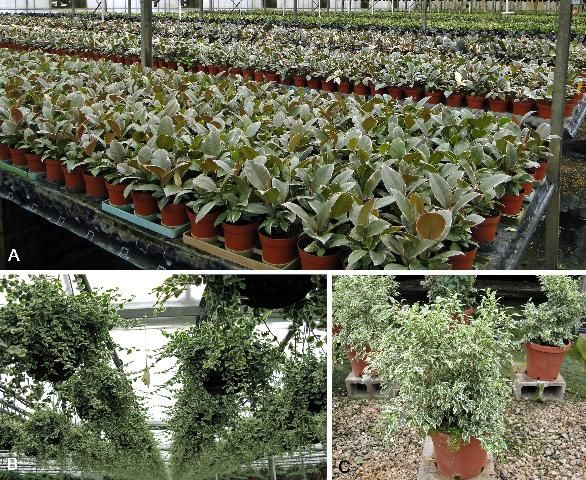
Credit: UF/IFAS
Cultural Guidelines
Propagation
Rooting of cuttings, air layering, and tissue culture are primary methods of fig propagation. Air layering or cuttings are mainly used for large specimens, whereas tissue culture propagated liners are used for producing figs in 10-inch or smaller containers. Due to the difficulty in rooting and tissue culture, F. binnendijkii 'Amstel King' is still propagated by air layering.
Production
Sphagnum peat, pine bark, vermiculate, or perlite can be volumetrically combined to formulate media for Ficus production. Ficus requires media with good container capacity and aeration, pH of 5.5–7, and soluble salts of 1–2 dS/m. Media may contain 10-20% coarse sand to keep plants from wind tipping. Excessive root growth beneath the containers should be trimmed regularly. Cease trimming roots one month before shipment because damage to roots at that time will shock the plant and affect interior performance. Ficus should be grown in a shadehouse with a temperature of 70 to 95°F and a relative humidity of 60 to 100%. Either controlled-released or water-soluble fertilizers with micronutrients, or a combination of both can be used for Ficus production. The appropriate ratio of N:P:K should be 3:1:2 or 3:1:3. The suggested application rate is 3 lbs N per 1,000 sq ft per month. Table 2 provides a guide for determining whether figs are appropriately fertilized based on leaf analysis. It is advisable to stop fertilizing one month before shipment. Ficus require plenty of water. Irrigate frequently during hot weather.
Ficus can grow at light levels varying from deep shade to full sun. However, Ficus is sensitive to radical changes in light intensities, particularly from production shadehouse to interior low light conditions. To produce superior interiorscapeable trees, two common procedures have been used in plant production. One is to initially grow them under 50% shade (about 6,250 foot candles), and then acclimatize them under 80–90% shade (about 2,500 to 1,250 foot candles) for at least two months before using them for interiorscaping. The other is to initially grow them under 70–80% shade (3,750 to 2,500 foot candles) until they are ready for interior use.
Results from our recent studies may assist with the choice of light levels for Ficus production. Nine cultivars: 'Florida Spire', 'Indigo', 'Midnight', 'Midnight Princess', 'Monique', and 'Winter Green' of Ficus benjamina, 'Cabernet' and 'Melany' of F. elastica, and 'Alii' of F. binnendijkii were grown to marketable size from cuttings or tissue cultured liners. The cultivars were grown under three different light conditions: 50, 70, or 80% shade (6,250, 3,750, or 2,500 foot candles). We then evaluated them for indoor performance in conditioning rooms with low light levels of 50 and 100 foot candles for one year. Data showed that plants produced under 70–80% shade were not only significantly larger and had better leaf color but also performed better under interior light levels of 100 or 50 foot candles than plants produced under 50% shade.
Shipping and Interior Care
Ficus should be shipped at a temperature of 55–65°F. Once plants are placed indoors, it is advisable not to move, prune, re-pot, or fertilize them for about four weeks at least because plants do not need additional stresses. However, only those plants produced continuously under light levels 70% or lower or produced under relatively high light levels but acclimatized under 80% shade for at least two months are suitable for interior use under light levels of 100 to 200 foot candles. 'Alii' may be used under 50 foot candles. Plants should not be fertilized if soluble salts are 1.0 dS/m or more when solution is extracted by the pour-through method. If soluble salt levels are higher than 3.0 dS/m, leaching the media may help reduce potential leaf burning problems. Media should be kept moist. Temperatures of 65 to 80°F are most appropriate, and drafts should be avoided. Proper pruning is usually necessary to maintain shape, thin foliage for better light penetration, and remove dead branches.