
Cultural Guidelines for Commercial Production of Interiorscape Aglaonema
The genus Aglaonema belongs to the family Araceae and comprises 21 species. All species are open-pollinated, herbaceous evergreens native to the humid and heavily shaded tropical forests of southeast Asia, northeast India, southeren China, Indonesia, and New Guinea. Due to the attractive foliar variegation and tolerance to low light, Aglaonema have been cultivated in China and other Asian countries for centuries as plants of good fortune. Thus, Aglaonema plants are commonly referred to as Chinese Evergreens. They were introduced into the western world in 1885.
Commercial production of Aglaonema cultivars in Florida started in the 1930s but it took almost 30 years before their ability to survive under interior low light conditions became widely recognized by interiorscapers. The increased interior use is also attributed to a continuing release of attractive interspecific hybrids. For example, a total of 29 Aglaonema hybrids received U.S. patents during the 1990s. The intent of this article is to describe common Aglaonema species and cultivars in the foliage plant industry (See Table 1), provide guidelines on their culture and interior use, and list physiological problems encountered in both production and in the interiorscape (See Table 3).
Cultural Guidelines
Propagation
The rooting of cuttings and division of basal shoots or suckers are the main methods of Aglaonema propagation since micropropagation (tissue culture) has not been successful with this genus. Cuttings should have four to five leaves and root best in well-aerated media (air space of 10 to 20%) with a pH of 5.5 to 6.5 and soluble salts of 1.0 to 1.5 dS/m. Currently, many unrooted cuttings are purchased from Central America and Caribbean nurseries. Cuttings should always be carefully inspected before sticking, as conditions during shipping may spread plant pathogens.
During propagation, the containers with cuttings should be kept off the ground to improve drainage. Cultivars vary in sucker production; some produce more than four, while others produce none. Consequently, cultivars producing the most suckers are grown in larger numbers, as more propagules are available for division.
Production
Quality Aglaonema production can be achieved with media comprised of sphagnum peat, pine bark, vermiculate, or perlite with a bulk density between 0.2 to 0.8 g/cm3 (dry weight), a total porosity of 50 to 75%, a moisture content of 50 to 75%, and air space of 10 to 20%. Media pH should range from 6.0 to 6.5 and soluble salts of 1 to 2.5 dS/m when root-zone solution is extracted by the pour-through method. Aglaonema should be grown in 75% to 90% shade (3,000 to 1,250 foot candles). Leaves of most Aglaonema cultivars lose color and are held in an upright vertical position when grown under the upper end of the suggested light range. Consequently most Aglaonema growers use 80 to 90% shade. Air temperatures below 55°F may cause chilling injury in Aglaonema, particularly 'Silver Queen'. Detailed information on cultivar response to chilling can be found at: https://edis.ifas.ufl.edu/ep103
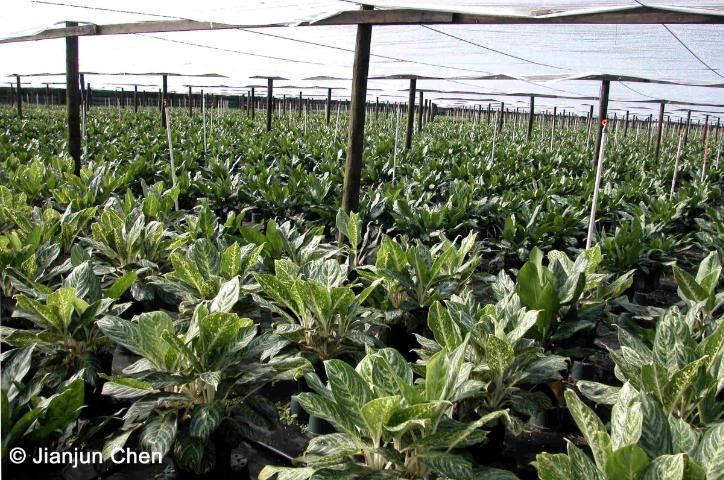
Either controlled-released or water-soluble fertilizers with micronutrients, or a combination of both, can be used for Aglaonema production. The appropriate ratio of N:P2O5:K2O should be 3:1:2. The suggested application rate is 2 to 2.5 lb N per 1,000 sq ft per month or 150 to 200 ppm N using a water-soluble complete fertilizer. A supplemental micronutrient fertilizer may be needed, as most Aglaonema cultivars are prone to develop copper and other microelement deficiencies. Growers are recommended to monitor media soluble salts and pH every 2 or 3 weeks using the pour-through method. If the soluble salts reading is 1 dS/m, the plant will show nutrient deficiency if no fertilizer is provided during growing season; if the soluble salts reading is 2 dS/m, nutrient levels are adequate; and if the reading is 3 dS/m or above, reduce either the rate or frequency of fertilizer application; in some cases, leaching media with water is necessary to reduce soluble salt buildup. Table 2 provides a guide for determining if Aglaonema cultivars are appropriately fertilized based on leaf analysis. It is advisable to stop fertilizing one month before shipment. Media should be kept moist with a container capacity of 50 to 80%.
Shipping and Interior Care
As mentioned previously, Aglaonema cultivars are generally sensitive to chilling temperatures, and air temperatures below 55°F during shipping can damage their leaves. Leaves of some cultivars are prone to mechanical damage during shipping. Thus, shipping boxes should be used to minimize plant movement.
Once plants are placed in interior conditions, only minimal maintenance is required. Aglaonema cultivars can tolerate a light level as low as 25 foot candles but should never be placed in full sun or the leaves will be scorched. A supply of a 20-20-20 water soluble fertilizer solution with a N level at 50 ppm once a month should be adequate under interior conditions. Over-fertilization indoors will cause soluble salts buildup and lead to leaf margin or tip injury. The soil should be kept moist but not saturated. When inflorescences appear (a spathe and spadix in the center of the foliage), it is best to remove them. This aids plant longevity and keeps the plant full. The foliage will get dusty and most interiorscapers either wipe the leaves with a damp, lint-free cloth periodically or use a light spray of leaf polish. Pruning is not necessary. However, dead or yellowing leaves should be removed. Plants should be rotated every 1-2 weeks within the cache pot to maintain symmetry.