
Commercial grape production requires cultivars that have high yield and quality and are also adapted to Florida's unique soils, weather, insects, and disease pressures. Other desired cultivar characteristics depend upon type of market and use. Fresh-fruit markets require a large-sized grape with high sugar content, a pleasing taste, an attractive, thin skin, and a dry scar-end that allows the grapes a minimum of one week of shelf life (https://edis.ifas.ufl.edu/publication/HS100). Wine, juice, and jelly cultivars require consistently high yields. For muscadine cultivars to be economically viable, commercial yields should be at 6 to 8 tons/acre. Berries must have a minimum of 14° Brix at harvest and a favorable sugar-to-acid ratio (https://edis.ifas.ufl.edu/publication/HS100). Color stability and the ability to maintain a good taste in the finished product are also requirements for grape juice or wine. For more information about grape production in Florida, visit https://hos.ifas.ufl.edu/grape/. This article provides a general overview on the commercial fresh market, wine and juice grape cultivars for county and state Extension faculty, grape growers, homeowners and students who are interested in growing grapes in Florida.
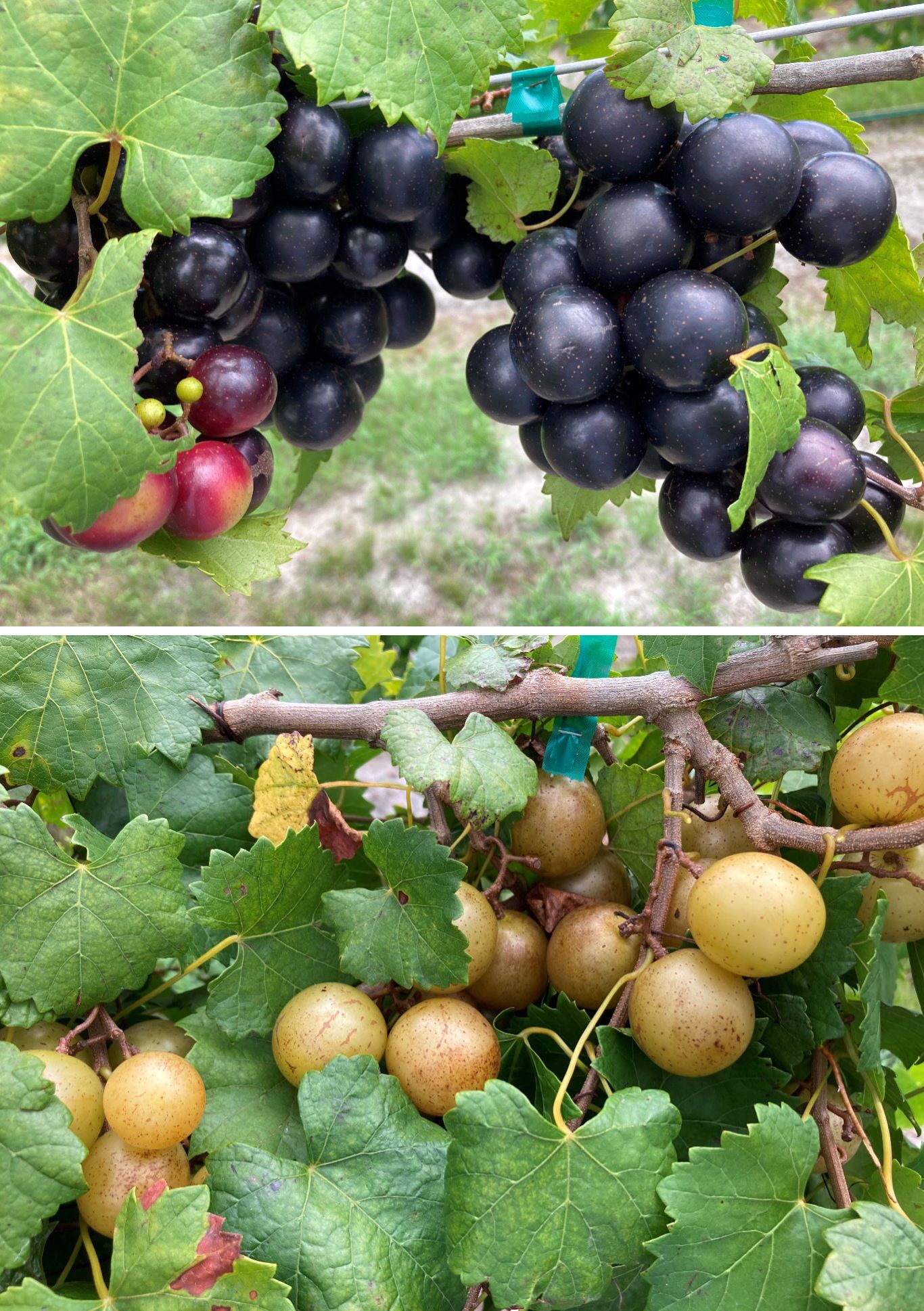
Credit: D. Huff, UF/IFAS
Southern bunch grapes (Vitis sp. hybrids) have been bred for resistance to Pierce's disease (https://edis.ifas.ufl.edu/publication/mg105). Pierce's disease is caused by a bacterium, Xylella fastidiosa. Most southern bunch grapes require a spray program for fungal diseases, especially during wet growing seasons. Perhaps the most serious disease of bunch grapes is anthracnose (Elsinoe ampelina [deBary] Shear). One advantage of bunch grapes is that they are all self-fruitful and do not require pollinizer rows planted next to them.
Muscadine grapes (Vitis rotundifolia) may only need an occasional fungicidal spray or none at all, depending on the rainfall during the growing season and the disease problem (https://edis.ifas.ufl.edu/publication/HS100, https://hos.ifas.ufl.edu/grape/production/diseases-and-pest-insect-control/). A disadvantage of muscadine grapes is that many of the large-fruited cultivars are pistillate, or female, and require self-fruitful companion rows in order to pollinize flowers sufficiently for commercial berry yields (https://edis.ifas.ufl.edu/publication/HS100). Self-fruitful cultivars may often yield 40%–50% more berries than female cultivars. However, many female cultivars tend to have larger berries, which is important for the commercial fresh-fruit market.
Grape root borer is the main insect pest for both bunch and muscadine grapes. Other insects may become minor problems, depending on the season (https://edis.ifas.ufl.edu/publication/HS100). For more detailed information on insect and disease pests of grapes, refer to https://edis.ifas.ufl.edu/publication/HS100 and https://hos.ifas.ufl.edu/grape/production/diseases-and-pest-insect-control/.
Cultivars for processing are listed in Tables 1 and 2. All listed cultivars are self-fruitful. Bunch weights are listed for bunch grapes only. A large bunch grape berry would be equivalent to a small muscadine grape berry.
Cultivars recommended by UF/IFAS for the fresh market are listed in Table 3. The type of pollination is identified for each cultivar to help the producer plan the vineyard rows. Rows of self-fruitful cultivars can be planted next to rows of female cultivars to increase berry yield.
Fresh-market muscadine cultivars recommended for trial plantings are listed in Table 4. Limited trial plantings are recommended before expanding acreage to determine whether those cultivars are adapted to the grower's location. Additional cultivar information can be obtained from the EDIS publication The Muscadine Grape (https://edis.ifas.ufl.edu/publication/HS100).
A successful fresh-market cultivar (https://edis.ifas.ufl.edu/publication/HS100) also must have high consumer preference. 'Fry', the cultivar standard for the fresh-market industry, and recommended cultivars 'Tara' and 'Southern Home' were compared to berries from trial plantings of 'Ison' and 'Nesbitt' in a controlled consumer-panel test (Breman et al. 2007). The ratings ranged from 1, the lowest, to 9, the highest. Results of that test are presented in Table 3. 'Ison' and 'Nesbitt' were rated higher than 'Fry', but the difference was not statistically significant. 'Tara' and 'Southern Home' were rated significantly lower than 'Fry'. Consumer ratings of berry color, sweetness, and flavor were indicators of the overall cultivar-preference score.
Commercial producers for the fresh market might consider consumer preferences before expanding their plantings of any cultivar. Data in Table 5 show that two trial cultivars, 'Ison' and 'Nesbitt', were significantly more preferred by consumers over 'Tara' and 'Southern Home'.
References
Andersen, P. C. 2017. “The Bunch Grape.” EDIS 2017 (3). https://edis.ifas.ufl.edu/publication/mg105
Andersen, P. C., A. Sarkhosh, D. Huff, and J. Breman. 2020. “The Muscadine Grape (Vitis rotundifolia Michx).” EDIS 2020 (6). https://doi.org/10.32473/edis-hs100-2020
Breman, J. W., A. Simonne, R. C. Hochmuth, L. Landrum, M. Taylor, K. Evans, C. Peavy, and D. Goode. 2007. "Quality Characteristics of Selected Muscadine Grape Cultivars Grown in North Florida." Proceedings of the Florida State Horticulture Society 120:8–10.
Cline, W. O. 2010. "2010 Southeast Regional Muscadine Grape Integrated Management Guide." https://grapes.ces.ncsu.edu/wp-content/uploads/2013/09/2010-muscadine-IMG-Draft-2feb2010-_Cline_-2.pdf?fwd=no
Table 1. Commercial wine cultivars.
Table 2. Commercial juice and jelly cultivars.
Table 3. Muscadine cultivars recommended for commercial fresh market.
Table 4. Fresh-market muscadine cultivars for planting on a trial basis.
Table 5. Sensory evaluation results of selected standard and trial fresh-market muscadine grape cultivars.