


Rice Beetle, Dyscinetus morator (Fabricus) (Insecta: Coleoptera: Scarabaeidae)
The Featured Creatures collection provides in-depth profiles of insects, nematodes, arachnids and other organisms relevant to Florida. These profiles are intended for the use of interested laypersons with some knowledge of biology as well as academic audiences.
Introduction
The rice beetle, Dyscinetus morator (Fabricius) (Figure 1), is a common beetle in the eastern half of the United States, and it is one of the most ubiquitous species taken in blacklight traps during much of the year. It appears to be only a minor pest, but it is often brought to the homeowner's attention because of the large quantities found around lights.
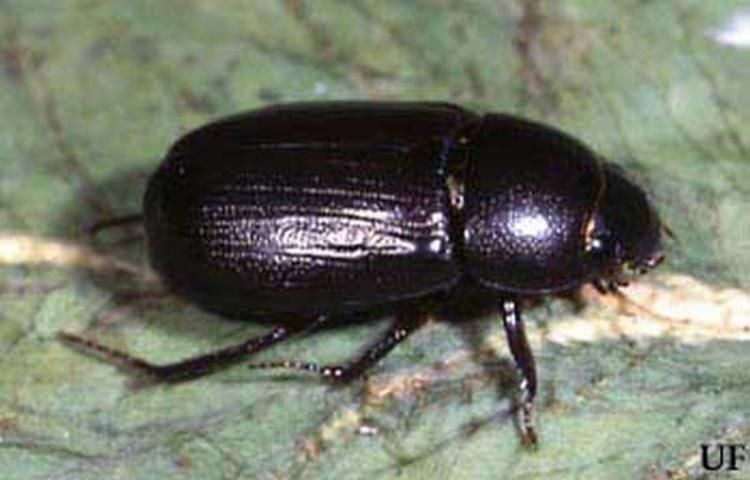
Credit: Paul M. Choate, University of Florida
Taxonomy
Dyscinetus morator is a member of the subfamily Dynastinae and the tribe Cyclocephalini. Arnett and his colleagues (2002) listed 15 species, most of which are found in Central and South America. Casey (1915) divided the genus into two groups based on the presence or absence of sexual dimorphism in the anterior tarsi. Only two species are recognized from the United States by Saylor (1945): D. picipes Burmeister from the southwestern US, Mexico, and the West Indies, and D. morator (F.) from the eastern US west to Texas. The latter was known for many years as D. trachypygus (Burmeister). Both species are highly variable and have several synonyms described primarily by Casey (1915).
Although Saylor synonymized all of Casey's species and implied he had examined the genitalia of the types, Blackwelder and Blackwelder (1948) stated, "Less than a third of the holotypes (or species) have been dissected by anyone. Since Saylor states that 'it is necessary to dissect and compare the male genitalia in order properly to place many of the troublesome variants,' his synonymy must be considered as inconclusive."
Distribution
Dyscinetus morator appears to be found in most of the eastern United States, although it is much more abundant in the south. Present throughout Florida, including the northern Keys, it is found west as far as Texas, Oklahoma, Kansas, and Iowa.
Description
Adult
The length of the adult is 12.7 to 19.1 mm (1/2 to 3/4 inch), while the width is 7.9 to 11.1 mm (5/16 to 7/16 inch). This is an extremely variable species in size, color, and shape. The rice beetle is usually black with a slight green sheen, oblong, subparallel, and moderately convex. Elytral punctures form five costules (ridges), their bordering punctures are nearly parallel, intervals are nearly impunctate, and the remaining punctures are irregular and variable. The male (Figure 2) has the last tarsal segment of the anterior tarsi enlarged and the terminal claws unequal in size, while the female has normal anterior tarsi with the claws equal.
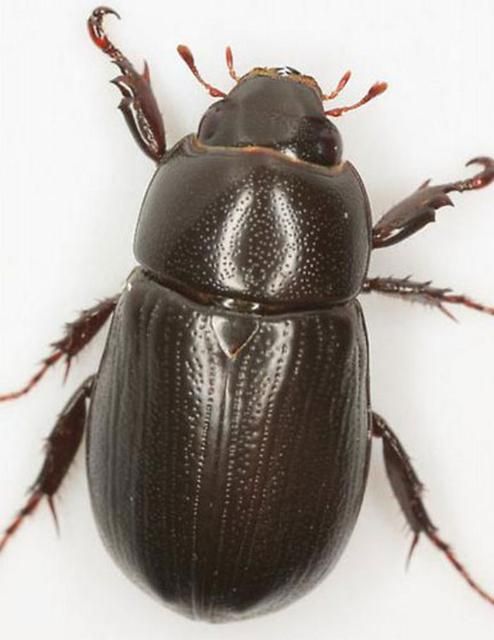
Credit: Mike Quinn. Used with permission.
Larva
The larva is a typical C-shaped scarab "white grub." Detailed descriptions can be found in Phillips and Fox (1924) and Ritcher (1944). The larva is easily distinguished from that of the related genus Euetheola by the absence of a median row of modified bristles on the last ventral segment (raster).
Biology
There have been very few observations on the details of the life history and behavior of this species. Phillips and Fox (1942) indicated that the life history agrees closely with Euetheola rugiceps (the rough-headed corn stalk-borer), but Dyscinetus morator appears to be more tolerant of the products of organic putrefaction (e.g., compost heaps and near pig pens). They found no evidence that it injures corn, but stated, "Farther south they attack rice, and for that reason the species has been given the popular name of 'rice beetle'." I have been unable to find any additional references to this habit in the United States; however, another species, Dyscinetus gagates (Burm.), is known as "escarabajo negro del trigo" in Argentina (Bosq 1945).
The adults are nocturnal and attracted to lights, especially ultraviolet (blacklight) and mercury vapor. They are especially abundant where such lights are placed near natural areas for the first time (e.g., in subdivisions, trailer lots, and newly cleared land). Such a situation occurred at Sebring, Florida, where bushels of the beetles were collected around newly erected light posts in a scrub oak-sand pine area. Once they are attracted to a light, they stay until dawn, when the daylight forces them to look for shelter (usually burrowing under any convenient shelter or into the soil). The same process is repeated each night, creating large numbers of beetles around a single light post. Buss (2006) recorded it as the most abundant species of phytophagous scarabs caught in light traps in 2002 in two widely distant locations in Florida.
There appear to be two generations per year in Florida, at least in the southern portion, judging from the large adult population peaks in the spring (March) and fall (November). Hays (1925) stated, "Others of the subfamily known to require the same, or approximately the same time [one year], are ... Dyscinetus trachypygus, Dyscinetus barbatus, and Euetheola rugiceps." Smyth (1915) studied the life cycles of two species (D. trachypygus and D. barbatus) in Puerto Rico. (Although there is a possibility of misidentification, D. morator (=trachypygus) is not now thought to be in the West Indies). Smyth found the average complete cycle from egg to adult was 104 and 144 days, respectively.
Economic Importance
In Florida, commercial growers consider it a pest of caladium bulbs in the field. Price and Kring (1991) observed adults feeding on early-season leaf buds and petioles in field and greenhouse conditions. As the caladium tubers enlarged in July and August, the adult chewed holes in the tubers, which then often rotted. Foster et al. (1986) verified it as a pest of carrots and radishes.
Scammell (1917) listed it, along with two other scarabs, as a pest in the larval stage of cranberries in New England. Larvae also feed on rice, pangola grass pastures, crabgrass, water hyacinth, caladium bulbs, and azaleas (Staines 1990).
Management
Cultural and Mechanical Control
Flooding has been recommended as a possible control in certain marshy situations where the crop schedule will permit. Thousands of the beetles can be collected at lights, and it has been recommended that traps be used in conjunction with these lights. A pan or bucket of soapy water suspended below a light has been used for control of May beetles and relatives. This system, with improved ultraviolet as an attractant, is still very effective in collecting large numbers of beetles.
Biological Control
No effective parasites or predators are known, although Moss and Funk (1965) described a new genus and species of mite, Dyscinetonyssus hystricosus, from beneath the elytra of Dyscinetus from Highlands Hammock State Park, Florida, collected in April 1962. They suggest that it is parasitic, although no behavioral observations were made on living material. Natural controls are not known, although milky disease, as used for Japanese beetle control, is a possibility.
Chemical Control
There are no specific insecticide recommendations for control of this species. Price and Kring (1991) ran a series of laboratory tests using 10 insecticides, with no insecticide killing more than 72.5% of the adults.
Selected References
Arnett RH, Thomas MC, Skelly PE, Frank JH 2002. American Beetles: Polyphaga: Scarabaeoidea through Curculionoidea. CRC Press, Boca Raton, USA. 861.
Blackwelder RE, Blackwelder RM. 1948. Fifth supplement, 1939 to 1947 (inclusive), to the Leng Catalogue of Coleoptera of America, North of Mexico. John D. Sherman, Jr., Mt. Vernon, USA. 87 pp.
Bosq JM. 1945. El "escarabajo negro del trigo" [Dyscinetus gagates] puede ser dañino a la silvi-cultura. Argentina Min. de Agr. Almanaque (1945) 20: 65-67.
Buss EA. 2006. Flight activity and relative abundance of phytophagous scarabs (Coleoptera: Scarabaeoidea) from two locations in Florida. Florida Entomologist 89: 32-40.
Casey JL. 1915. A Review of the American Species of Rutelinae, Dynastinae and Cetoniinae, pp. 1-394. In Memoirs of the Coleoptera VI. New Era Printing Co., Lancaster, USA. 460 pp.
Davis JJ. 1916. A progress report on white grub investigations. Journal of Economic Entomology 9: 261-281.
Foster RE, Smith JP, Cherry RH, Hall DG. 1986. Scientific Notes: Dyscinetus morator (Coleoptera: Scarabaeidae) as a pest of carrots and radishes in Florida. Florida Entomologist 69: 431-432.
Hayes WP. 1925. A comparative study of the history of certain phytophagous scarabaeid beetles. Kansas Agricultural Experiment Station Technical Bulletin 16: 1-146.
Moss WW, Funk RC. 1965. Studies on the developmental chaetotaxy of Dyscinetonyssus hystricosus n.g., n.sp. (Acari: Mesostigmata: Laelaptoidea). Acarologia 7: 235-267.
Phillips WJ, Fox H. 1924. The rough-headed corn stalk-beetle. U.S. Department of Agriculture Bulletin 1267: 1-34.
Price JF, Kring JB. 1991. Dyscinetus morator (Coleoptera: Scarabaeidae) flight activity, food plant acceptance, damage and control in Caladium. Florida Entomologist 74: 415-421.
Ritcher PO. 1944. Dynastinae of North America with descriptions of the larvae and keys to the genera and species (Coleoptera: Scarabaeidae). Kentucky Agricultural Experiment Station Bulletin 467: 1-56.
Saylor LW. 1945. Synoptic revision of the United States scarab beetles of the subfamily Dynastinae, No. 1, tribe Cyclocephalini. Journal of Washington Academy of Science 35: 378-386.
Scammell HB. 1917. Cranberry insect problems and suggestions for solving them. USDA Farmers' Bulletin 860: 1-42.
Smyth EG. 1915. Report of the south coast laboratory. 4th Rept. Board Comm. Agr. Puerto Rico (July 1914-June 1915): 45-50.
Staines Jr. CL. 1990. Scientific Note: Dyscinetus morator (Coleoptera: Scarabaeidae) feeding on roots of azaleas (Rhododendron spp.). Entomological News 10: p. 98.