
The Featured Creatures collection provides in-depth profiles of insects, nematodes, arachnids and other organisms relevant to Florida. These profiles are intended for the use of interested laypersons with some knowledge of biology as well as academic audiences.
Introduction
The olive fruit fly, Bactrocera oleae (Rossi), is a widespread, monophagous pest that feeds exclusively on wild and cultivated olives (Daane and Johnson 2010). Genetic studies suggest that this fruit fly is native to Africa, where its original host plants were wild precursors of the cultivated olive (Nardi et al. 2005). The widespread distribution of this pest is likely due to the geographical spread of olive growing operations.
Distribution
The olive fruit fly is found almost anywhere cultivated olives are grown or wild olives naturally occur. The olive fruit fly has been reported in Africa, the Canary Islands, the Middle East, China, California, Mexico, and Central America (Daane and Johnson 2010; Nardi et al. 2005). As of 2015, it has not been reported as established in Georgia or Florida.
Description
Eggs
The female fly deposits an egg inside the developing olive fruit, so it is not visible unless the fruit is cut open. Females typically deposit one egg per olive (Ant et al. 2012) on smaller fruit (< 1 cm3) (Yokoyana et al. 2006). Newly deposited eggs of the olive fruit fly are opaque and creamy white in color. Eggs are about 0.74 mm long and 0.21 mm wide (Genc 2014). The shape is typical of tephritid fruit fly eggs—elongated and somewhat curved. They maintain this appearance until hatch time, when the first instar larva is visible through the chorion (the membrane surrounding the egg) (Genc 2014).
Larvae
Larvae emerge from the anterior end of the egg and move deep within the olive fruit to feed (Hanife 2014). As with the egg, the larva will not be visible until the fruit is cut open (Figure 1). Larvae are typical tephritid fruit fly maggots: small (5–6 mm long, 1.5 mm wide), elongated, and slightly tapered at each end (Phillips 1946).
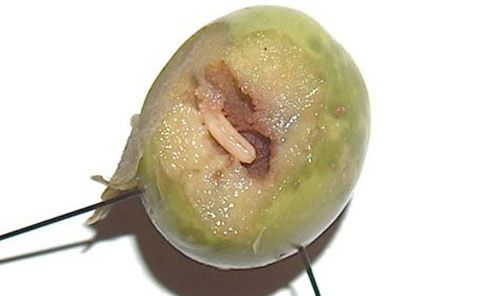
Credit: Giancarlo Dessì, Istituto Professionale Statale per l'Agricoltura e l'Ambiente "Cettolini" di Cagliari
Pupae
Pupation usually occurs within the olive fruit but may occur in the soil depending on the time of year and number of generations. Pupation is more likely to take place in the soil at the end of the season in areas where there are many generations per year (Rice 2000).
Adult
The adult olive fruit fly is very small—about 5 mm long with a wingspan of 10 mm (Weems 1966). Wings are largely transparent, with a dark brownish-black spot at the tip of each wing. The thorax and abdomen of the adult fly are mostly dark-brown to black, with yellow-brown markings and short, silvery hairs (Weems 1966) (Figure 2). The female has a serrated ovipositor that is used to pierce the skin of fruits during oviposition.
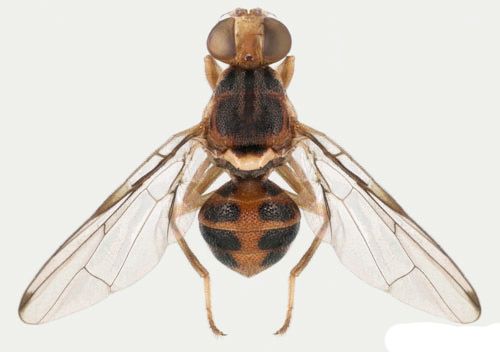
Credit: Natasha Wright, Florida Department of Agriculture and Consumer Services
Life Cycle and Biology
The female deposits eggs inside developing olives, using her serrated ovipositor to make a cut in the olive skin. Eggs hatch two to three days later and the larvae begin feeding on the olive flesh (Rice 2000; Nardi et al. 2003) (Figure 1). The larval stage lasts around 20 days (Rice 2000). Pupation can occur within the olive fruit or in the soil. Pupation in the soil is more likely in winter months and this stage can last up to six months; pupation within the olive fruits lasts around 8-10 days (Vossen et al. 2006). Unlike the larvae, adults do not feed on olives, but on nutrient-rich substances such as honeydew and bird droppings (Rice 2000). The female olive fruit fly has been reported to lay as many as 500 eggs in her lifetime of less than six months (Rice 2000). In warm areas with abundant host plants, like California, the olive fruit fly may produce up to five or six generations per year (Rice 2000).
Hosts
Larvae of the olive fruit fly feeds only on the fruit of wild and cultivated olive trees (Olea spp.). Susceptible wild species include Olea verrucosa, Olea chrysophylla, and Olea europaea, the latter of which can be found in both cultivated groves and in the wild (Daane and Johnson 2010). Female flies have shown oviposition preference for larger table olive species (Rice 2000).
Damage
The oviposition activity of the females as well as larval feeding are responsible for the destruction of olive fruits. Cuts in the olive skin from the ovipositor and the larval feeding on the olive flesh can cause olive fruits to dry out and fall from trees (Nardi et al. 2003; Weems 1966) (Figure 1). In addition, the oviposition behavior of the olive fruit fly increases the fruit's susceptibility to bacterial and fungal pathogens (Delkash-Roudsari et al. 2014). Infested olives completely lose their market value for table consumption and oil production (Rice 2000). Damage thresholds for the olive fruit fly vary by region but are typically low. In California, for example, the damage threshold in commercial orchards is 0% (Vossen et al. 2006).
Management
Cultural Control
Field sanitation is a critical step in preventing outbreaks of the olive fruit fly. Any fruits that remain in the field (on the tree or on the soil) may contain eggs or larvae, contributing to the olive fruit fly population. Bait sprays are another common cultural control technique for the olive fruit fly, wherein attractant sprays containing insecticide are applied to the field in concentrated areas. This method is effective at eliminating female olive fruit flies, which are attracted to ammonia-containing proteins when they are preparing for egg production (Varikou et al. 2015). Mass trapping is another common technique. This method also involves chemical attractants like those used in the spray method but traps the adult females for removal (Varikou et al. 2015). Bait spraying and mass trapping are both effective in controlling olive fruit fly populations, though mass trapping may be preferred because it does not require chemical application to the crop plants themselves.
Biological Control
Many insects have been investigated as potential biological control agents of the olive fruit fly. Daane and Johnson (2010) recommended a small group of braconid wasps that parasitize the olive fruit fly in its native range. Braconid species shown to parasitize olive fruit fly include Psyttalia lounsburyi, Psyttalia concolor, Psyttalia ponerophaga, Utetes africanus, and Bracon celer, with parasitoid abundance and efficacy varying over different geographic locations. Psyttalia concolor (Figure 3) has shown mixed results as a biological control organism following releases aimed to control the Mediterranean fruit fly, Ceratitis capitata (Wiedemann) (commonly known as the Medfly) in Europe in the 1950s (Nardi et al. 2003).
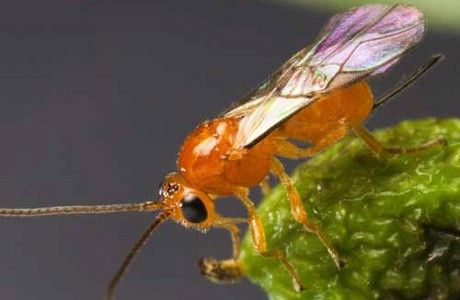
Credit: Peggy Greb, USDA
Many other parasitoid wasps are found in regions where the olive fruit fly is considered a pest, but they are often not sufficiently abundant to provide control. Common beneficial insects like ladybird beetles (Coccinellidae) and lacewings (Chrysopidae) are ineffective in controlling the olive fruit fly because these insects prey upon the immature stages of pests, which, in this case, are sequestered within developing olives (Nardi et al. 2003).
Sterile Insect Technique
Sterile insect releases have been proposed as an effective and environmentally-friendly method of control for the olive fruit fly. This control method involves the rearing and release of large numbers of sterilized male fruit flies. When these males mate with wild female flies, viable eggs cannot be produced. Thus, the next generation of pest flies is greatly reduced. Over time, this could eradicate the pest population. Sterile insect releases have many benefits; this method is species-specific, environmentally sound, and relatively speedy. Drawbacks to this technique lie in the initial set up of the program, such as guaranteeing a place to rear the flies, choosing a reliable sterilization method, and timing the release of the flies (Ant et al. 2012). Also, females laying sterile eggs will still damage fruit with their ovipositors. This technique has been a successful management strategy for many destructive pests, like the Mediterranean fruit fly, Ceratitis capitata (Wiedemann), which can cause widespread damage due to its oviposition behavior and relatively broad host range.
Selected References
Ant T, Koukidou M, Rempoulakis P, Gong HF, Economopoulos A, Vontas J, Alphey L. 2012. Control of the olive fruit fly using genetics-enhanced sterile insect technique. BioMed Central Biology 10: 1-8. (14 February 2019)
Corrado G, Alagna F, Rocco M, Renzone G, Varricchio P, Coppola V, Coppola M, Garonna A, Baldoni L, Scaloni A, Rao R. 2012. Molecular interactions between the olive and the fruit fly Bactrocera oleae. BioMed Central Plant Biology 12: 1-17. (14 February 2019)
Daane KM, Johnson MW. 2010. Olive fruit fly: Managing an ancient pest in modern times. Annual Review of Entomology 55: 151-169.
Delkash-Roudsari S, Zibaee A, Abbci-Mozhdehi MR. 2014. Digestive proteolytic activity in larvae and adults of Bactrocera oleae Gmelin (Diptera: Tephritidae). Journal of Asia-Pacific Entomology 17: 483-491.
Genc H. 2014. Embryonic development of the olive fruit fly, Bactrocera oleae Rossi (Diptera: Tephritidae), in vivo. Turkish Journal of Zoology 38: 598-602. (14 February 2019)
Hoelmer KA, Kirk AA, Pickett CH. 2007. Ecology of the olive fruit fly and its parasitoids in wild olives in Southern Africa. Journal of Insect Science 7: 9-10.
Nardi F, Carapelli A, Dallai R, Frati F. 2003. The mitochondrial genome of the olive fly Bactrocera oleae: two haplotypes from distant geographical locations. Insect Molecular Biology 12: 605-611.
Nardi F, Carapelli A, Dallai R, Roderick GK, Frati F. 2005. Population structure and colonization history of the olive fly, Bactrocera oleae (Diptera, Tephritidae). Molecular Ecology 14: 2729-2738.
Perri E, Iannotta N, Muzzalupo I, Rizzuti B, Russo A, Caravita MA, Pellegrino M, Parise A, Tucci P. 2007. Kaolin protects olive fruits from Bactrocera oleae Gmelin infestations unaffecting olive oil quality. Bulletin OILB/SROP 30: 153.
Phillips VT. 1946. The biology and identification of trypetid larvae (Diptera: Trypetidae). Memoirs of the American Entomological Society 12: 1-161.
Rice R. (2000). Bionomics of the olive fruit fly, Bactrocera (Dacus) oleae. University of California Plant Protection Quarterly 10: 1-5. (14 February 2019)
Varikou K, Garantonakis N, Birouraki A. 2015. Residual attractiveness of various bait spray solutions to Bactrocera oleae. Crop Protection 68: 60-66.
Vossen P, Varela L, Devarenne A. (2006). Olive fruit fly. University of California Cooperative Extension—Sonoma County. (14 February 2019)
Yokoyama VY, Miller GT, Stewart-Leslie J, Rice RE, Phillips PA. 2006. Olive fruit fly (Diptera: Tephritidae) populations in relation to region, trap type, season, and availability of fruit. Journal of Economic Entomology 99: 2072-2079. (February 2016)