


Japanese Orange Fly, Bactrocera tsuneonis (Miyake) (Insecta: Diptera: Tephritidae)
The Featured Creatures collection provides in-depth profiles of insects, nematodes, arachnids and other organisms relevant to Florida. These profiles are intended for the use of interested laypersons with some knowledge of biology as well as academic audiences.
Introduction
The Japanese orange fly, Bactrocera tsuneonis (Miyake), is one of the most important pests of citrus in Japan. Extensive outbreaks have occurred in some commercial citrus areas since 1947, when up to 60 percent or more of the fruits were infested. This fruit fly has also been reported to have infested 50 percent of the oranges at Kiangtsin, in the Szechwan Province of southwestern China, during 1940.There have been no interceptions of the Japanese orange fly in the United States, probably due in a large part to the protection provided by a US embargo of long standing against citrus from the orient.
There have been some efforts recently to effect the removal of this embargo in order that citrus from Japan might be exported to the US. If this were to be done, the danger of introducing the Japanese orange fly into the US would be greatly increased.
Synonyms
Tetradacus tsuneonis (Miyyake)
Dacus chenia Chen
Dacus tsuneonis Miyake
Distribution
This species is found in Japan (Kyushu, Amami-O-shima Island and Ryukyu Islands), southwestern China (Szechwan and Kweichow Provinces) and probably Taiwan (White and Elson-Harris 1994).
Description
Immature stages are similar in appearance to those of other Bactrocera. Each of the two anterior spiracles of mature larvae bears approximately 34 tubules. Adults are larger than those of most other species of Bactrocera. The adult female is approximately 11 mm long, excluding the ovipositor, with a wing expanse of about 10 mm; the male is slightly smaller. The head is predominately yellow, with a black ocellar triangle; antennae ochraceous, arista piceous, with yellow base. The thorax is densely punctate, predominately ochraceous, with short, yellowish pubescence; a median longitudinal Y-shaped purplish testaceous streak on dorsum, terminating posteriorly in center of scutum; a pair of rather faint submedian, somewhat wavy, purplish testaceous lines, interrupted at transverse suture and united posteriorly with posterior branches of Y-shaped streak, a yellowish patch on each humeral callus; scutellum yellowish with two bristles. The halteres are ochraceous. The legs are ochraceous, with yellow pubescence. The abdomen is densely punctate, bright ochraceous above, yellowish beneath, and brownish at end, with a short, yellowish pubescence; a longitudinal median black, rather broad streak extends the length of the abdomen, or almost so; transverse bands present on the third, fourth, and sometimes the fifth segment, band on third segment cross-marking longitudinal streak.
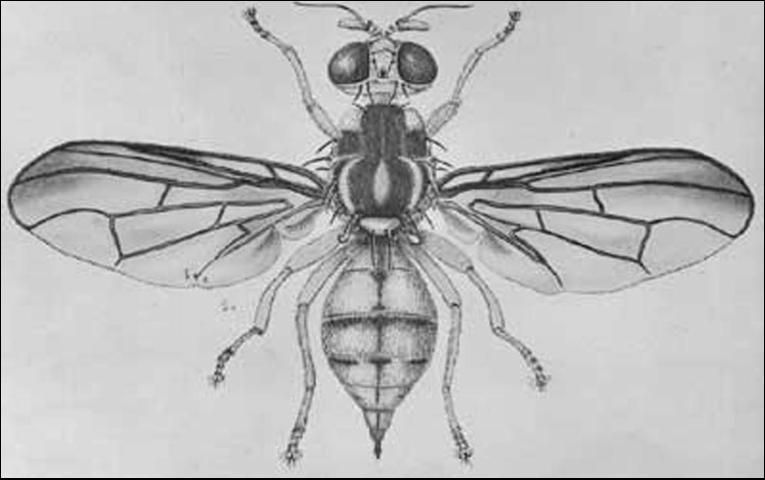
Credit: Division of Plant Industry
Life Cycle
In Japan, there appears to be only one generation per year. There, adult emergence begins in early June and lasts through mid-July. Adults may be found occasionally as late as October. The ratio of males to females is approximately one to one. The preoviposition period of the female is 17 to 25 days. Oviposition occurs primarily in July and August, and eggs are laid under the rind. Thick-skinned fruit seldom are attacked as the ovipositor is not long enough to reach the pulp. Typically a single oviposition puncture is made in a fruit; from two to six eggs are deposited in a puncture from which only one larva emerges.
Larvae appear about the first of October and devour the contents of one carpel after another, from two to ten carpels being infested by a single maggot. By early November, the larvae are mature, and about this time the infested fruit drops to the ground. Pupation occurs in the top two inches of soil. Occasionally, larvae drop to the ground to pupate while the fruit is still on the tree.
Adults feed on honeydew excreted by aphids, coccids, and psyllids; this appears to be necessary for health, longevity, and egg production during the preoviposition period. Frequent copulation apparently is necessary, as this occurs after each batch of eggs has been deposited.
Hosts
This species infests Citrus, including orange, grapefruit, and mandarin orange.
Attractants
Males are not known to be attracted to any synthetic lure (White and Elson-Harris 1994).
Selected References
Miyake T. 1919. Imperial Cent. Agricultural Experiment Station Bulletin (Tokyo) 2: 85–165, Illustrations in English. 1919. Review of Applied Entomology 7: 238–239.
Chen SH. 1940. Sinensia 11: 131–135; 1941. Review of Applied Entomology 29: 524.
Chen SH. 1940. Senensia 11: 577–587; 1942. Review of Applied Entomology 30: 71.
Sun CY, I-Lung D, Liao Y-M. 1958. Preliminary studies on the Chinese citrus fly, T. citri Chen. Acta Oecon, Ent. Sinica (Peking) 1: 175–187. In Chinese, English Summary.
Yasumatsu, K, Nagatomi A. 1959. Kyushu University Faculty of Agr. Sci. Bulletin 17: 129–146. In Japanese, English Summary.
USDA, Survey and Detection Operations, Plant Pest Control Division, Agricultural Research Service. Anonymous. 1961. Insects not known to occur in the United States. Cooperative Economic Insect Report 11-1-36. Japanese Orange Fly (Dacus tsuneonis Miyake): 29–31.
White IM, Elson-Harris MM. 1994. Fruit Flies of Economic Significance: Their Identification and Bionomics. CAB International. Oxon, UK. 601 pp.