


Gall Wasps, Callirhytis quercusclaviger (Ashmead) and Callirhytis cornigera (Osten Sacken) (Insecta: Hymenoptera: Cynipidae)
The Featured Creatures collection provides in-depth profiles of insects, nematodes, arachnids and other organisms relevant to Florida. These profiles are intended for the use of interested laypersons with some knowledge of biology as well as academic audiences.
Introduction
Callirhytis quercusclaviger (Ashmead) causes spine-bearing potato gall on laurel oak, Quercus laurifolia Michx., in Florida (Ashmead 1881). The horned oak gall, caused by Callirhytis cornigera (Osten Sacken), occurs on water oak, Quercus nigra L., as well as several other Quercus species (Drooz 1985; Osten Sacken 1862).
Credit: Lyle J. Buss, UF/IFAS
Generally, individual trees or small groups of trees become slightly to moderately infested by these Callirhytis spp. Widespread infestations are not common (Kinsey 1935). However, severe gall wasp infestations have been observed in several Florida counties. Extremely high numbers of twig galls of Callirhytis quercusclaviger have occurred on thousands of laurel oaks in several locations. These infestations have affected young to mature trees in woodlands and residential areas. The overabundance of twig galls has resulted in notable levels of branch dieback, crown thinning, and tree mortality.
Distribution
Specific records and observations are from Alachua, Duval, Lake, Leon, Marion, Orange, Polk, Sumter, Suwannee, and Wakulla counties. However, it is likely both Callirhytis spp. occur throughout the ranges of their respective host oaks in Florida. Both species also occur from Georgia north to southern Canada (Johnson and Lyon 1994).
Identification
Galls
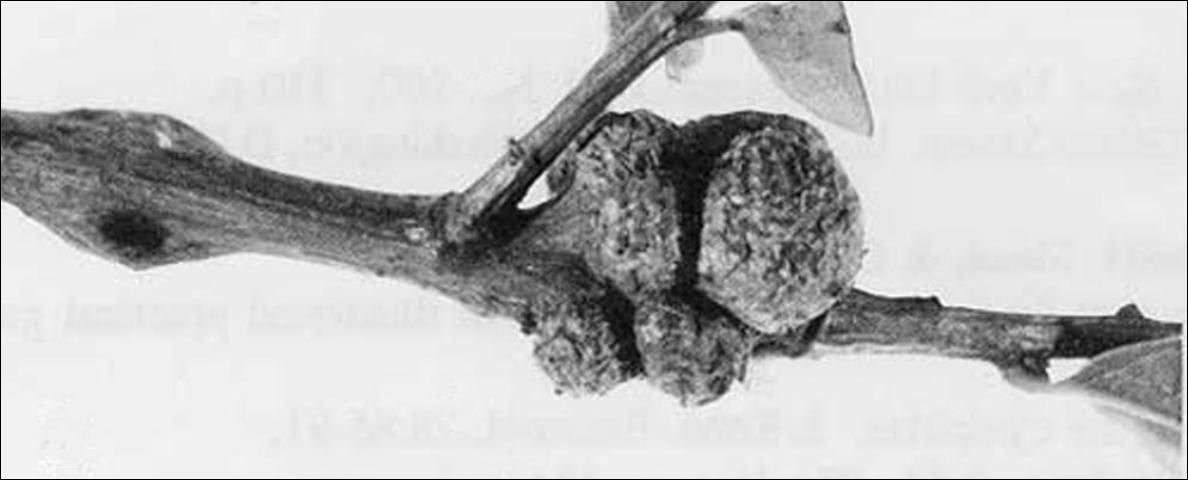
Mature twig galls remain as individual swellings or form massive compound galls more than 5 cm in diameter and up to 20 cm long (Osten Sacken 1862; Taft and Bissing 1988).
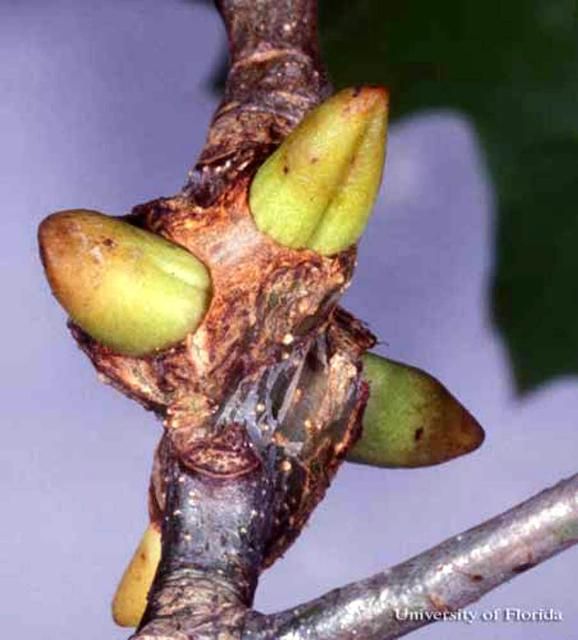
Young galls are slight, tumor-like swellings of periderm tissue. Bark color of young galls is a greenish-brown and bark surfaces are smooth except for protruding lenticels (Taft and Bissing 1988).
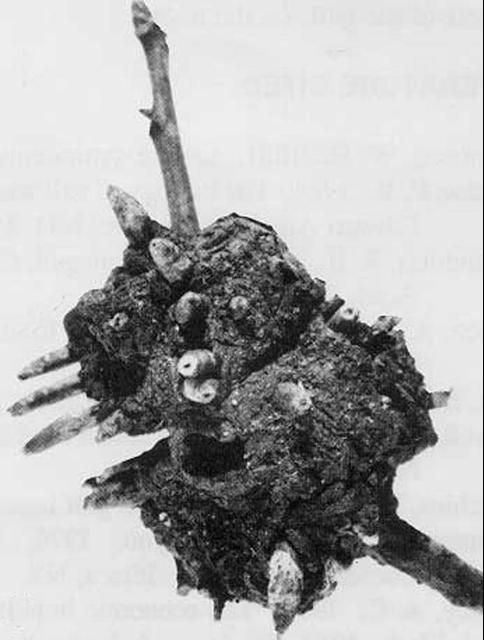
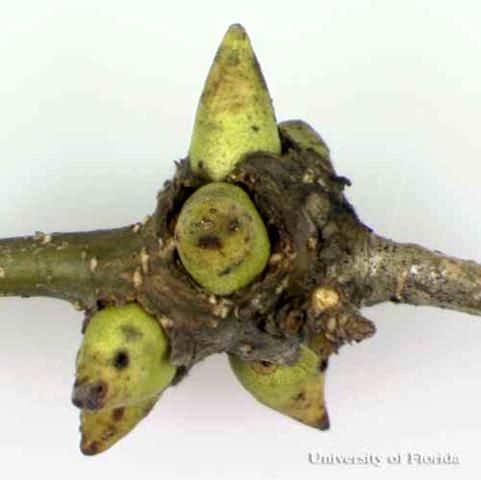
If sufficiently mature, twig galls exhibit spines or horns. Older galls become very woody, discolored, and horns will be absent (Ashmead 1881). Galls are pathologically developed tissues. Cell hypertrophy (over-growth) and hyperplasia (cell proliferation) result in gall formation (Mani 1964).
Credit: Jeffery Lotz, DPI
Credit: Jeffery Lotz, DPI
Credit: Lyle J. Buss, University of Florida
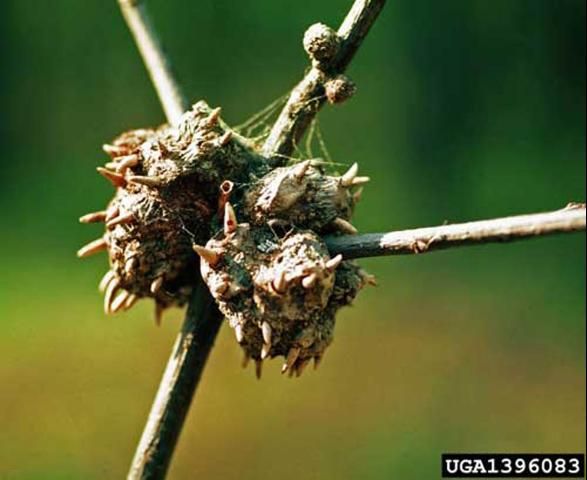
Credit: USDA Forest Service, www.forestryimages.org
Adult Wasp
In C. quercusclaviger, the female body is generally reddish-brown with the abdomen much deeper than long and brownish-black on the dorsum. The female's ovipositor projects at a 45-degree angle. The wings are yellowish and about 2 mm long (Ashmead 1881). C. cornigera is similar in appearance.
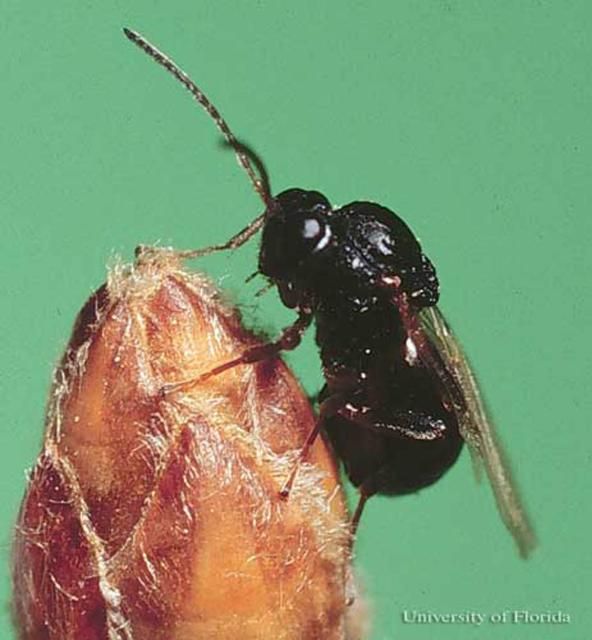
Credit: Eileen Buss, University of Florida
Biology
Little information is available for Callirhytis quercusclaviger. The apparent life cycle of Callirhytis cornigera is complicated. In New York, parthenogenic female wasps emerge from twig galls in May and June. These females oviposit eggs on veins on the underside of leaves. Small vein galls appear from late May through June. Male and female wasps emerge from the vein galls in early July. Mated females oviposit eggs in young oak twigs. Twig galls appear the following spring. Two or more years are required for the immature gall wasps to complete development in the twig galls.
The galls provide shelter, protection, and food for the immature wasps (Hutchins 1969). Inside a gall, the larvae are surrounded by tissues rich in nutrients (Askew 1984). As the larvae reach maturity small spines or horns become evident on the gall. An adult wasp emerges from each horn (Johnson and Lyon 1976).
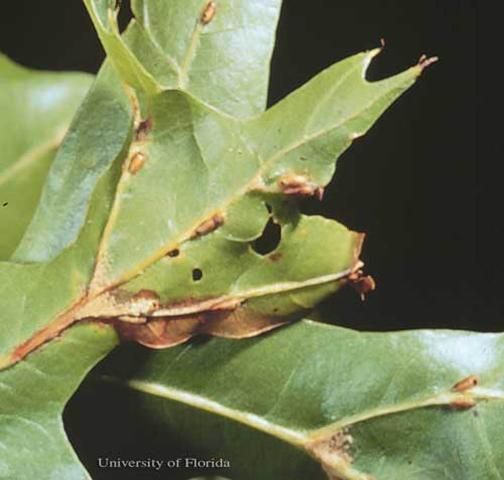
Credit: Eileen Buss, University of Florida
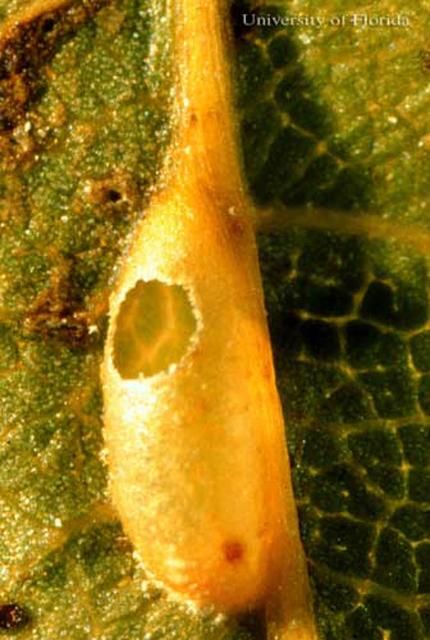
Credit: Eileen Buss, UF/IFAS
Economic Importance
Twig galls can cause severe injury, loss of growth, and tree mortality (Johnson and Lyon 1976; Drooz 1985; Cummings 1976). The horned oak gall apparently becomes epidemic periodically in some areas and has killed thousands of pin oak, Quercus palustris Muench (Taft and Bissing 1988). Twig galls result in disruption of the vascular tissues through the galled area. Normal transportation of photosynthates, water, and minerals becomes severely limited to and from leaves (Taft and Bissing 1988). In Florida, mature laurel oak trees in residential areas have succumbed to severe gall wasp infestations. Severe branch dieback and crown thinning are commonly observed on many laurel oaks.
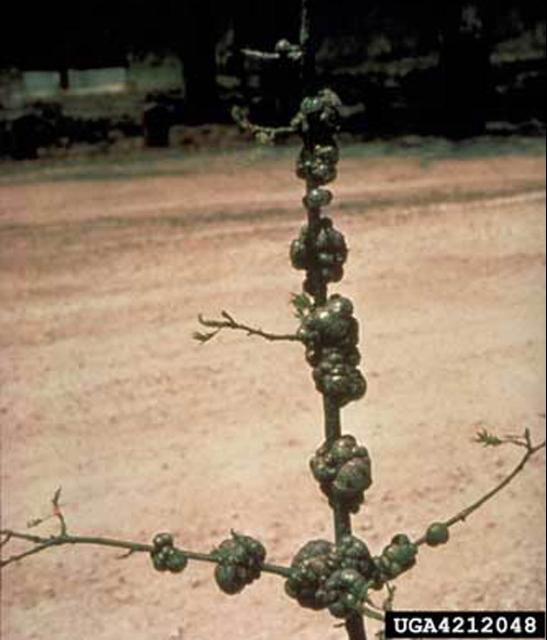
Credit: Minnesota Department of Natural Resources, www.forestryimages.org
Johnson and Lyon (1994) report that Callirhytis cornigera attacks the twigs of pin, scrub, black, blackjack, and laurel oak from Georgia to southern Canada, while Callirhytis quercusclaviger infests twigs of scarlet, red, pin, and black oak.
Survey
Symptoms of infestation include branches exhibiting knotty, oval or spherical enlargements (galls) varying in size with horn-like projections. Galls may be present on all branches.
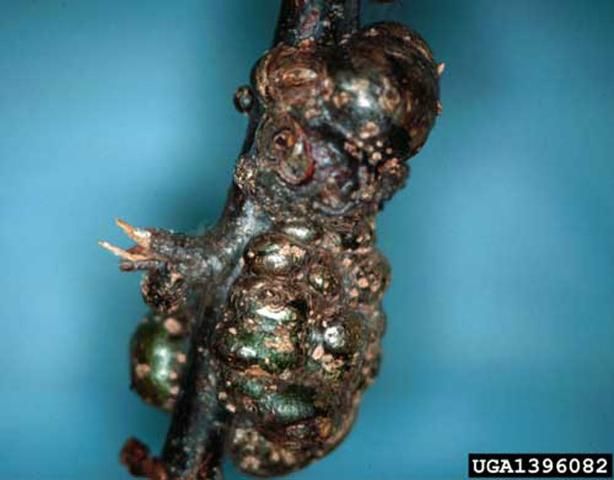
Credit: USDA Forest Service, www.forestryimages.org
Management
Management of these gall wasps is difficult. Prune infested branches where possible. Systemic insecticides may prove somewhat useful. In several large infestations investigated in Florida, the common variables were extremely high densities of laurel oak growing on sandy soils that are deeply drained, strongly acidic, and with low fertility (e.g., Alpin and Blanton soils). The high oak density apparently resulted from exclusion of fire because laurel oak is very susceptible to fire (Fowells 1965). Today, laurel oaks are often considered weeds due to their success in establishment and resulting densities. The stress of an ongoing, multi-year drought cycle may exacerbate the effects of the galls on the trees.
Selected References
Ashmead WH. 1881. On the cynipidous galls of Florida. American Entomological Society Transactions 9: xxiv-xxviii.
Askew RR. 1984. The biology of gall wasps, Chapter 8. In Ananthakrishnan TN. (ed.). Biology of gall insects. Edward Arnold, Baltimore, MD 8: 223–271.
Cummings RB. 1976. Horned oak gall, Callirhytis punctata (O.S.) on pin oak in LaPorte Co., Ind. Proceedings of the Indiana Academy of Science 1976: 230.
Drooz AT. 1985. Insects of Eastern Forests. USDA Forest Serv., Washington, D.C. Miscellaneous Publication No. 1426. 608 p.
Felt E. 1917. Key to American insect galls. New York State Museum Bulletin No. 200. 310 p.
Fowell HA. 1965. Silvics of forest trees of the United States. USDA Forest Service, Washington, D.C. Agricultural Handbook No. 271: 581–583.
Hutchins RE. 1969. Galls and Gall Insects. Dodd, Mead, & Co., NY. 128 p.
Johnson WT, Lyon HH. 1976. Insects That Feed on Trees and Shrubs. An illustrated practical guide. Cornell University. Press, Ithaca, NY. 463 p.
Johnson WT, Lyon HH. 1994. Insects That Feed on Trees and Shrubs. An illustrated practical guide. 2nd ed. rev. Cornell University. Press, Ithaca, NY. 560 p.
Kinsey AC. 1935. The economic importance of the cynipidae. Journal of Economic Entomology 28: 86–91.
Mani MS. 1964. Ecology of Plant Galls. Dr. W. Junk, Publ. The Hague. 434 p.
Osten Sacken R. 1862. Additions and corrections to the paper entitled: "On the Cynipidae of the North American oaks and their galls." Proceedings of the Entomological Society of Philadelphia. 1: 241–259.
Taft JB, Bissing DR. 1988. Developmental anatomy of the horned oak gall induced by Callirhytis cornigera onQuercus palustris (pin oak). American Journal of Botany 75: 26–36.