
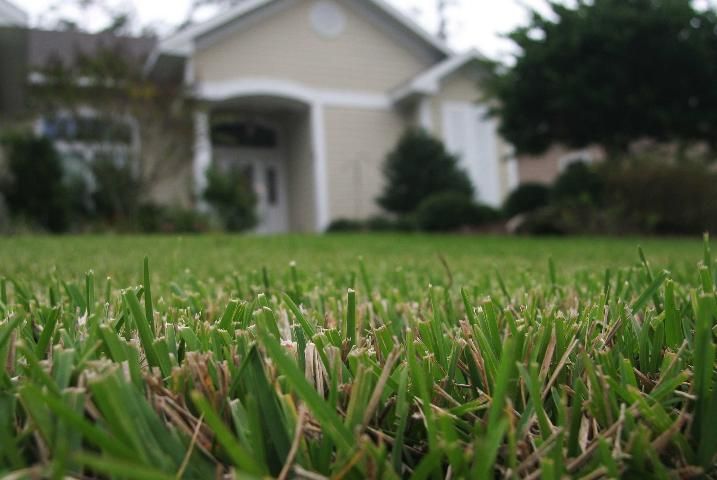
Credit: UF\IFAS photo Thomas Wright 01832S
The following is a general key that may help in making a preliminary diagnosis of landscape turfgrass. Additional diseases not listed are commonly diagnosed from golf course turfgrass. Please see the linked documents for more specific diagnostic characteristics, and information concerning the time of year the disease is most likely to occur. In many cases, the key will help narrow down the potential disease problem you face. Read more information by clicking the links in the key below to see EDIS publications on these diseases. If you cannot narrow down the potential problem using the key, consider consulting your local county extension office, or submit a sample to an Extension Plant Diagnostic Clinic.
Diagnostic Features and Control of Turfgrass Diseases
Each linked EDIS publication in the key above will have the following sections. The types of information given in each section is explained below.
Disease: This is the correct name for the problem.
Pathogen: This is the Latin name of the fungus that causes the disease. The first word is the genus name, and the second word is the species name.
Turfgrasses Affected: This is a list of the turfgrasses that are normally affected by this disease. If one or two turfgrass species are more likely to be affected than others, that is indicated.
Occurrence: The exact time when a disease will occur is dependent on the environment. The time of year when the disease is most likely to occur is indicated. Since there are distinct climatic variations in Florida (north vs. south; coastal vs. inland), these variations should be considered when diagnosing a disease problem. The situations (ex: rain or fog) or stresses (ex: nitrogen deficiency) that will cause the disease to occur or make it worse are stated.
Symptoms/Signs: This section describes the appearance of the turf when diseased (symptoms) and what if any fungal structures, molds, or other evidence of the pathogen (signs) may be present.
Cultural Controls: This section describes the cultural controls that can be employed to prevent the disease or to help the turfgrass recover from the disease. Cultural controls require that everyone involved with management of the turfgrass work together to solve or prevent the disease problem. Refer to the cultural control sections of the specific EDIS publication for the disease being managed or consult other resources like the Florida Lawn Handbook for more details. Specific cultural practices such as nutrition or water management differ between some diseases, so an accurate diagnosis is important.
Chemical Controls: Chemical control treatments (fungicides) are listed as the common name only in many EDIS publications. Refer to the Pest Control Guide for Turfgrass Managers (https://nwdistrict.ifas.ufl.edu/phag/files/2015/04/2012_UF_Pest_Control_Guide.pdf) or the Homeowner's Guide to Fungicides for Lawn and Landscape Disease Management (https://edis.ifas.ufl.edu/publication/pp154). for an example of a corresponding trade name. Fungicide labels change frequently, so read the label to determine if the product is still legal to use on the turfgrass site.
Fungicides suppress or inhibit fungal growth. They do not stimulate turfgrass growth. In many cases, diseases occur when the turf is not growing rapidly, usually due to sub-optimal temperatures. Under these circumstances, recovery from a disease will be slow. After all, to replace diseased leaf tissue the grass plant must produce new leaves.