
Beans, Willow-Leaf Lima -- Phaseolus lunatus forma salicis Van Esel. Beans, Willow-Leaf Lima -- Phaseolus lunatus forma salicis Van Esel.
Beans, Willow-Leaf Lima -- Phaseolus lunatus forma salicis Van Esel.1
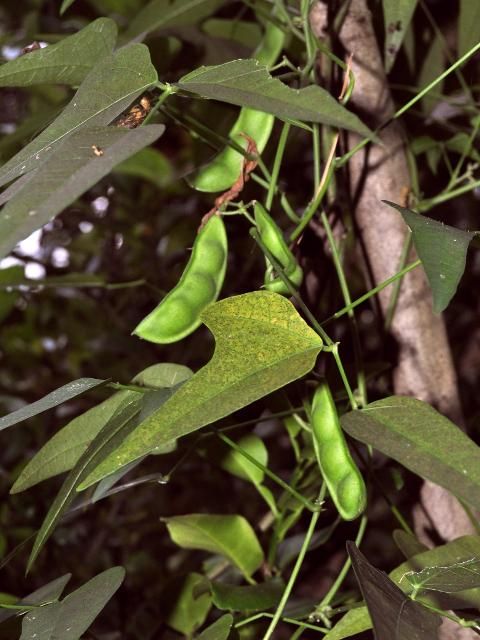
James M. Stephens2The willow-leaf lima bean is a form of pole butter bean (P. lunatus L.) that keeps surfacing from time to time in home gardens around the state of Florida. In most respects it is like the standard pole lima bean, except that it has very narrow lanceolate leaflets the shape of a willow or peach leaf.
Lima beans are of American origin, and evidence indicates that they have been grown in or near the tropics since prehistoric times. Guatemala is considered to be the original home of the lima bean, although its naming came from Lima, Peru where it is first thought to have originated. American settlers were growing baby limas in about 1700.
DESCRIPTION
Strains of lima beans found in tropical America where it is indigenous always had the broader, ovate leaf pattern, and the indeterminate (vine) form of growth. The alternative characteristics -- lanceolate leaflets and determinate (bush) growth habit -- are derived characteristics and are restricted to cultivated types. Thus, it appears that the willow-leaf lanceolate shape was derived from a rare mutation. Cultivated varieties of this leaf shape are very few, although the shape has been transferred to most all types.This species exhibits the seldom encountered genetic characteristic of narrow leaflets. The smooth, white, or otherwise colored seeds are edible. The plants should be grown in the garden just like the more familiar types of pole lima beans.

Footnotes
1. This document is HS560, one of a series of the Horticultural Sciences Department, Florida Cooperative Extension Service, Institute of Food and Agricultural Sciences, University of Florida. Original publication date April 1994. Reviewed May 2003. Visit the EDIS Web Site at http://edis.ifas.ufl.edu.2. James M. Stephens, professor, Horticultural Sciences Department, Cooperative Extension Service, Institute of Food and Agricultural Sciences, University of Florida, Gainesville FL 32611.
The Institute of Food and Agricultural Sciences (IFAS) is an Equal Opportunity Institution authorized to provide research, educational information and other services only to individuals and institutions that function with non-discrimination with respect to race, creed, color, religion, age, disability, sex, sexual orientation, marital status, national origin, political opinions or affiliations. For more information on obtaining other extension publications, contact your county Cooperative Extension service.
U.S. Department of Agriculture, Cooperative Extension Service, University of Florida, IFAS, Florida A. & M. University Cooperative Extension Program, and Boards of County Commissioners Cooperating. Larry Arrington, Dean.
Copyright Information
This document is copyrighted by the University of Florida, Institute of Food and Agricultural Sciences (UF/IFAS) for the people of the State of Florida. UF/IFAS retains all rights under all conventions, but permits free reproduction by all agents and offices of the Cooperative Extension Service and the people of the State of Florida. Permission is granted to others to use these materials in part or in full for educational purposes, provided that full credit is given to the UF/IFAS, citing the publication, its source, and date of publication.
