University of FloridaSolutions for Your Life

Download PDF 
Publication #HS570

Cabbage, Sea-Kale — Brassica oleracea L. (Tronchuda group)1

James M. Stephens2

This cabbage-like plant is easily confused with sea-kale (Crambe maritima), due to the similarity of common names. Sea-kale cabbage is classified as one of the Savoy cabbages, meaning its leaves are crinkled rather than being smooth. Other names for it are couve tronchuda, Braganza cabbage, and Portugal cabbage.
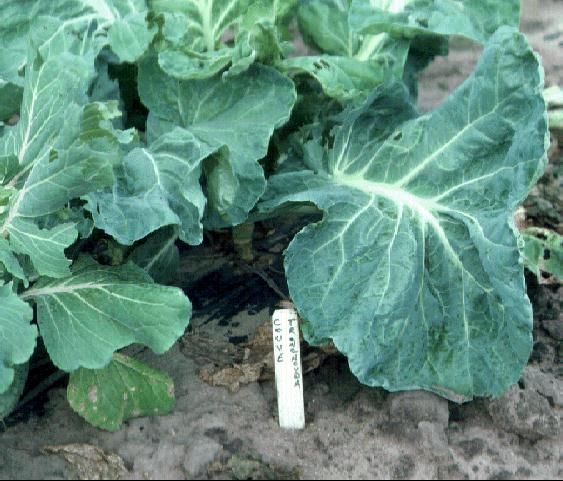
Sea-kale cabbage. 

DESCRIPTION

The plant resembles a thick-stemmed collard with large floppy leaves. It is reported to form a loose head, but in Florida trials it remained open. Leaves are close together, round, smooth, and slightly notched at the margins.

CULTURE

Sea-kale cabbage should be grown at the same time of the year and by the same methods proven successful for other forms of cabbage. Frost does not bother it, and the lack of cold weather probably was the cause for its failure to form a head at Gainesville. In the Florida trials it was attacked by cabbage worms, notably cabbage loopers and imported cabbage worms.

USE

Prepare and serve sea-kale cabbage as a cooking green.

Footnotes

1.

This document is HS570, one of a series of the Horticultural Sciences Department, Florida Cooperative Extension Service, Institute of Food and Agricultural Sciences, University of Florida. Original publication date May 1994. Reviewed March 2009. Visit the EDIS Web Site at http://edis.ifas.ufl.edu.

2.

James M. Stephens, Professor, Horticultural Sciences Department, Cooperative Extension Service, Institute of Food and Agricultural Sciences, University of Florida, Gainesville FL 32611.


The Institute of Food and Agricultural Sciences (IFAS) is an Equal Opportunity Institution authorized to provide research, educational information and other services only to individuals and institutions that function with non-discrimination with respect to race, creed, color, religion, age, disability, sex, sexual orientation, marital status, national origin, political opinions or affiliations. For more information on obtaining other extension publications, contact your county Cooperative Extension service.

U.S. Department of Agriculture, Cooperative Extension Service, University of Florida, IFAS, Florida A. & M. University Cooperative Extension Program, and Boards of County Commissioners Cooperating. Millie Ferrer, Interim Dean.


Bookmark and Share