
Kale -- Brassica oleracea L. (Acephala group) Kale -- Brassica oleracea L. (Acephala group)
Kale -- Brassica oleracea L. (Acephala group)1
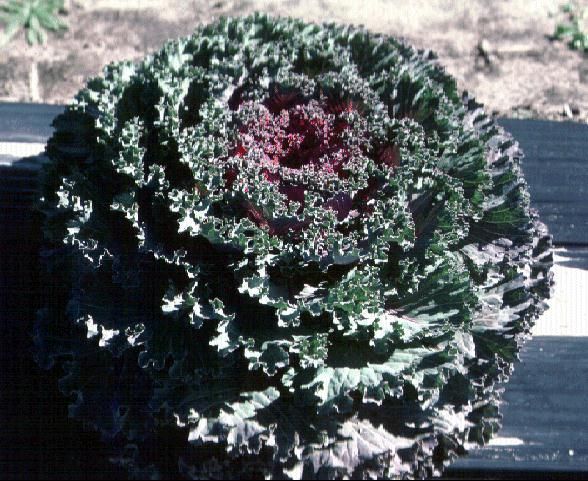
James M. Stephens2Kale is cool-season cooking green somewhat similar to collard and nonheading cabbage. Kale is also called borecole. "Kale" is a Scottish word derived from coles or caulis, terms used by the Greeks and Romans in referring to the whole cabbage-like group of plants. The German word "kohl" has the same origin. The Scotch varieties have deeply curled grayish green leaves.
Kale is native to the Mediterranean or to Asia Minor. It was introduced to America from Europe as early as the 17th century. Kale is not a big commercial crop in Florida, but is found in about one out of ten home gardens. Most southern gardeners, including Floridians, prefer collards to kale.
![]()
Kale. CULTURE AND USE
Kale produces seed in the second year. It is grown from seed as an annual. Culture is similar to that for cabbage and collards. Throughout Florida, it can be seeded or transplanted from September through March with fairly good results. For best results, it should be planted so that harvest takes place in the coolest months. For home use, some of the leaves are stripped off as needed; the plants then continue to produce more leaves. It takes about 2½ to 3 months from seeding to harvest. The main problems are those that occur on cabbage and collards. Because of the curly leaves, sand is more difficult to remove.Among the varieties listed by seed companies are `Blue Curled Scotch,' `Dwarf Siberian,' `Dwarf Green Curled Scotch,' `Dwarf Blue Scotch,' `Imperial Long Standing,' `Siberian,' `Spring,' and `Flowering Kale.' The latter is very attractive for landscape planting and is edible, but not very palatable. The term "flowering" derives from the shape and coloration of the plant, which resembles a flower, and does not refer to actual flowers.
Footnotes
1. This document is HS617, one of a series of the Horticultural Sciences Department, Florida Cooperative Extension Service, Institute of Food and Agricultural Sciences, University of Florida. Original publication date May 1994. Reviewed May 2003. Visit the EDIS Web Site at http://edis.ifas.ufl.edu.2. James M. Stephens, Professor, Horticultural Sciences Department, Cooperative Extension Service, Institute of Food and Agricultural Sciences, University of Florida, Gainesville FL 32611.
The Institute of Food and Agricultural Sciences (IFAS) is an Equal Opportunity Institution authorized to provide research, educational information and other services only to individuals and institutions that function with non-discrimination with respect to race, creed, color, religion, age, disability, sex, sexual orientation, marital status, national origin, political opinions or affiliations. For more information on obtaining other extension publications, contact your county Cooperative Extension service.
U.S. Department of Agriculture, Cooperative Extension Service, University of Florida, IFAS, Florida A. & M. University Cooperative Extension Program, and Boards of County Commissioners Cooperating. Larry Arrington, Dean.
Copyright Information
This document is copyrighted by the University of Florida, Institute of Food and Agricultural Sciences (UF/IFAS) for the people of the State of Florida. UF/IFAS retains all rights under all conventions, but permits free reproduction by all agents and offices of the Cooperative Extension Service and the people of the State of Florida. Permission is granted to others to use these materials in part or in full for educational purposes, provided that full credit is given to the UF/IFAS, citing the publication, its source, and date of publication.
