University of FloridaSolutions for Your Life

Download PDF 
Publication #HS654

Rakkyo — Allium chinense G. Don.1

James M. Stephens2

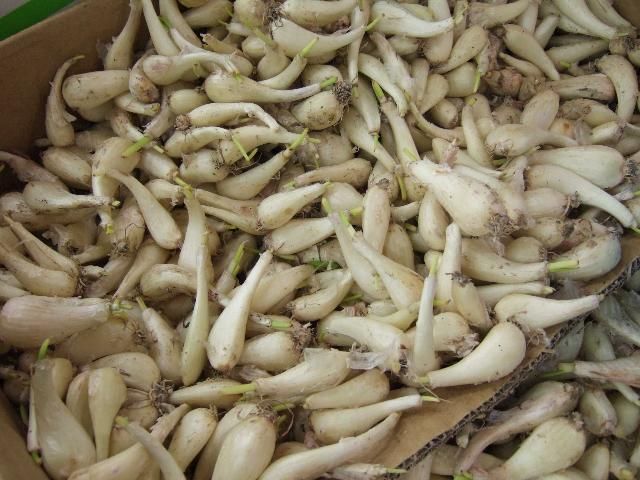
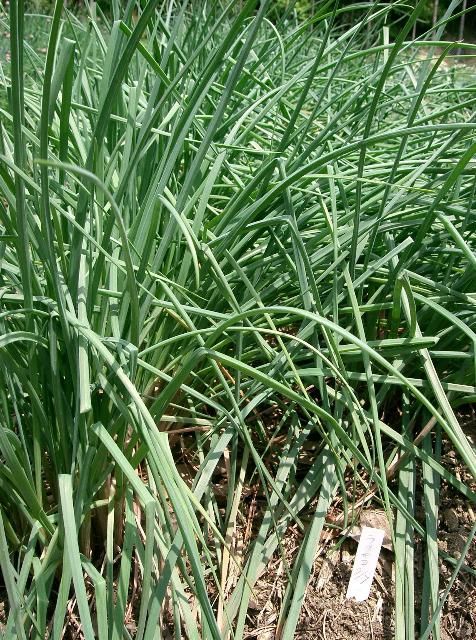
Rakkyo belongs to the onion family, and it closely resembles chives. The bright green hollow leaves enlarge at the base to form small bulbs. Chives, of course, do not enlarge in this manner. One interesting feature of rakkyo is that its seed stalk (scape) is solid, a characteristic usually reserved for those members of Allium having flat rather than round, hollow leaves.

Rakkyo goes by such other names as Japanese scallion and ch'iao t'ou. While important as a vegetable in the Orient, it is seldom grown in Florida or in the United States. Do not confuse with wild leeks (or ramps), which have flat, bladed leaves and grow well around the state.
CULTURE

Rakkyo is started by bulb division. In Florida, set the bulbs in the fall and harvest the new bulbs that form in the following late summer. Rakkyo is reported to need a period of dormancy in the summer rather than winter for bulb initiation, but this response to Florida's climatic conditions has not been verified.

USE

Some rakkyo bulbs are pickled, some are canned, and others are used as a boiled vegetable.
Footnotes

1.

This document is HS654, one of a series of the Horticultural Sciences Department, Florida Cooperative Extension Service, Institute of Food and Agricultural Sciences, University of Florida. Original publication date May 1994. Revised June 1994. Reviewed March 2009. Visit the EDIS Web site at http://edis.ifas.ufl.edu.

2.

Cooperative Extension Service, Institute of Food and Agricultural Sciences, University of Florida, Gainesville FL 32611.


The Institute of Food and Agricultural Sciences (IFAS) is an Equal Opportunity Institution authorized to provide research, educational information and other services only to individuals and institutions that function with non-discrimination with respect to race, creed, color, religion, age, disability, sex, sexual orientation, marital status, national origin, political opinions or affiliations. For more information on obtaining other extension publications, contact your county Cooperative Extension service.

U.S. Department of Agriculture, Cooperative Extension Service, University of Florida, IFAS, Florida A. & M. University Cooperative Extension Program, and Boards of County Commissioners Cooperating. Millie Ferrer, Interim Dean.


Bookmark and Share