

Spinach, Malabar -- Basella rubra L. Spinach, Malabar -- Basella rubra L.
Spinach, Malabar -- Basella rubra L.1
James M. Stephens2Malabar spinach is also known as Ceylon spinach, climbing spinach, gui, acelga trepadora, bretana, libato, vine spinach, and Malabar nightshade. The red leaf form belongs to the rubra species, while the green form is classified in the alba species.
![]()
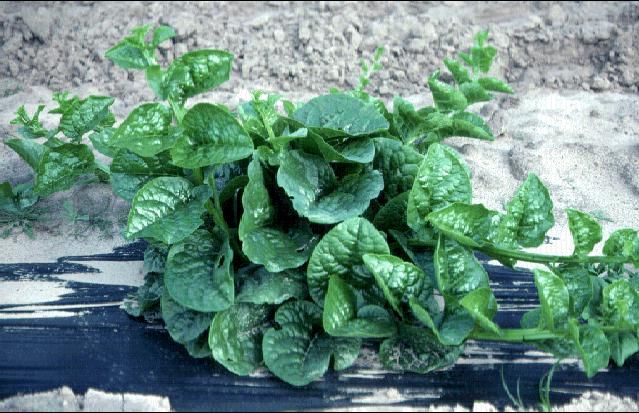
Malabar spinach. DESCRIPTION
Malabar is not a true spinach, but its leaves, which form on a vine, resemble spinach and are used in the same way. It comes from India, and is distributed widely in the tropics, particularly in moist lowlands. In Florida, it is rare, even in home gardens.CULTURE
Here and in the tropics, it grows well in a variety of soils, seemingly without regard to fertility. Moisture is important and the plants make their best growth during warm, rainy periods. A small amount of shade seems to be beneficial, although open-sun culture does not present a serious problem.Malabar spinach can be grown from seeds or cuttings. While not essential, the vine should be trellised. Two vines are sufficient to supply a small family all summer and fall. Vines are somewhat ornamental, so can be trained to climb over doorways for easy accessibility. The thick, fleshy leaves are cut off together with some length of stem to keep the plant pruned to a desired shape. Stems that are too tough to eat can be put back in the soil and rerooted. Plants started in Gainesville in August made excellent growth during the fall months.
USE
When cooked, Malabar spinach is not as slick in texture as many greens, such as spinach. The Bengalis cook it with chopped onions, hot chilis, and a little mustard oil.

Footnotes
1. This document is HS671, one of a series of the Horticultural Sciences Department, Florida Cooperative Extension Service, Institute of Food and Agricultural Sciences, University of Florida. Original publication date May 1994. Reviewed May 2003. Visit the EDIS Web Site at http://edis.ifas.ufl.edu.2. James M. Stephens, Professor, Horticultural Sciences Department, Cooperative Extension Service, Institute of Food and Agricultural Sciences, University of Florida, Gainesville FL 32611.
The Institute of Food and Agricultural Sciences (IFAS) is an Equal Opportunity Institution authorized to provide research, educational information and other services only to individuals and institutions that function with non-discrimination with respect to race, creed, color, religion, age, disability, sex, sexual orientation, marital status, national origin, political opinions or affiliations. For more information on obtaining other extension publications, contact your county Cooperative Extension service.
U.S. Department of Agriculture, Cooperative Extension Service, University of Florida, IFAS, Florida A. & M. University Cooperative Extension Program, and Boards of County Commissioners Cooperating. Larry Arrington, Dean.
Copyright Information
This document is copyrighted by the University of Florida, Institute of Food and Agricultural Sciences (UF/IFAS) for the people of the State of Florida. UF/IFAS retains all rights under all conventions, but permits free reproduction by all agents and offices of the Cooperative Extension Service and the people of the State of Florida. Permission is granted to others to use these materials in part or in full for educational purposes, provided that full credit is given to the UF/IFAS, citing the publication, its source, and date of publication.
