Tomato, Tree -- Cyphomandra betacea (Cav.) Sendt. Tomato, Tree -- Cyphomandra betacea (Cav.) Sendt.
Tomato, Tree -- Cyphomandra betacea (Cav.) Sendt.1
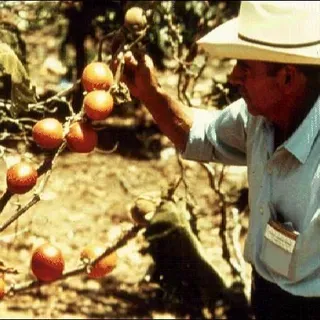
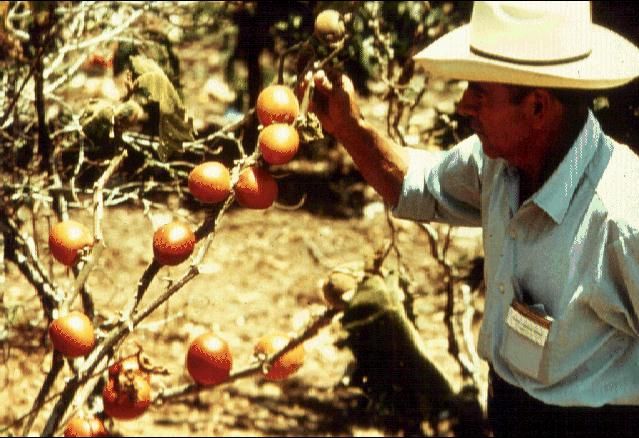
James M. Stephens2Advertisements appear quite often in newspapers extolling the merits of the tree tomato . It is not a true tomato, but is a perennial shrub 6-10 feet high, having large, 5 inch long, heart-shaped, hairy leaves. The fruit looks more like a small eggplant than a tomato. It is 2-3 inches long, oval in shape, smooth, and long stemmed. The mature fruit has soft, red skin and contains many small seeds.
![]()
tree tomato. CULTURE
Tree tomato is grown in Florida in gardens and around the house, and does best in frost-free locations. It is grown widely in South America, especially Peru and Brazil.It begins blooming 2 years after seeding. Fruit production declines sharply after 5-6 years. The time required from bloom to mature fruit is about 3 months. Plants are easily propagated from seed, but also may be started from cuttings. It has been slow to produce fruit in Gainesville trials, but has produced fairly well in Dade County.
Gardeners often advertise seed for sale in seed exchange bulletins, and it is listed by seed and plant companies.
Footnotes
1. This document is HS679, one of a series of the Horticultural Sciences Department, Florida Cooperative Extension Service, Institute of Food and Agricultural Sciences, University of Florida. Original publication date May 1994. Reviewed May 2003. Visit the EDIS Web Site at http://edis.ifas.ufl.edu.2. James M. Stephens, Professor, Horticultural Sciences Department, Cooperative Extension Service, Institute of Food and Agricultural Sciences, University of Florida, Gainesville FL 32611.
The Institute of Food and Agricultural Sciences (IFAS) is an Equal Opportunity Institution authorized to provide research, educational information and other services only to individuals and institutions that function with non-discrimination with respect to race, creed, color, religion, age, disability, sex, sexual orientation, marital status, national origin, political opinions or affiliations. For more information on obtaining other extension publications, contact your county Cooperative Extension service.
U.S. Department of Agriculture, Cooperative Extension Service, University of Florida, IFAS, Florida A. & M. University Cooperative Extension Program, and Boards of County Commissioners Cooperating. Larry Arrington, Dean.
Copyright Information
This document is copyrighted by the University of Florida, Institute of Food and Agricultural Sciences (UF/IFAS) for the people of the State of Florida. UF/IFAS retains all rights under all conventions, but permits free reproduction by all agents and offices of the Cooperative Extension Service and the people of the State of Florida. Permission is granted to others to use these materials in part or in full for educational purposes, provided that full credit is given to the UF/IFAS, citing the publication, its source, and date of publication.