
Empty Containers
What should you do with the empty container once you have used all of the pesticide or how should you dispose of unusable, unwanted, or excess pesticide?
To dispose of empty residential-use pesticide containers properly, follow the directions provided on each product label (Figure 1). The directions for disposal of pesticide containers often differ from product to product.
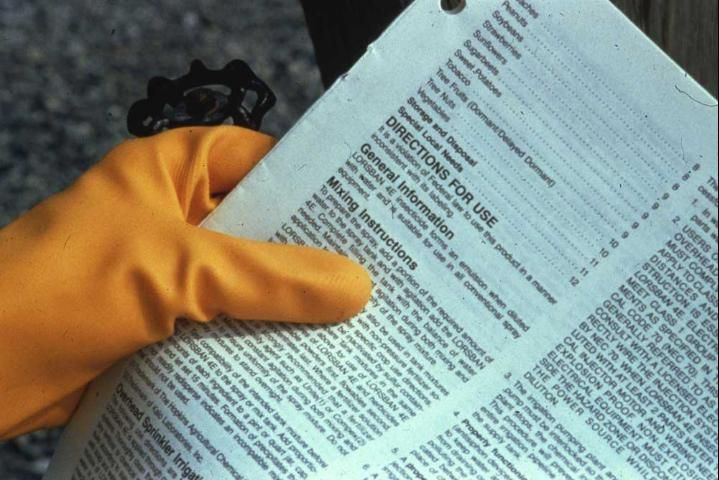
If the label on your empty pesticide container tells you to rinse the container, use the rinse water to dilute the pesticide in your sprayer or applicator container to the correct concentration, or spray it directly on your target site. Do not pour the rinse water into a household drain, on the ground, or into a gutter or storm drain.
For ready-to-use products that do not need to be diluted, do not rinse the container. There is not a good way to dispose of this rinse water. Some lawn pesticide products come in a single-use hose-end sprayer. You should not try to open and rinse these containers when they are empty.
A primary rule for pesticide containers has been "Never save or reuse an empty pesticide container for any reason." However, there are now a limited number of homeowner-use products that permit the reuse of the application container but only with refills containing exactly the same product.
Though pesticide containers can be recycled, these containers also need to undergo special treatment and cannot simply be tossed into your curbside bin. Do not dispose of empty pesticide containers by open burning. Do not burn, incinerate, or puncture aerosol containers. Follow instructions on the label to prepare the empty container for disposal and put it in the trash.
Unwanted, Unusable, or Excess Pesticide
Sometimes you may have unwanted, unusable, or excess pesticides. What should you do with them?
The label on the product container usually has general guidance for disposal, but unlike the information for container disposal, you may need to check with state or local authorities to determine what to do with the product. Some disposal statements on pesticide products marketed for residential use include:
-
It is best to use the entire product contents in accordance with label directions. If it necessary to dispose of unused product, please follow applicable state or local guidelines.
If possible, it is generally best to dispose of the product by using it in accordance with the directions on the product label. This can be done by applying dilute spray mixture to sites listed on the label. If you do not have a use for the product, perhaps a neighbor does. There may be times, however, when the contents of a partially filled container cannot be used. Most counties or municipalities in Florida have collection programs for household hazardous waste that accept residential-use pesticide products for disposal. Such programs operate year-round or have specified collection days during the year and are the preferred method for disposal of unwanted, unusable, or excess residential-use pesticides. To find the nearest location to drop off your unwanted pesticides call 1-800-CLEANUP or visit http://earth911.com/ (Visited February 26, 2016). Regardless, do not simply put them aside into a closet or garage thinking they will go away. Such a practice is an accident waiting to happen.
Never pour unwanted pesticides down the drain or on the ground.
To minimize the need to dispose of unwanted pesticides, use them only when necessary; purchase only the amount needed; and use up the product in accordance with the label directions.
Be safe, not regretful; always read and follow all pesticide product labels.