Pesticide Labeling: Environmental Hazards Statements
This document explains environmental hazard statements seen on pesticide labels and discusses the toxicity criteria used in determining the manner in which they are presented on the pesticide label. Examples of typical statements regarding environmental hazards found on pesticide labels are provided.
Introduction
Fortunately, they are not frequent occurrences, but negative consequences from pesticide use do happen from time to time: a fish-kill is reported in a sub-division's lake, a beekeeper's hives are lost from a faulty pesticide application, or an unusually high bird mortality rate is reported from an area that had been recently treated for a sudden pest outbreak. The pesticide label's environmental hazards statement provides the precautionary language advising of the potential hazards to the environment from transport, use, storage, or spill of the product. The hazards may be to water, soil, air, beneficial insects, plants, and/or wildlife.
What are a product's environmental hazards based upon?
Generally, the information contained in this section is based upon the results of seven basic acute toxicity studies performed on the technical grade of the active ingredient(s) in the formulation:
-
Avian oral LD50 with bobwhite quail or mallards;
-
Avian dietary LC50 with mallards;
-
Avian dietary LC50 with bobwhite quail;
-
Freshwater fish LC50 with rainbow trout;
-
Freshwater fish LC50 with bluegill sunfish;
-
Acute LC50 with freshwater invertebrates (Daphnia magna or water flea); or
-
Honeybee contact LD50.
In addition, data are collected concerning a chemical's potential to contaminate groundwater or surface water, to drift, and to adversely affect non-target plants and bees. All of these studies provide important information that will help determine how a product may best be used.
Do all products require an environmental hazards statement?
The product's use pattern usually determines the need for and the specific text of the environmental hazards section. For example, it would not be logical to see statements regarding potential drift problems on the labels of granular products, since they are not applied as sprays and are seldom associated with drift. Products that are intended for use exclusively indoors may omit the environmental hazards statement. Products applied to domestic animals, such as flea collars or ear tags, may have no environmental hazards statements. However, some domestic use products may have the statements because of the potential for contamination of water by the product's use (e.g., as a dog dip). Historically, products used outdoors will have environmental hazard statements on their labels.
Where are environmental hazards statements located within the labeling?
The environmental hazards section of the label is found under the general heading, "Precautionary Statements." It will also have its own heading, "Environmental Hazards."
General Environmental Hazards Statements
Generally, all products with directions for outdoor, terrestrial uses should have the following statements in the environmental hazards section:
"For terrestrial uses: Do not apply directly to water, or to areas where surface water is present or to intertidal areas below the mean high water mark. Do not contaminate water when disposing of equipment washwater or rinsate."
These statements are preceded by "For terrestrial uses," to make it clear that the statements do not apply to the other general use patterns – mosquito adulticides, aquatic uses such as mosquito larvicides, aquatic herbicides, piscicides, greenhouse and indoor uses, etc.
Some Bt products do not require the statements above. This is based on the fact some Bt products are applied to terrestrial agricultural fields to control mosquitoes in periodic standing water.
If a product is applied aerially to forests, the above statements may be preceded with the phrase: "Except under the forest canopy." This is because there are many creeks under forest canopies. As written, the statement would give the user the right to spray the forest canopy, but requires spray valves to be shut off when passing over ponds, creeks, etc. not under the forest canopy.
For outdoor residential consumer products (except for lawn care which requires the same statement as outdoor terrestrial uses), the statements that are usually seen are:
"Do not contaminate water when disposing of equipment washwaters or rinsates."
A couple of exceptions exist for these types of products. Use pattern is factored in to account for the site and how the product will be applied. For example, a product intended for application to water to control algal growth, those two statements would be inappropriate. Another example would be with residential aerosol spray products, such as those applied to wasp or hornet nests. In this case, no equipment would be used; therefore the statement regarding cleaning of equipment would not appear.
Products with directions for outdoor terrestrial uses requiring a fish or aquatic invertebrate toxicity statement usually contain a statement warning of hazard from drift or runoff. These products will have a statement such as: "Drift and runoff may be hazardous to aquatic organisms in water adjacent to treated areas." The word, "drift," is not included on granular products or if it is applied "in furrow" or injected into the soil.
Groundwater advisories. When the EPA has determined that a pesticide or its major degradates have significant mobility and persistence characteristics, then its product label will state:
Ground Water Advisory
"This chemical has properties and characteristics associated with chemicals detected in ground water. The use of this chemical in areas where soils are permeable, particularly where the water table is shallow, may result in ground-water contamination."
-
If the chemical (or major degradates) has mobility and persistence characteristics similar to other chemicals found in groundwater as a result of normal label uses, and: 1) Detections are reported in groundwater in a prospective groundwater study or other studies that are conducted during the registration process, or other reliable data exist publicly, or 2) field dissipation studies confirm the chemical leaches, then the following statement may appear:
Ground Water Advisory
"[Name of chemical][A degradate of (name of chemical)] has the potential to leach through soil into ground water under certain conditions as a result of label use. Use of this chemical in areas where soils are permeable, particularly where the water table is shallow, may result in ground-water contamination."
Surface water label advisories. Historically, the EPA has required products to add the following statement to all household and agricultural labels modified for the specific pesticide characteristics and targeted audience. "The active ingredient in [product name] has the potential to contaminate surface water through ground spray drift. Under some conditions, the active ingredient may also have a high potential for runoff into surface water (primarily via dissolution in runoff water) for several months post-application. These include poorly drained or wet soils with readily visible slopes toward adjacent surface waters, frequently flooded areas, areas overlaying extremely shall ground water, areas with in-field canals or ditches that drain to surface water, areas not separated from adjacent surface waters with vegetated filter strips, and areas overlaying tile drainage systems that drain to surface water."
-
In addressing surface water concerns, the users of specific products are advised either on:
-
Household product labels: "Avoid applying this product to ditches, swales, and drainage ways. Runoff of this product will be reduced by avoiding applications when rainfall is forecasted to occur within 48 hours;" or:
-
Agricultural product labels: "A level, well-maintained vegetative buffer strip between areas to which this product is applied and surface water features such as ponds, streams, and springs will reduce the potential for contamination of water from rainfall-runoff. Runoff of this product will be reduced by avoiding applications when rainfall is forecasted to occur within 48 hours."
Some agricultural product labels will also have this statement added: "Sound erosion control practices will reduce this products contribution to surface water contamination."
Non-Target Organism Statements
The following statement has historically been present in the environmental hazards section of the label when a pesticide intended for outdoor use contains an active ingredient which has a mammalian acute oral LD50 of <100 mg/kg, an avian acute oral LD50 of <100 mg/kg, or a subacute dietary LC50 of <500 ppm:
"This pesticide is toxic to (birds or mammals) or (birds and mammals)."
Similarly for fish or aquatic invertebrates, including estuarine species such as oysters and mysid shrimp, when the active ingredient has a fish acute LC50 or EC50 of <1 ppm:
"This pesticide is toxic to (fish) (fish and aquatic invertebrates) (oysters/shrimp) or (fish, aquatic invertebrates, oysters and shrimp)."
If field studies or accident history indicate that use of the pesticide may result in fatality to birds, fish, or mammals, the following statement will appear:
"This pesticide is extremely toxic to (birds), (mammals), (fish), or (birds and mammals and fish)."
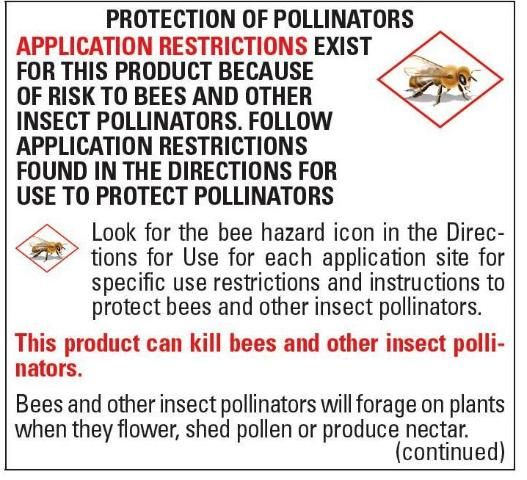
If a pesticide is used outdoors as a foliar application, especially to crops, and is toxic to pollinating insects, a box will be included in the environmental hazards . Table 1 sets out the toxicity groupings and label statements that will appear accordingly.
If a product is used to control aquatic weeds, the statement in the environmental hazards section will usually contain the following: "Treatment of aquatic weeds can result in oxygen loss from decomposition of dead weeds. This loss can cause fish suffocation. Therefore, to minimize this hazard, treat 1/3 to ½ of the water area in a single operation and wait at least 10 to 14 days between treatments. Begin treatment along the shore and proceed outards in bands to allow fish to move into untreated areas. Consult with the State lead agency with primary responsibility for regulating pesticides before applying to public waters to determine if a permit is needed."
Pesticide products that include directions for mosquito control may require statements in the environmental hazards section, although the aquatic toxicity of the specific product may lead to more or less stringent statements. For example, certain bacterial larvicides, such as some Bt products, are considered non-toxic to aquatic organisms and would not require any statement. Some pyrethroids registered as mosquito adulticides are highly toxic to aquatic organisms and may require stronger precautions than those listed below, tailored to the specific products, in order to prevent water contamination. Products with aquatic toxicity concerns between these extremes would have one of the following statements:
Larvicides: "Aquatic organisms may be killed in waters where this pesticide is used. Consult with the State agency with primary responsibility for regulating pesticides before applying to public waters to determine if a permit is needed."
Adulticides: "Do not apply over water, except where mosquitoes are emerging or swarming, or to treat vegetation where mosquitoes may rest. Drift and washoff from vegetation may be hazardous to aquatic organisms (and wildlife) in or adjacent to treated areas. Do not contaminate water when disposing of equipment wash waters or rinsates. Before making the first mosquito control application in a season, consult with the State agency with primary responsibility for regulating pesticides to determine if permits are required."
If a pesticide product is applied to irrigation water and contains an ingredient requiring an aquatic organism toxicity statement, the environmental hazards section will have the following statement: "Irrigation water treated with this product may be hazardous to aquatic organisms. Treated water must either be held on the irrigated field until absorbed by the soil or not released for (number) days."
Miscellaneous Statements
For products containing directions for treating seed or formulated as a granule, pellet, or treated bait, labels generally require the following statements:
"Treated (seed), (granules), (pellets), or (baits) exposed on soil surface may be hazardous to (birds), (wildlife), (fish and aquatic invertebrates), or (birds, other wildlife, and fish). Cover or collect (seeds), (granules), (pellets), or (baits) spilled during loading."
When the label bears a reference to mixing with other products, this statement may be present:
"Observe the most restrictive of the labeling limitations and precautions of all products used in mixtures."
Additional Information
Fishel, F.M. 2005. Interpreting Pesticide Label Wording. PI-34. Gainesville: University of Florida Institute of Food and Agricultural Sciences. https://edis.ifas.ufl.edu/pi071
Fishel, F.M. 2008. EPA Approval of Pesticide Labeling. PI-167. Gainesville: University of Florida Institute of Food and Agricultural Sciences. https://edis.ifas.ufl.edu/pi203
Fishel, F.M. 2008. Pesticide Characteristics. PI-166. Gainesville: University of Florida Institute of Food and Agricultural Sciences. https://edis.ifas.ufl.edu/pi061
Nesheim, O.N. and F.M. Fishel. 1993. Protecting Water Resources from Agricultural Pesticides. PI-1. Gainesville: University of Florida Institute of Food and Agricultural Sciences. https://edis.ifas.ufl.edu/pi001
Nesheim, O.N., F.M. Fishel and M. Mossler. 2005. Toxicity of Pesticides. PI-13. Gainesville: University of Florida Institute of Food and Agricultural Sciences. https://edis.ifas.ufl.edu/pi008