Emergency Exemption Pesticide Registrations
This document describes a unique type of pesticide registration—Emergency Exemption, also known as a Section 18 registration, and examples of situations where it is warranted.
What is an emergency exemption pesticide registration?
A section 18 is an emergency exemption to allow use of a product against an emergency pest problem. Section 18 of the Federal Insecticide, Fungicide, and Rodenticide Act (FIFRA) allows an individual state to issue an emergency exemption if the Florida Department of Agriculture and Consumer Services (FDACS) and the Environmental Protection Agency (EPA) agree that:
-
There are no effective pesticides registered for control of emergency; and
-
There are no economically or environmentally feasible alternative practices which provide adequate control available; and
-
The situation:
-
Involves the introduction or dissemination of a pest new to or not heretofore known to be widely prevalent or distributed within or throughout the US and its territories; or
-
Will present significant risks to human health; or
-
Will present significant risks to threatened or endangered species, beneficial organisms, or the environment; or
-
Will cause significant economic loss due to:
-
An outbreak or an expected outbreak of a pest; or
-
A change in plant growth or development caused by unusual environmental conditions where such change can be rectified by the use of a pesticide(s).
There are four types of emergency exemption: specific, quarantine, public health, or crisis.
-
Most emergency exemptions are issued as specific section 18s. Specific exemptions may be authorized in an emergency condition to avoid a significant economic loss, or a significant risk, to endangered species, threatened species, beneficial organisms, or the environment.
-
A quarantine section 18 is issued for three years and used is to prevent the introduction or spread of a foreign pest into or throughout the United States.
-
A public health exemption can be issued, but this provision is rarely used.
-
A crisis exemption may be issued in an emergency condition when the time from discovery of the emergency to the time when the pesticide use is needed is insufficient to allow for authorization of a specific, quarantine, or public health exemption.
Emergency exemptions are for those uses for which no tolerance or exemption from tolerance requirements have already been established. The EPA will issue a time-limited tolerance to allow harvest of crops that have been treated under the exempt use.
A use that involves an existing tolerance or exemption from the requirement of a tolerance would be registered under Section 24(c), a Special Local Needs Registration. These types of pesticide registrations are discussed in UF/IFAS Extension EDIS Document PI-95 Special Local Need Pesticide Registrations—24(c) (https://edis.ifas.ufl.edu/pi132).
How is an emergency exemption pesticide registration requested?
The applicant of a section 18 request is always someone other than the product's registrant. Applications for specific and crisis exemptions must be submitted in writing to the Commissioner of Agriculture. The commissioner, through designated staff, will conduct an evaluation of the exemption application to determine that it is complete and meets all minimum criteria. Upon review and approval by the commissioner, applications for specific exemptions will be forwarded to the EPA for approval. In cases where a crisis declaration is requested, the commissioner will notify the EPA of his or her intent to declare a crisis and proceed accordingly. Applications and information are available through FDACS' Bureau of Scientific Evaluation and Technical Assistance at (850) 617-7917.
Examples of Emergency Exemptions in Florida
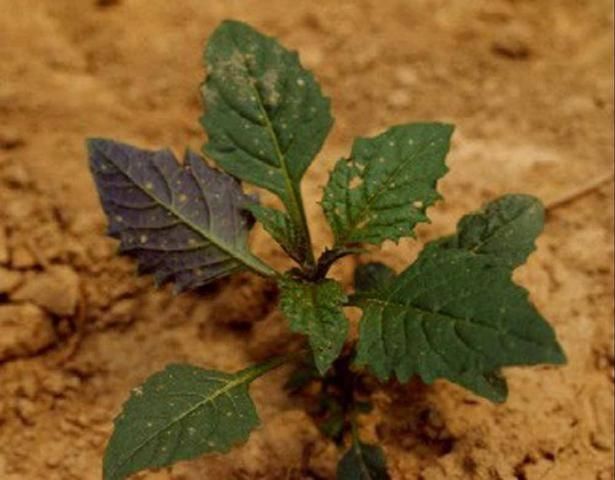
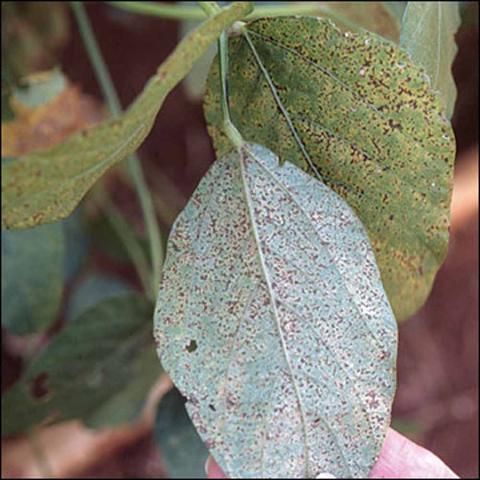
Although emergency exemptions are not a frequent occurrence, there are several examples in recent years where they have benefited agricultural producers. In 2002, carfentrazone-ethyl met the specific-use emergency criteria to manage paraquat-resistant nightshade (Figure 1), purslane, and morning glory in tomato, eggplant, and pepper. Another recent example of a section 18 registration that occurred in Florida, in this case for quarantine purposes, was the exemption for use of several fungicides for control of Asian soybean rust (Figure 2).
Credit: Virginia Tech University
Credit: University of Missouri
Additional Information
Fishel, F.M. 2006a. Federal Regulations Affecting Use of Pesticides. PI-131. Gainesville: University of Florida Institute of Food and Agricultural Sciences. https://edis.ifas.ufl.edu/pi168
Fishel, F.M. 2006b. Special Local Need Pesticide Registrations – 24(c). PI-95. Gainesville: University of Florida Institute of Food and Agricultural Sciences. https://edis.ifas.ufl.edu/pi132