- Topics: Plant Pathology | Gulf Coast REC | Strawberry Diseases | Mertely, James C | Peres, Natalia A

Powdery mildew, caused by Sphaerotheca macularis, occurs in most areas of the world where strawberries are grown.
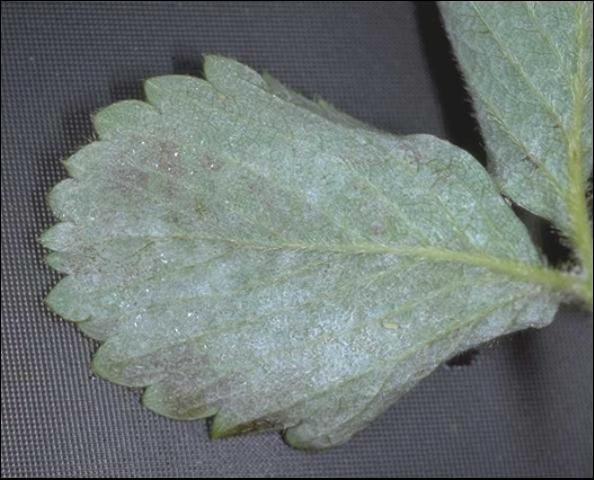
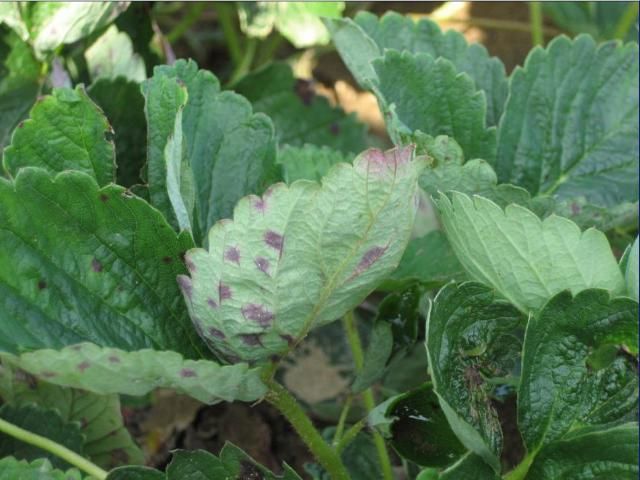
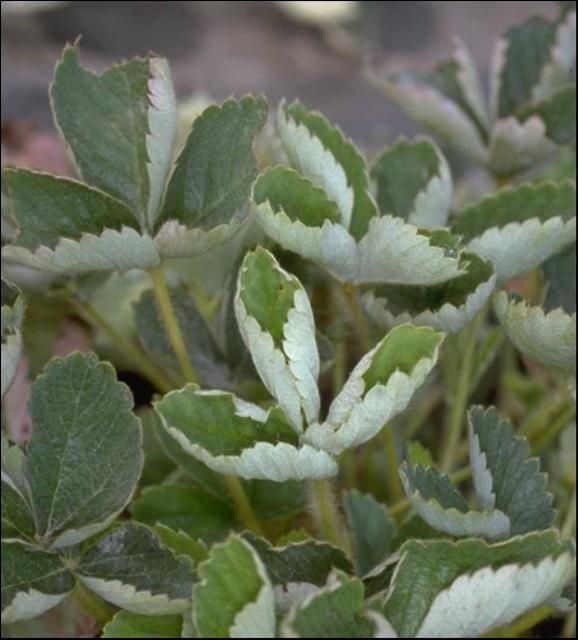
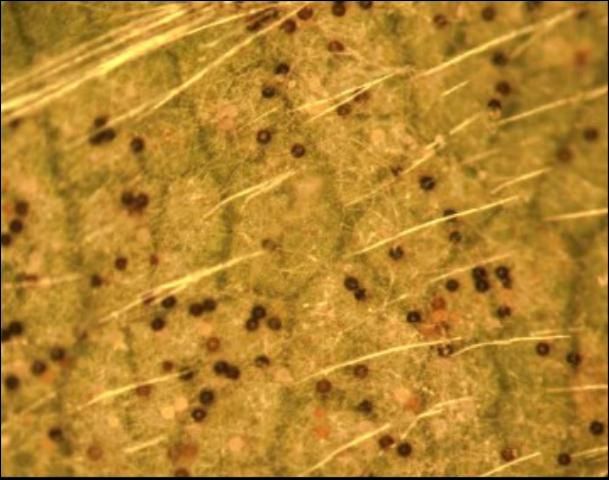
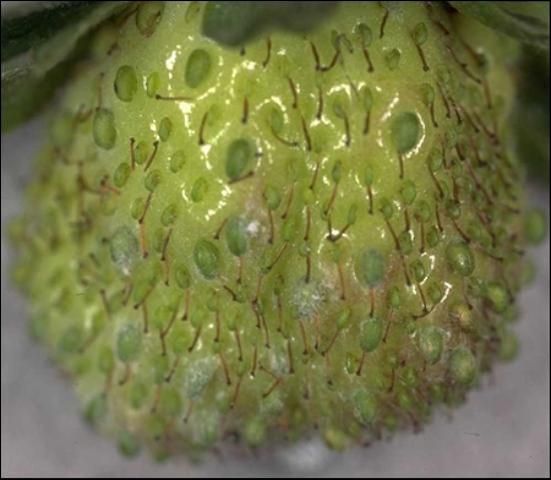
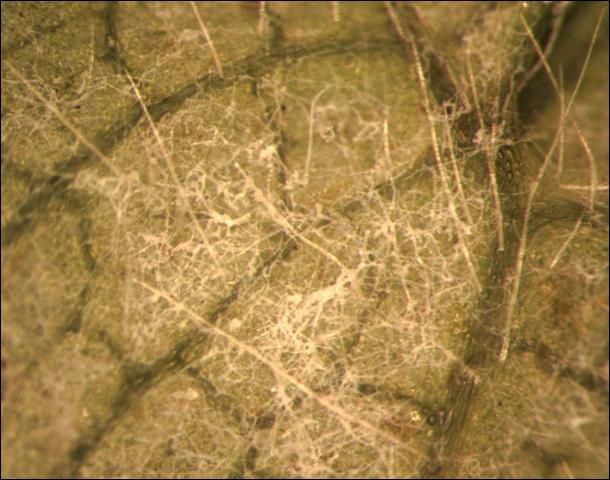
Sphaerotheca macularis infects leaves, flowers and fruit. Early foliar infections are characterized by small white patches of fungus growing on the lower leaf surface. On susceptible cultivars, dense mycelial growth and numerous chains of conidia (spores) give these patches a powdery appearance (Figure 1). Under favorable conditions, the patches expand and coalesce until the entire lower surface of the leaf is covered (Figure 2). In some strawberry cultivars, relatively little mycelium is produced, making it difficult to see the white patches. Instead, irregular yellow or reddish brown spots develop on colonized areas on the lower leaf surface, and eventually break through to the upper surface (Figure 3). The edges of heavily infected leaves curl upward (Figure 4). At times, dark round structures (cleistothecia) are produced in the mycelia on the undersides of leaves (Figure 5). Cleistothecia are initially white but turn black as they mature. The fungus also infects flowers, which may produce aborted or malformed fruit. In addition, S. macularis colonizes older fruit producing a fuzzy mycelial growth on the seeds (Figure 6). Both types of infection may reduce fruit quality and marketable yields.
Sphaerotheca macularis is an obligate parasite that only infects living tissue of wild or cultivated strawberry. The fungus readily infects living, green leaves in the nursery. Thus, infected transplants are normally the primary source of inoculum for fruiting fields in Florida. When conditions are favorable, conidia produced on infected plants are wind dispersed. Development and spread of powdery mildew is favored by moderate to high humidity and temperatures between 60° to 80° F. Rain, dew and overhead irrigation inhibit the fungus. Because dry conditions and high humidity are common in greenhouses and plastic tunnels, powdery mildew is typically more severe in protected culture. In open fields in central Florida, the disease is typically most severe in November and December, usually subsides in January and early February, but may reappear in late February and March.
Use of transplants free of powdery mildew is a good method for controlling the disease but even disease free fields can become infected by conidia blown in from neighboring fields. Cultivars differ widely in their resistance to powdery mildew. Unfortunately, the most popular cultivars, Strawberry Festival and Treasure, are quite susceptible to the disease. Fields with susceptible cultivars should be surveyed regularly for powdery mildew, especially early in the season. Fungicides should be applied at the first sign of disease to control powdery mildew on susceptible cultivars. This is especially important when using protectant fungicides such as elemental sulfur. Systemic fungicides have some limited curative action. These include Rally®, whose active ingredient is myclobutanil, and which was formerly named Nova®. Sonoma® is a competing brand that also contains myclobutanil. Fungicides in the same chemical class as Rally® and Sonoma® include Procure®, Bumper®, and Orbit®. These products are treated as a group since they belong to the same fungicide class and have similar properties. All share a common, single mode of action and, for this reason, should be rotated with other fungicides with different properties to avoid the development of resistance. Quintec® is a recently introduced and effective fungicide with a different mode of action than other powdery mildew products. Other rotational options include the benzimidazole fungicide Topsin M® and the strobilurin fungicides Abound®, Cabrio®, and Pristine®, but caution should be taken to not exceed four applications of these products per season. In addition, powdery mildew was recently added to the label of Switch®. Controlling foliar infections helps to prevent fruit infections.
Fungicides registered for control of powdery mildew of strawberries in Florida.
Product name (active ingredient) |
Fungicide Group |
Maximum Rate Per Acre Per: Application Season |
Min. Days To Harvest |
Remarks |
|
Abound (azoxystrobin) |
11 |
15.4 fl oz. |
1.92 qt |
0 |
Do not make more than 2 consecutive appl. and no more than 4 appl./crop year. See label for instructions on dipping transplants. |
Bumper 41.8 EC (propiconazole) |
3 |
4 fl oz. |
16 fl. oz. |
0 |
Do not make more than 2 consecutive applications. |
Cabrio EG (pyraclostrobin) |
11 |
14 fl. oz. |
70 fl. oz. |
0 |
Do not make more than 2 consecutive applications and no more than 5 appl./crop year. |
Nova 40 W (myclobutanil) |
3 |
5 oz. |
30 oz. |
0 |
Do not plant rotational crops until 30 days after last application. |
Orbit (propiconazole) |
3 |
4 fl.oz. |
16 fl. oz. |
0 |
Do not make more than 2 consecutive applications. |
(potassium bicarbonate) many brands1 |
NC |
varies |
varies |
1 |
Do not mix with highly acidic products. |
Pristine (pyraclostrobin + boscalid) |
11+7 |
23 oz. |
115 oz. |
0 |
Do not make more than 2 consecutive appl. and no more than 5 appl./ crop. |
Procure 50WS (triflumizole) |
3 |
8 oz. |
32 oz. |
1 |
Do not plant leafy vegetables within 30 days or root vegetables within 60 days or rotational crops not on label for one year after application. |
Quintec (quinoxyfen) |
13 |
6 fl. oz. |
24 fl. oz. |
1 |
Do not make more than 2 consecutive applications or more than 4 applications per crop. Do not plant crops not on label for 30 days after application. |
Rally 40W (myclobutanil) |
3 |
5 oz. |
30 oz. |
0 |
Do not plant rotational crops until 30 days after last application. |
Sonoma 40 WSP (myclobutanil) |
3 |
5 oz. |
30 oz. |
0 |
Do not plant rotational crops until 30 days after last application. |
(sulfur) many brands2 |
M1 or M9 |
varies |
varies |
1 |
Do not use when temperatures exceed 80 to 85°F. |
Switch 62.5 WG (cyprodinil + fludioxonil) |
9+12 |
14 oz. |
56 oz. |
0 |
Do not make more than 2 consecutive applications. Do not plant crops not on the label for 30 days after last application. |
T-Methyl 70 W WSB (thiophanate-methyl) |
1 |
1 lb. |
4 lb. |
1 |
Fungicides from different chemical groups should be used in spray program for disease resistance management. |
Topsin 4.5 FL (thiophanate-methyl) |
1 |
20 fl. oz. |
80 fl. oz. |
1 |
Fungicides from different chemical groups should be used in spray program for disease resistance management. |
Topsin M 70 WP Topsin M WSB (thiophanate-methyl) |
1 |
1 lb. |
4 lb. |
1 |
Fungicides from different chemical groups should be used in spray program for disease resistance management. |
a Fungicide group (FRAC Code): Numbers (1-37) and letters (M) are used to distinguish the fungicide mode of action groups. All fungicides within the same group (with same number or letter) indicate same active ingredient or similar mode of action. This information must be considered for fungicide resistance management decisions. M = Multi site inhibitors, fungicide resistance risk is low; NC = not classified. Source: http://www.frac.info/ (FRAC = Fungicide Resistance Action Committee). 1 e.g. Kaligreen, Armicarb 100, Milstop 2 e.g. Micro Sulf, , Sulfur 90W, Super-Six, Microthiol Disperss, Wettable Sulfur, Kumulus DF, Dusting Sulfur-IAP, Thioperse 80%, Yellow Jacket Dusting Sulfur, Yellow Jacket Wettable sulfur. |
|||||
This is document PP-208 a publication of the Plant Pathology Department, Florida Cooperative Extension Service, Institute of Food and Agricultural Sciences, University of Florida, Gainesville, FL. Publication date: March 2005. Revised January 2009. Please visit the EDIS Web site at http://edis.ifas.ufl.edu.
N.A. Peres, assistant professor, Plant Pathology Department, and J.C. Mertely, coordinator programs/services, Gulf Coast Research and Education Center--Dover, FL. Florida Cooperative Extension Service, Institute of Food and Agricultural Sciences, University of Florida, Gainesville, FL 32611.
The use of trade names in this publication is solely for the purpose of providing specific information. UF/IFAS does not guarantee or warranty the products named, and references to them in this publication does not signify our approval to the exclusion of other products of suitable composition.
The Institute of Food and Agricultural Sciences (IFAS) is an Equal
Opportunity Institution authorized to provide research, educational
information and other services only to individuals and institutions
that function with non-discrimination with respect to race, creed,
color, religion, age, disability, sex, sexual orientation, marital
status, national origin, political opinions or affiliations.
For more information on obtaining other extension publications,
contact your county Cooperative Extension service.
U.S. Department of Agriculture, Cooperative Extension Service,
University of Florida, IFAS, Florida A. & M. University Cooperative
Extension Program, and Boards of County Commissioners Cooperating. Millie Ferrer, Interim Dean.