
Leaf scald was first recognized as a bacterial disease of sugarcane in the 1920s. It is a vascular disease caused by Xanthomonoas albilineans (Rott and Davis 2000). Up to now, the disease has been found in at least 60 countries, and many of these countries are in the most productive sugarcane areas of the world.
Leaf scald is a disease that can cause sugarcane death. Therefore, it can have a great effect on sugarcane yields and has the potential to seriously limit the cultivation of susceptible varieties. The disease is insidious in that it may have a latent (asymptomatic) period that lasts for months and sometimes years. Leaf scald is further complicated by the fact that it may be manifested in a chronic phase (progressive increase of disease severity) or an acute phase (sudden appearance of the disease and plant death).
The disease was discovered on the mainland United States at the USDA Sugarcane Field Station at Canal Point, FL, in 1967. This sugarcane breeding station has been screening for resistance to leaf scald since its discovery.
The incidence of leaf scald in both the Canal Point (CP) sugarcane breeding program and in growers' fields has decreased from the 1990s. At that time, 10% of the clones in Stage II and 5%–10% of the stools in the most severely infected fields of CP 80-1743 were affected with leaf scald at harvest. Although CP 80-1743 was moderately susceptible, yield losses were extremely rare because the percent incidence of leaf scald rarely exceeded 5% and only a 20%–30% reduction in yield occurred in the symptomatic stalks. Fields with the highest incidence of leaf scald were usually under stress conditions, and fields without stress did not record notable losses. The cultivars released since CP 80-1743 have exhibited a lower incidence of leaf scald in growers' fields.
Symptoms
Plants infected with the leaf scald pathogen do not always display external symptoms. These plants are referred to as being latently infected, and the mechanism of latent infection is not understood so far. There are also cases of apparent recovery in which symptoms subside and do not become visible until ratoon crop regrowth or after planting infected seed cane. However, during this apparent recovery, the disease is in a period of latent infection in the affected cane.
The chronic phase is characterized by several external symptoms. The most typical symptom is a white pencil line streak about 1–2 mm wide on the leaf that extends from the midrib to the leaf margin running parallel to the veins (Figure 1). A diffuse yellow border of varying widths runs parallel to the pencil line streak. The pencil line may have areas of reddish discoloration along part of its length. As the disease progresses, necrosis develops from the leaf tip or leaf margin, and finally extends the entire leaf (Figure 2). Leaves look burned and curl inward, giving the foliage a scalded appearance, hence the name for the disease. Ultimately, the entire plant dies.
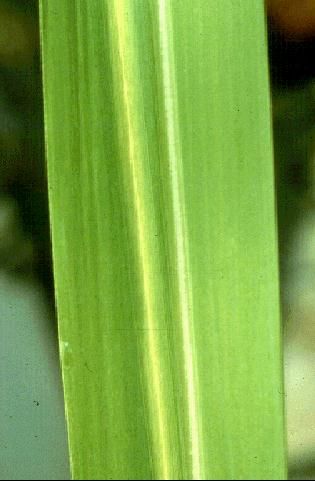
Credit: Philippe Rott, UF/IFAS
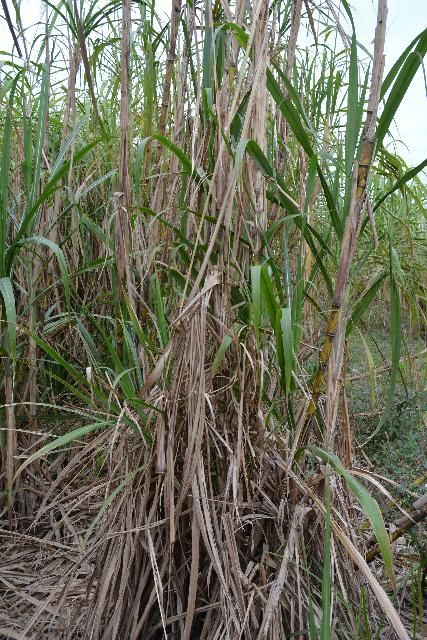
Credit: Philippe Rott, UF/IFAS
Leaf scald can also cause partial or complete bleaching/chlorosis of the leaf blade (Figure 3). Close inspection of these areas may reveal the diagnostic white pencil line or its reddish necrotic sections.
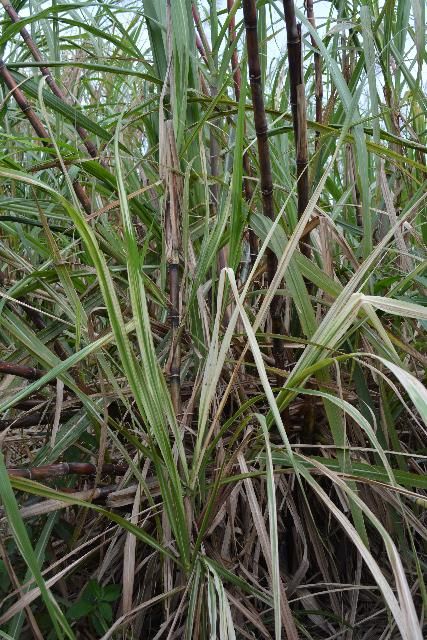
Credit: Philippe Rott, UF/IFAS
The disease can also cause shoots to be stunted and wilted. Usually, affected leaves turn a dull blue-green color before dense browning (a late symptom of the disease). Under stress conditions the whole stool may die. This has happened in a few fields of CP 80-1743 grown under stress conditions.
On mature stalks, the spindle leaves become necrotic from the tips and moderate to profuse side shoots develop. Side shoots first appear at the bottom of the stalk and progress upward. These side shoots usually show the scalding and/or white pencil lines (Figure 4). The side shoots often die while quite small (<18 inches or 46 cm).
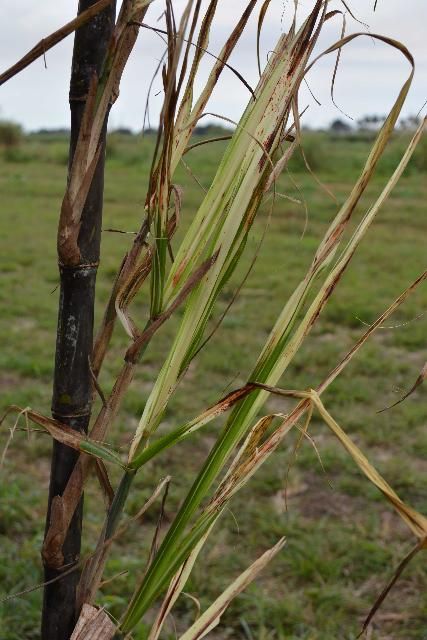
Credit: Philippe Rott, UF/IFAS
Internally, affected stalks may show bright to dark red streaks caused by necrosis of the vascular bundles (Figure 5). These streaks are most prominent at the nodes and are usually present at the juncture of side shoots and the stalk.
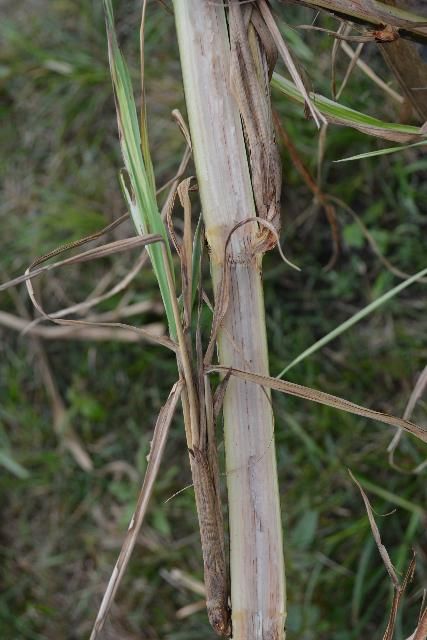
Credit: Philippe Rott, UF/IFAS
The acute phase is characterized by a sudden wilting and death of mature stalks, often without previous symptom expression. The onset of this condition generally follows a period of stress, especially after prolonged drought, but seems to be restricted to highly susceptible varieties.
Causal Agent
In the early stages of infection, the leaf scald bacterium is restricted to the xylem elements of the vascular bundles in the white pencil line streaks. It is generally not found in the surrounding chlorotic leaf tissues. A phytotoxin called albicidin has been isolated from chlorosis-inducing strains of X. albilineans. This phytotoxin inhibits chloroplast differentiation and thus disrupts photosynthesis. In the late stages of infection, the pathogen exits the xylem and invades other tissues, causing the appearance of lysigenous cavities in the stalk (Mensi et al. 2014).
Variants of the pathogen have been identified. Worldwide there are at least three serological strains of the bacterium, and several variants in virulence have also been reported. Two distinct genetic strains have been reported in Florida, and one of them was associated with the leaf scald outbreak that occurred in the late 1980s (Davis et al. 1997).
Spread of the Disease
Leaf scald is a systemic disease that may be inconspicuous (latent) for lengthy periods of time, and infected seed cane is a major cause of disease spread (Ricaud and Ryan 1989). Cutting knives, including those on machinery, are an important source of infection.
The pathogen can survive in stubble but does not appear to survive for long periods of time in soil or un-decomposed cane trash.
Alternative hosts offer another means of pathogen survival. X. albilineans naturally infects several wild grass weeds, such as elephant grass (Pennisetum purpureum).
Besides transmission by cutting knives and infected cuttings, aerial spread of leaf scald has been reported to occur in Florida, Guadeloupe (French West Indies), and Mauritius. There have been suggestions that the leaf scald outbreak that occurred in Florida in the late 1980s was caused by a new strain of the pathogen that survives better on sugarcane leaves or has a greater propensity toward aerial transmission (Davis et al. 1997).
The amount of damage caused by leaf scald appears to be influenced by environmental conditions. Periods of stress such as drought, waterlogging, and low temperature are reported to increase disease severity. The yield of stalks that are dead or have necrotic tops and leaves with numerous side shoots is decreased to 20%–30% of that of symptomless stalks. Presently, very few plants show these symptoms at harvest, and leaf scald is not an economic problem at this time in Florida because of the use of resistant varieties.
Prevention and Control
The best control for leaf scald is preventing the disease and replacing susceptible varieties with resistant varieties. Because leaf scald is a latent disease, growers should be alert for infection even in varieties thought to be resistant.
Seed cane can be given a long hot-water treatment to kill the pathogen. In Australia, a 24-hour presoak in flowing water followed by a three-hour 50°C (122°F) treatment is used to clean infected planting material. The shorter two-hour 50°C (122°F) treatment used for ratoon stunting disease provides only partial control. Using disease-free seed cane derived from a tissue culture process also controls the disease.
To prevent mechanical spread of the pathogen, all cane cutting knives, including those on mechanical harvesters, should be sterilized when coming from suspect fields. Disinfection of the knives can be accomplished by cleaning and immersing for several minutes in a suitable antiseptic solution, such as Lysol, alcohol, or a diluted solution of bleach. If the pathogen is transmitted aerially, it also influences the length of time disease-free seed fields remain disease-free. There are no known chemical or biological controls for this disease.
References
Davis M.J., P. Rott, C.J. Warmuth, M. Chatenet, and P. Baudin. 1997. "Intraspecific genomic variation within Xanthomonas albilineans, the sugarcane leaf scald pathogen". Phytopathology 87(3):316–324. https://doi.org/10.1094/PHYTO.1997.87.3.316
Mensi, I.., M.S. Vernerey, D. Gargani, M. Nicole, and P. Rott. 2014. "Breaking dogmas: The plant vascular pathogen Xanthomonas albilineans is able to invade non-vascular tissues despite its reduced genome". Open Biology 4:130116. https://doi.org/10.1098/rsob.130116
Ricaud C., and C.C. Ryan, 1989. "Leaf scald". In Diseases of sugarcane. Major diseases, edited by Claude Ricaud, Brian T. Egan, A. Graves Gillaspie Jr., and C. Graham Hughes, 39–58. Amsterdam, The Netherlands: Elsevier. https://doi.org/10.1016/b978-0-444-42797-7.50007-7
Rott, P., and M. Davis. 2000. "Leaf scald". In A guide to sugarcane diseases, edited by Philippe Rott, Roger A. Bailey, Jack C. Comstock, Barry J. Croft, and A. Salem Saumtally, 38–44. Montpellier, France: CIRAD/ISSCT, La Librairie du Cirad.