

Selling Yourself: A Guide to Writing Effective Resumes1

Credit: Creatas Images/Thinkstock.com
Introduction
One vital tool to have when seeking employment or considering a career change, is a powerful, effective, and well-written resume. While a resume is not the sole deciding factor in the hiring decision, it is a major deciding factor in gaining an interview. It is for this reason that the resume is so important.
There are a number of fundamental elements to consider before beginning the process of writing of a resume or cover letter. This paper will guide the reader through the basic components of the resume and cover letter and provide comments on frequently asked questions by job seekers.
The Cover Letter
The purpose of the cover letter is to introduce the applicant to the potential employer. There are no stringent guidelines to writing a cover letter, but it should effectively highlight the applicant's skills and qualifications and explain the reason for the letter and enclosed resume.
It should be assumed that there are many applicants for the position and that few will get interviewed. When writing a cover letter, the applicant should ask the question: "How can my knowledge and abilities increase a company's sales and profits, or otherwise add value to the organization?"
The Resume
The Basics
First, a common myth about the resume is that it must be limited to one page. In today's business setting, nothing could be further from the truth. Some experts now advise expanding the resume to two or more pages if the information has value (Rockport Institute 2002). That is, never use unnecessary filler information that has no value to the potential employer.
Second, it is important to print the resume on high quality paper. What does it say to the potential employer when a resume is printed on standard photocopier paper? Retail office stores offer high quality resume paper that comes in many colors and textures to express the individuality of the applicant.
Third, it is very important for the resume to be easy to read and be well organized (Rockport Institute 2002). A well-written resume that is grammatically correct and free from spelling errors demonstrates the writing and organizational skills of the applicant.
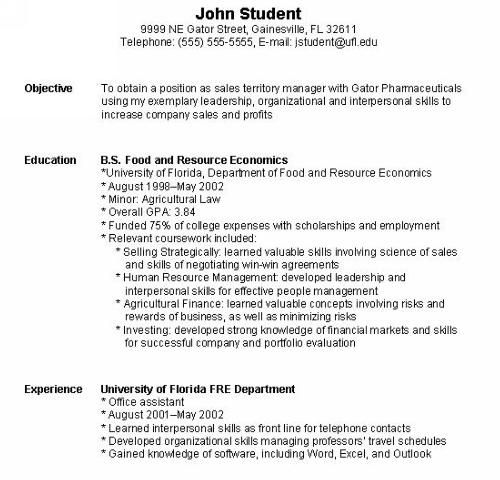
Finally, the resume should be written from the perspective of the potential employer (Rockport Institute 2002). Resumes should be written specifically with this question in mind: "Why should this employer interview or hire me?" A sample resume is included at the end of this document (Table 1) to illustrate the various parts of a resume.
The Heading
The heading is one of the most important areas of the resume. It should include the following contact information:
• Full name
• Current address
• Current phone number
• E-mail address
The applicant's name should be printed in large, bold text at the top of the page so that it stands out from the rest of the resume. Some applicants use a different font for the heading, but this is an individual preference. It is undoubtedly the first thing you want a reader to notice about the resume. Including the address and phone number is standard operating procedure for all resumes. Contact information should be concise and listed at the top of the resume under the applicant's name. Because many, if not most, employers contact applicants via e-mail, it is advisable to include an e-mail address as part of the heading, if possible. Avoid using an unprofessional e-mail address (e.g., bigbird@gmail.com) on a resume.
Objective Section
The objective section should be a short, concise statement that outlines exactly what the applicant intends to accomplish by writing the resume. Applicants should consider both their our goals and the company's goals when writing the objective statement. Whatever is chosen for the objective statement should entice the potential employer to read the resume. For instance, the objective could state how the applicant wishes to increase company sales and profits. This is obviously of benefit to the potential employer. The applicant's leadership, organization, and interpersonal skills will almost certainly be of benefit to the employer as well.
Education Section
The education section is very important for both current college students and recent graduates with no experience because it provides them the opportunity to explain their potential skills for the job. Both current college students and recent graduates would be well advised to list the education section before experience, while seasoned veterans of the workforce might elect to list employment experience before education.
The education section should be listed in chronological order, with the most recent diploma/degree listed before the name of the school attended. It is also advisable to list the major and specialization. Consider including any specific coursework, as well as skills developed from that coursework, that might be relevant to the position for which the applicant is applying.
There is much debate relating to the issue of including grade point averages (GPA) in the education section of a resume. It is the authors' belief that the GPA should always be included if it is higher than 3.0. Because there are different GPAs that can be used in the resume (e.g., overall GPA, upper division GPA, major GPA, specialization GPA, etc.), the applicant should include the highest GPA. However, not listing a GPA in the resume might be interpreted as if the applicant has something to hide.
If the applicant is a college student or recent graduate, there is no need to include high school education information. High school graduates should follow the same rules for completing the education section as college students.
As a final note on the education section, applicants who self-funded all or a majority of their college expenses might want to list that fact on their resumes. This would demonstrate that the applicant is well rounded and can balance a busy schedule.
Experience Section
The employment experience section offers the applicant the opportunity to demonstrate work skills. The authors believe that employers hire people for SKILLS developed, not DUTIES performed. Therefore, the applicant's resume should heavily emphasize skills that were developed from performing duties, rather than just enumerating the duties performed. Heavy emphasis should also be placed on special achievements in the workplace. The authors advise avoiding the use of terms such as "responsible for" and "assisted in." For example, instead of the statement, "Worked as a teaching assistant in the instruction of AEB 3341," a more favorable statement would be, "By working as a teaching assistant in the instruction of AEB 3341, I developed exemplary organizational and people skills by interacting with students in a classroom setting."
Once again, reverse chronological order is preferred, with employment history beginning with most recent employment. In this case, place of employment should come first, as in the sample resume (Figure 1).
Additional/Other Information Section
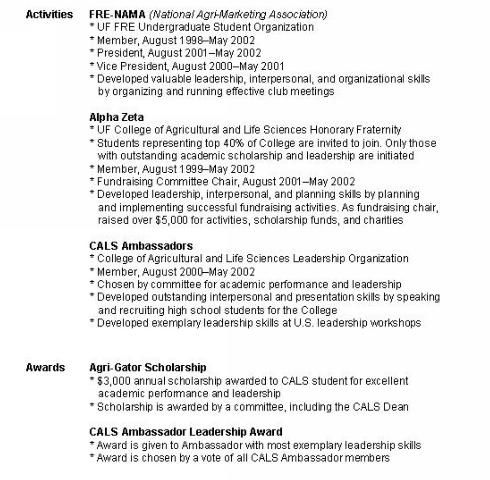
The additional/other information section allows the applicant to emphasize special activities and achievements acquired outside the workforce or through college extra-curricular activities. Emphasis should be placed on skills developed and achievements accomplished. Because organizational activities are of interest to employers, the applicant should use this section as an opportunity to demonstrate how he or she is a well-rounded individual with strong leadership abilities. The applicant should state how he or she participated in student organizations, not just list the names of the organizations with which he or she was involved.
In addition to organizational activities, the applicant should also list scholarship awards along with the recognition criteria for the awards and the grantors of awards. Non-school awards should also be listed.
It is advisable to include any special abilities, licenses, or certifications, etc., that may be applicable to a potential position. The applicant should include anything that might be appealing to a potential employer.
There is a debate on whether to include any interests or hobbies in this section. The authors believe that this can certainly do no harm, if space permits. Who knows? Perhaps the potential employer has similar interests, which might help the applicant gain employment.
There is also a debate on whether to list references. Some professionals advise listing references on the resume, while others advise listing references as "available upon request." The authors believe that it is best to leave a reference section out of the resume because almost all employers assume that references are available upon request. The applicant should have an available list of references (including how to contact the references and what information the references may provide) to give to the potential employer when requested.
Conclusions
A cover letter and resume are basically documents designed to present the applicant's skills in the best possible way to add value to an organization. It should be written to correctly and effectively set the applicant apart from other applicants being considered by focusing on achievements aimed at increasing professional development and abilities.
A final piece of technical advice. When composing your resume, it is important to consider the audience by including the following (Markel 2001):
Determine who is reading your resume.
Write what the reader wants to hear.
Make your resume easy to read.
Write a resume with substance and depth.
Good luck and happy job-hunting!
Reference
Markel, M. 2001. Technical Communication. 6th ed. Bedford/St. Martins. Boston, MA.
Rockport Institute. 2002. How to write a masterpiece resume. http://rockportinstitute.com/resumes/.
Accent Resume Writing. 2002. http://www.accent-resume-writing.com/resume-writing-101.html.