
Introduction
Timing and placement of fertilizer applications can influence fertilizer use efficiency and ultimately crop production. An important objective underlying any fertilizer application is to ensure that nutrients are used efficiently by the target crop in order to achieve optimum yield and avoid detrimental effects to the environment. Appropriate crop nutrition management decisions include avoiding over-fertilization to target fields and/or misapplication of fertilizer sources to non-target areas. With respect to phosphorus (P) fertilizers, over-fertilization and/or misapplication can negatively impact the P concentration of water drained from agricultural fields. Controlled P fertilizer application is an identified Best Management Practice (BMP) approved by the South Florida Water Management District (SFWMD), one designed to reduce drainage water P loads in the Everglades Agricultural Area (EAA). The controlled P fertilizer application BMP is widely implemented by growers throughout the EAA, since this BMP is readily implemented, reduces P fertilizer costs, and normally results in improved crop production. This EDIS document is one in a series of publications that provide current implementation guidelines for commonly employed BMPs that target the reduction of P loads leaving EAA farms via drainage water.
Controlled P Fertilizer Placement
Agricultural production on organic (Histosol) soils plays a major economic role in the south Florida region. However, agriculture has also come under public scrutiny due to concerns that P concentrations in farm drainage waters may contribute to unfavorable ecological impacts observed in Lake Okeechobee, Water Conservation Areas, and the Everglades National Park (Newman et al., 1997; SFWMD, 1992). Improved P fertilizer management is a tool designed to increase P fertilization efficiencies while also decreasing P loading in agricultural drainage water from EAA farms (Izuno et al., 1991). Strategies for reducing P losses from the organic soils of the EAA focus on lowering P fertilization rates based on improved soil-test calibrations and improved P fertilizer placement. Fertilizer placement refers to the practice of positioning fertilizer in a specific area within the field (any number of banding strategies), generally near the plant roots, in contrast to broadcast strategies which apply fertilizer more or less evenly across the entire field surface. Fertilizer application strategies can greatly influence the efficiency of crop recovery of P, which in turn influences the potential for P transport loss via erosion and runoff events (Pierzynski et al., 1994). The rate and method of P fertilizer application have direct effects on the quantity of P that can potentially be transported off of the farm. Best management practices and improved recognition of plant-available residual P levels in soils have decreased the overall use of P fertilizer (Sharpley, 1999). Consequently, the quantity of P leaving EAA agricultural lands in drainage water is very small relative to the quantity of P applied to the crop as fertilizer. The benefits of banding P fertilizers for various crops are well documented (Randall and Hoeft, 1988).
Reasons supporting the banding of P fertilizers in the EAA include:
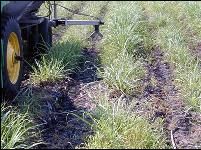
- Banding P fertilizer has shown a marked positive effect on crop yield response depending on soil test levels in soils with low levels of available P, placement of fertilizer P close to the root system results in greater P plant uptake and use efficiency by the crop (Figure 1). At low fertilization rates, the efficiency of P uptake by the crop is greater for banding than broadcast application, especially for P applications on soils with high P-fixation capacity, such as the organic soils of the EAA (Sanchez et al., 1990, 1991).
Credit: UF/IFAS
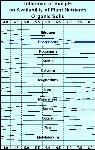
Band application of P fertilizer reduces the soil-fertilizer surface contact area, resulting in slowed P fixation (i.e., P that is chemically transformed and rendered unavailable to plants) rates by the organic soils of the EAA, resulting in increased quantities of P that is available for crop uptake. Banding of P fertilizer often decreases soil pH within the narrow application zone which encourages improved P availability over a longer period of crop growth. This phenomenon is particularly important for soils with naturally high P fixation capacities (i.e., EAA organic soils with pH greater than 6.5; Figure 2; Lucas, 1982).
Credit: Lucas (1982)
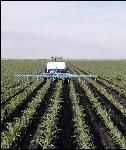
Banding greatly reduces the likelihood of overlapping fertilizer applications, since fertilizer placement is readily visible to the fertilizer rig operator (Figure 3).
Credit: UF/IFAS
- The most important advantage of banding is the significant reduction of the overall amount of P applied to a particular crop. This is especially important for vegetable production on the organic soils of the EAA. Sanchez et al. (1990) reported that banding can reduce the amount of P fertilizer applied to lettuce by 66% compared to broadcast application. Banding is also a viable strategy to reduce the amount of P used in sweet corn production on organic soils (Sanchez et al., 1991), since it provides a method to achieve profitable sweet corn production while minimizing environmental risks.
Prevention of P Fertilizer Misapplication
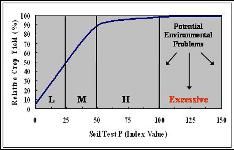
Soils with high P fertility levels, or soils that have annually received P fertilization rates that exceed those of crop removal, often exhibit high soil-test P levels. Application of P fertilizers to fields with soil test values well above levels identified as high or optimum is considered unnecessary and increases the possibility of P losses to surface waters (Figure 4; Sharpley et al., 1993). Preventing over-fertilization and misapplication of P fertilizers to non-target areas will aid in reducing farm drainage P loads.
Credit: Sharpley et al. (1993)
Some practical recommendations to keep in mind to reduce the chances that P fertilizers are applied to non-target areas or over-applied to target areas:
- Establish a well-documented, highly visible P fertilization management decision program that is based on a consistent soil-testing program designed to deliver agronomically and economically sensible P fertilizer recommendations for all field/crop combinations on the farm.
- Properly fine-tune and calibrate fertilizer application spreaders several weeks before the planting season starts and then at least one day before any given application date. The goal is to avoid procrastination that might lead to a rushed, incomplete calibration effort.
- Never broadcast fertilizers near open waterways such as canals and ditches. If these field scenarios are anticipated, use pneumatic controlled edge or band applicators.
- When turning fertilizer application rigs, use reduced ground speeds to avoid flinging fertilizer onto roadways and into ditches and canals (Figure 5).
- Use row-marking strategies such as foams or soil markers to avoid overlapping fertilizer applications (i.e., an excessive application rate).
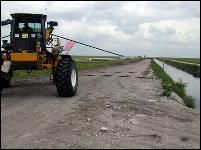
Credit: UF/IFAS
Summary
- Band-application of P fertilizers to agricultural fields in the EAA is an effective BMP to reduce P loads leaving farms via drainage waters.
- On the neutral and higher pH, organic soils of the EAA, fertilizer use efficiency is greater for band-applied P fertilizer than for broadcast-applied P fertilizer.
- Band-applied P fertilizer rates are generally reduced by half or more compared to broadcast-applied P fertilizer rates for most crops, including leafy vegetables and sweet corn.
- The reduction in total amount of P applied per acre made possible with banded P application strategies will generally result in a significant reduction in off-farm drainage P loads relative to the use of broadcast P applications.
- Tune and calibrate fertilizer application equipment in a timely manner and confirm application rates during the in-field fertilizer application event to ensure accuracy and precision. Proper maintenance of fertilizer equipment will help limit the misapplication of P fertilizers to fields.
Acknowledgements
The authors are grateful for the financial support of the Everglades Agricultural Area Environmental Protection District and The Florida Department of Environmental Protection that enables the preparation of this document as well as the implementation of the relevant BMP studies described herein.
References
Izuno, F.T., C.A. Sanchez, F.J. Coale, A.B. Bottcher, and D.B. Jones. 1991. “Phosphorus concentrations in drainage water in the Everglades Agricultural Area.” J. Environ. Qual. 20:608–619. https://doi.org/10.2134/jeq1991.00472425002000030018x
Lucas, R.E. 1982. Organic soils (Histosols). Formation, distribution, physical and chemical properties and management for crop production. Res. Rpt. 435, Michigan State University.
Newman, S., K.R. Reddy, W.F. DeBusk, Y. Wang, G. Shih, and M.M. Fisher. 1997. “Spatial distribution of soil nutrients in a northern Everglades marsh.” Water Conservation Area 1. Soil Sci. Soc. Am. J. 61:1275–1283. https://doi.org/10.2136/sssaj1997.03615995006100040038x
Pierzynski, G.M., J. T. Sims, and G.F. Vance. 1994. Soil and Environmental Quality. Lewis Publ., Boca Raton.
Randall, G.W., and R.G. Hoeft. 1988. “Placement methods for improved efficiency of P and K fertilizers.” J. Prod. Agric. 1:70–78. https://doi.org/10.2134/jpa1988.0070
Sanchez, C.A., P.S. Porte, and M.F. Ulloa. 1991. “Relative efficiency of broadcast and banded phosphorus for sweet corn produced on Histosols.” Soil Sci. Soc. Am. J. 55:871–875. https://doi.org/10.2136/sssaj1991.03615995005500030042x
Sanchez, C.A., S. Swanson, and P.S. Porter. 1990. “Banding P to improve fertilizer use efficiency of lettuce.” J. Amer. Soc. Hort. Sci. 115:581–584. https://doi.org/10.21273/JASHS.115.4.581
Sharpley, A.N. 1999. Global issues of phosphorus in terrestrial ecosystems. P. 15-46. In K.R. Reddy et al. (ed.), Phosphorus biogeochemistry in subtropical ecosystems. Lewis Publ., Boca Raton, FL.
Sharpley, A.N., T.C. Daniel, and D.R. Edwards. 1993. “Phosphorus movement in the landscape.” J. Prod. Agric. 6:492–500. https://doi.org/10.2134/jpa1993.0492
South Florida Water Management District. 1992. Surface water improvement and management plan for the Everglades. SFWMD, West Palm Beach, FL.