
Introduction
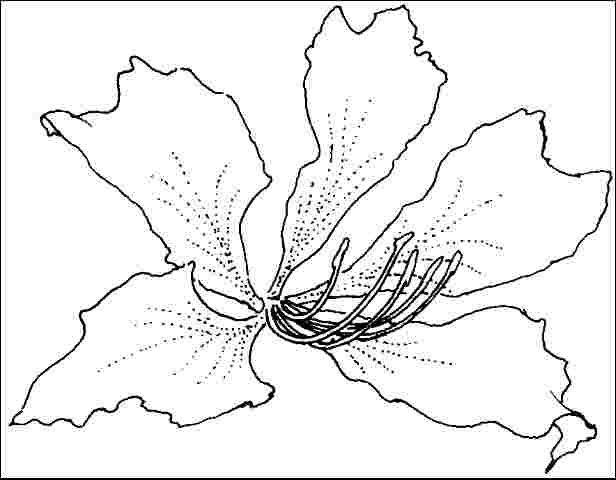
This fast-growing orchid-tree will ultimately reach 35 feet in height and width, the slender trunks topped with arching branches clothed in large, two-lobed, deciduous leaves. In fall, before the leaves drop, orchid-tree is festooned with many showy and delightfully fragrant, 5-inch-wide blossoms, the narrow purple, pink, and lavender petals arranged to closely resemble an orchid. These flowers appear on the trees from September through November and are a beautiful sight to see, creating a vivid splash of color in the autumn landscape. The flowers are followed by 12-inch-long, slender, brown, flat seedpods which usually persist on the tree throughout the winter, then fall to create a mess to clean up. The spectacular flower display makes orchid-tree a favorite for specimen plantings.
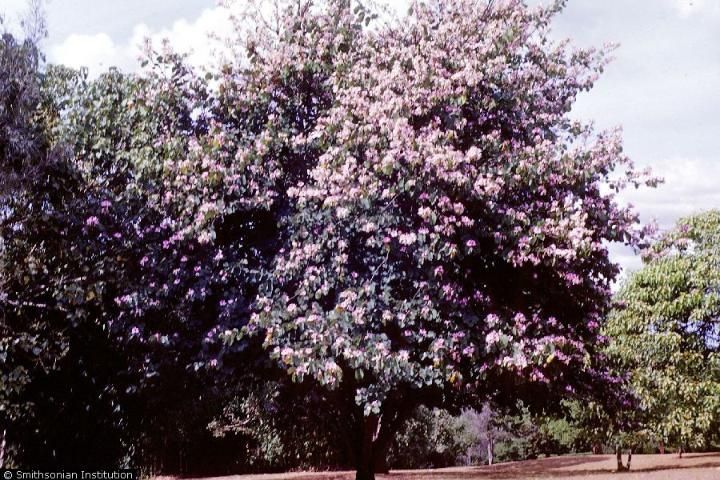
Credit: R.A. Howard @ USDA-NRCS PLANTS Database
General Information
Scientific name: Bauhinia purpurea
Pronunciation: bah-HIN-ee-uh per-POOR-ee-uh
Common name(s): Purple orchid-tree
Family: Leguminosae
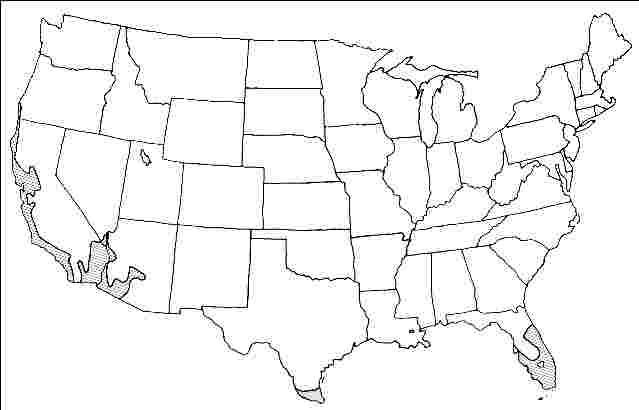
USDA hardiness zones: 9B through 11 (Figure 2)
Origin: not native to North America
Invasive potential: According to the IFAS Assessment of Non-Native Plants in Florida's Natural Areas (IFAS Invasive Plant Working Group 2008), Bauhinia purpurea is invasive and not recommended in Florida (to see if any exceptions for specified and limited use have been approved since publication, check the Conclusions Table at: http://plants.ifas.ufl.edu/assessment/conclusions.html).
Uses: reclamation; street without sidewalk; deck or patio; shade; specimen; parking lot island < 100 sq ft; parking lot island 100–200 sq ft; parking lot island > 200 sq ft; tree lawn 3–4 feet wide; tree lawn 4–6 feet wide; tree lawn > 6 ft wide; highway median
Availability: somewhat available, may have to go out of the region to find the tree
Description
Height: 30 to 35 feet
Spread: 30 to 35 feet
Crown uniformity: symmetrical
Crown shape: vase, round
Crown density: moderate
Growth rate: fast
Texture: coarse
Foliage
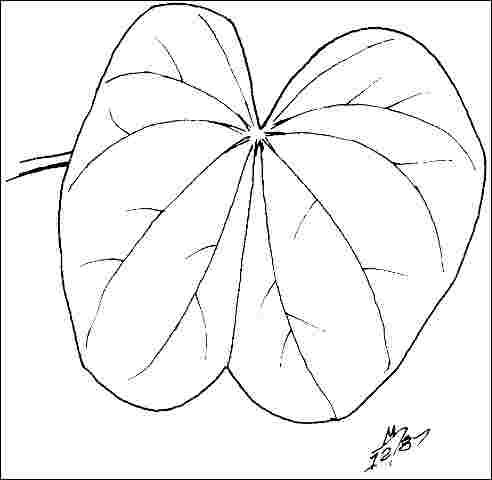
Leaf arrangement: alternate (Figure 3)
Leaf type: simple
Leaf margin: cleft, lobed
Leaf shape: orbiculate
Leaf venation: palmate
Leaf type and persistence: deciduous
Leaf blade length: 2 to 4 inches
Leaf color: green
Fall color: no color change
Fall characteristic: not showy
Flower
Flower color: red, purple, blue
Flower characteristics: very showy
Fruit
Fruit shape: elongated, pod or pod-like
Fruit length: 6 to 12 inches
Fruit covering: dry or hard
Fruit color: brown
Fruit characteristics: does not attract wildlife; showy; fruit/leaves a litter problem
Trunk and Branches
Trunk/bark/branches: branches droop; not showy; can be trained to one trunk; thorns
Pruning requirement: needed for strong structure
Breakage: susceptible to breakage
Current year twig color: brown
Current year twig thickness: medium, thin
Wood specific gravity: unknown
Culture
Light requirement: full sun, partial sun, or partial shade
Soil tolerances: clay; sand; loam; acidic; slightly alkaline; well-drained
Drought tolerance: high
Aerosol salt tolerance: moderate
Other
Roots: not a problem
Winter interest: yes
Outstanding tree: no
Ozone sensitivity: unknown
Verticillium wilt susceptibility: unknown
Pest resistance: free of serious pests and diseases
Use and Management
Orchid-tree should be grown in full sun on well-drained soil. Trees are very drought-tolerant and actually flower best on dry soils. Problems include a tendency to show nutritional deficiencies, especially potassium; the weak wood which is susceptible to breakage in storms; the abundant seedlings which may germinate in the landscape; and the litter problem created by the falling leaves, flowers, and seedpods. Orchid-tree may need occasional pruning to develop a uniform shape when it is young. Branches tend to develop low on the trunk and droop toward the ground forming a large bush if left unpruned. Occasional pruning during the life of the tree will help maintain a nice, neat appearance.
Propagation is by seeds, grafting, cuttings, and air-layerings.
Pests
Borers, caterpillars, and mites.
Diseases
Leaf spot and leaf scorch diseases.
Literature Cited
Fox, A.M., D.R. Gordon, J.A. Dusky, L. Tyson, and R.K. Stocker (2008) IFAS Assessment of Non-Native Plants in Florida's Natural Areas: Status Assessment. http://plants.ifas.ufl.edu/assessment/pdfs/status_assessment.pdf (November 16, 2012)