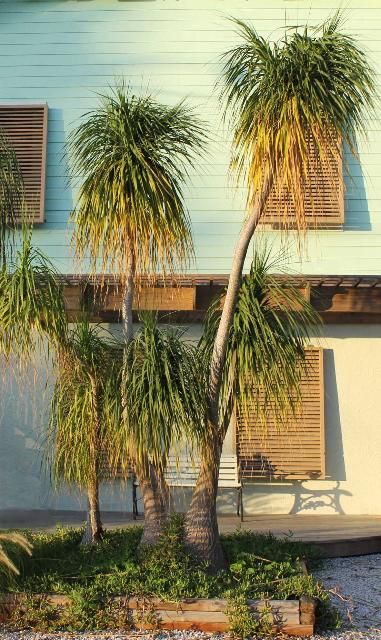
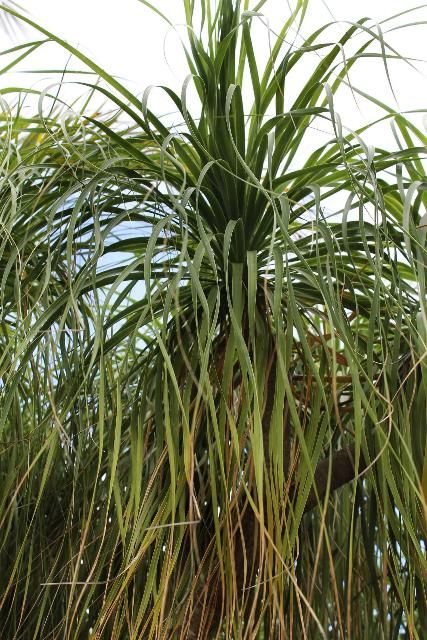
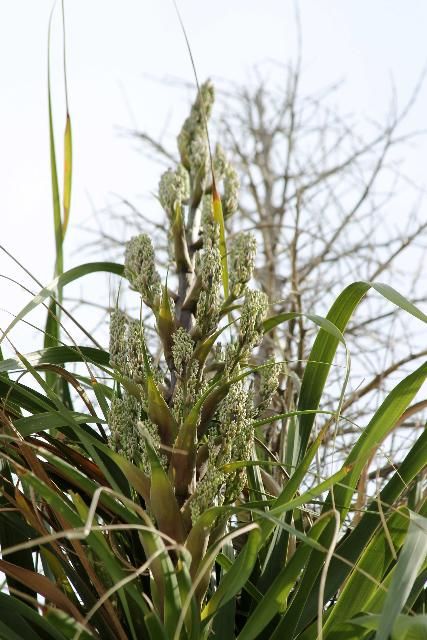
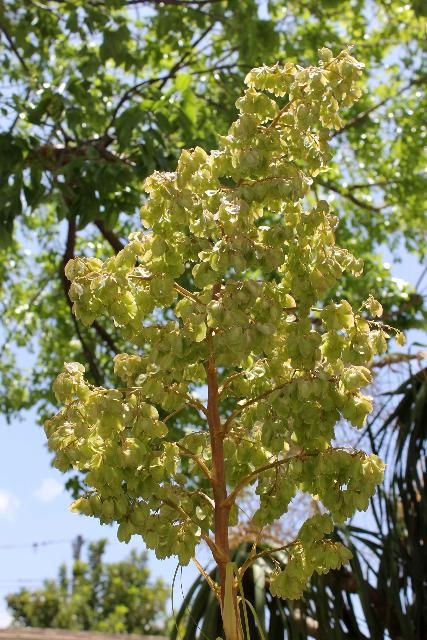
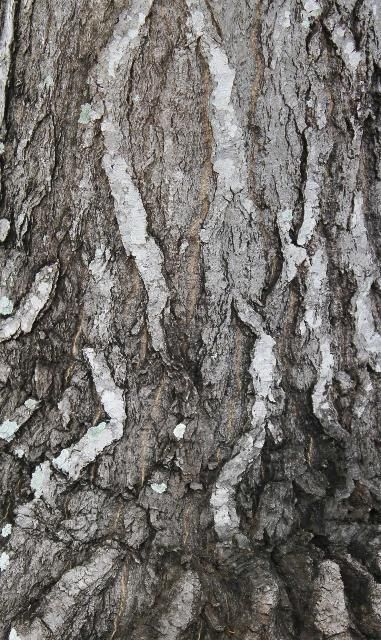
This upright, fine-textured evergreen tree grows very slowly up to 30 feet in height but rarely exceeds 10 feet. A distinctive plant, ponytail palm has a greatly swollen trunk base (sometimes to seven feet across) that narrowly tapers and eventually branches in older specimens. The dark green leaves, up to five feet long and 3/4 of an inch wide, are produced in tufts clustered at the tips of branches. The cascading nature of the leaves gives much the appearance of a pony's tail. Creamy yellow flowers are quite showy as they are held above the foliage in spring or summer for several weeks. The tree will occasionally flower two or even three times a year. This plant makes a great conversation piece, whether grown as a specimen, a container plant, near patios, or placed in rock gardens. It can also be used as a houseplant.
Figure 1. Full Form - Beaucarnea recurvata: ponytail palm Credit: UF/IFAS
General Information
Scientific name: Beaucarnea recurvata
Pronunciation: boe-KAR-nee-uh reck-er-VAY-tuh
Common name(s): ponytail palm
Family: Asparagacea
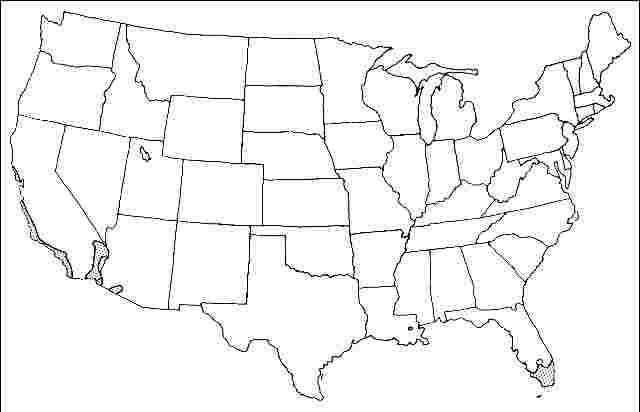
USDA hardiness zones: 10A through 11 (Figure 2)
Origin: native to Belize, Guatemala, and southeastern Mexico
UF/IFAS Invasive Assessment Status: not assessed/incomplete assessment
Uses: indoors; specimen; container or planter; deck or patio
Pest resistance: free of serious pests and diseases
Use and Management
Ponytail palm grows in full sun or partial shade on a wide range of soils. Soil must have good drainage as plants have a tendency to develop root rot on poorly drained soils. Plants moved from indoors to permanent outside locations should be gradually exposed to the increase in light and temperature change.
Propagation is by seed, which usually must be imported from Mexico.
Pests
Chewing insects may disfigure the leaves.
Diseases
Root rots can kill plants grown on wet soils.
References
Koeser, A. K., Hasing, G., Friedman, M. H., and Irving, R. B. 2015. Trees: North & Central Florida. University of Florida Institute of Food and Agricultural Sciences.
Koeser, A.K., Friedman, M.H., Hasing, G., Finley, H., Schelb, J. 2017. Trees: South Florida and the Keys. University of Florida Institute of Food and Agricultural Sciences.