Edward F. Gilman, Dennis G. Watson, Ryan W. Klein, Andrew K. Koeser, Deborah R. Hilbert, and Drew C. McLean
Introduction
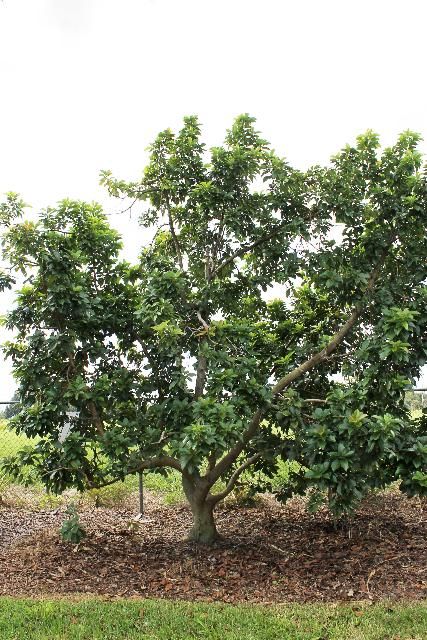
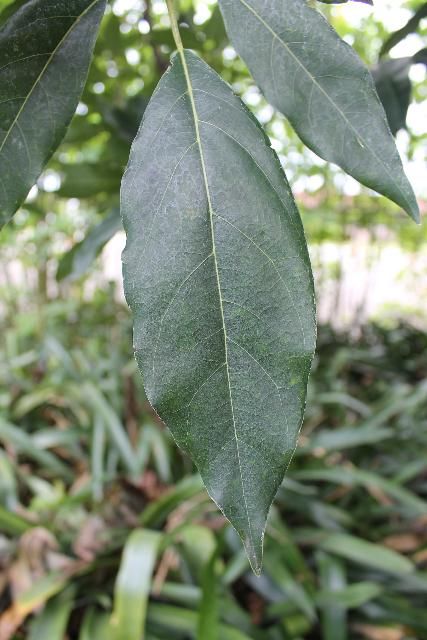
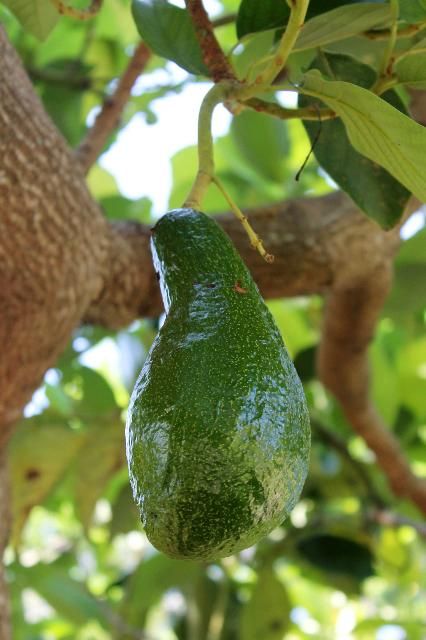
The large, lustrous dark green evergreen leaves and low-branching, open canopy of Avocado makes it a wonderful shade tree, but it is most often grown for the abundant production of its well-known, delicious, buttery fruits. Depending on cultivars and variety, the fruits may vary from smooth-skinned to rough, and yellow-green to purple. Commonly seen at 30 to 40 feet in height but capable of growing much larger, Avocado fits well into large residential landscapes in frost-protected locations. It can be pruned to an open spreading form or left to grow tall forming a rather narrow oval. Older trees become more rounded. The somewhat showy, greenish yellow flowers appear on terminal panicles in late winter to early spring and are followed by the large, pendulous, pear-shaped fruits, ripening late summer to early spring, depending upon variety.
Figure 1. Full Form - Persea americana: avocado Credit: UF/IFAS
General Information
Scientific name: Persea americana
Pronunciation: PER-see-uh uh-mair-ih-KAY-nuh
Common name(s): avocado
Family: Lauraceae
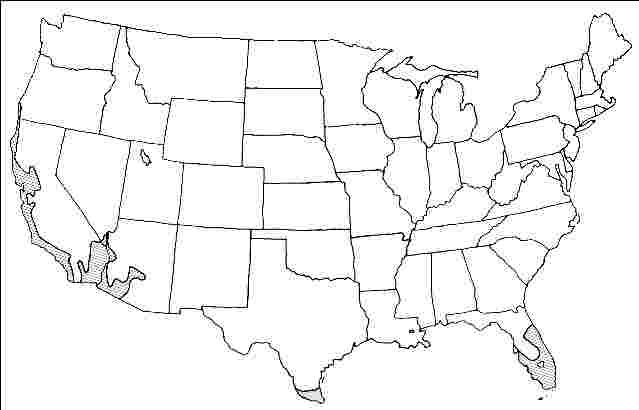
USDA hardiness zones: 9B through 11 (Figure 2)
Origin: native to Mexico and the tropical Americas
UF/IFAS Invasive Assessment Status: not assessed/incomplete assessment
Uses: shade; fruit; specimen
Figure 2. Range
Description
Height: 30 to 40 feet
Spread: 25 to 35 feet
Crown uniformity: symmetrical
Crown shape: oval, round
Crown density: moderate
Growth rate: fast
Texture: coarse
Foliage
Leaf arrangement: alternate
Leaf type: simple
Leaf margin: entire
Leaf shape: elliptic to oval
Leaf venation: pinnate
Leaf type and persistence: evergreen, broadleaf evergreen
Leaf blade length: 4 to 11 inches
Leaf color: emerges shiny and reddish, becoming darkgreen on top and paler green underneath
Avocado trees grow quickly in either full sun or light shade on any well-drained soil. Trees should be watered regularly until established and later during droughts. A forest tree in its native habitat, Avocado respond well to a thick leaf mulch and periodic fertilization. Lawn grasses should be kept away from the trunk. The brittle wood of Avocado trees is subject to storm damage when trees grow taller than 50 feet in the open.
Some of the many cultivars available for variety of fruit production and season are: `Lula', `Tonnage', `Taylor', `Booth 7', `Booth 8', `Pollack', `Trapp', `Walden', `Linda', and `Itzamna'.
Propagation is by seed or grafting.
Pests
Mites and scale infestations can become quite serious in local areas.
Diseases
Root rots on poorly-drained soils and leaf-spotting diseases can be troublesome.
Redbay Ambrosia Beetle-Laurel Wilt Disease (RAB-LW) is a major threat to avocado trees and related species.
Reference
Koeser, A.K., Friedman, M.H., Hasing, G., Finley, H., Schelb, J. 2017. Trees: South Florida and the Keys. University of Florida Institute of Food and Agricultural Sciences.