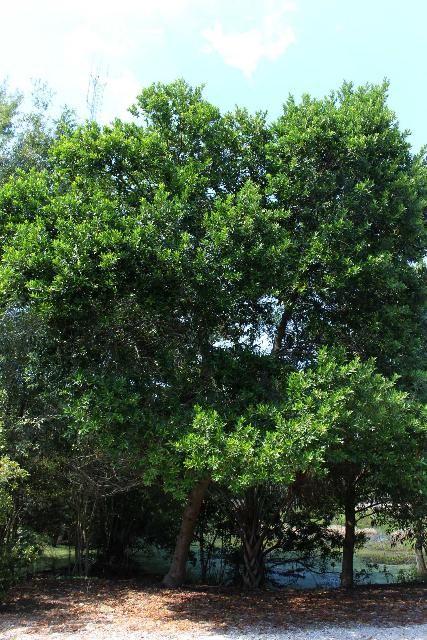
Cherry-laurel, a dependable, easily grown, North American native, is densely foliated with glossy, dark green, evergreen leaves. The tree can reach 40 feet in height with a 25-foot spread though is often seen smaller when grown in the open. Cherry-laurel will create a dense screen or hedge with regular pruning, but is also attractive when allowed to grow naturally into its upright-oval, dense form. Properly trained to a central leader, the plant could make a good small to medium-sized street tree.
The tree usually maintains a good central leader and small-diameter, strong lateral branches following one or two proper pruning's before the tree is 8 to 10 years old. Cherry-laurel was widely planted in Texas until the severe drought of the early 1950s weakened these trees there. Many of the weakened trees eventually died from borers.
Figure 1. Full Form - Prunus caroliniana: cherry-laurel Credit: UF/IFAS
General Information
Scientific name: Prunus caroliniana
Pronunciation: PROO-nus kair-oh-lin-ee-AY-nuh
Common name(s): cherry-laurel, Carolina laurelcherry
Family: Rosaceae
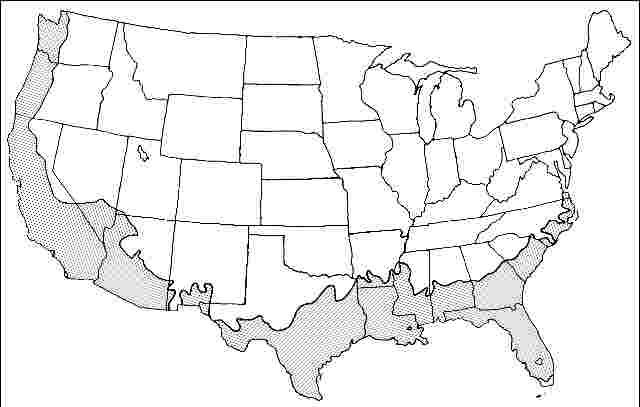
USDA hardiness zones: 8A through 10A (Figure 2)
Origin: native to the southeastern United States and eastern Texas
UF/IFAS Invasive Assessment Status: native
Uses: street without sidewalk; deck or patio; screen; hedge; reclamation; trained as a standard; sidewalk cutout (tree pit); tree lawn 3-4 feet wide; tree lawn 4-6 feet wide; tree lawn > 6 ft wide; urban tolerant; highway median
Figure 2. range
Description
Height: 25 - 40 feet
Spread: 15 - 25 feet
Crown uniformity: symmetrical
Crown shape: oval, round
Crown density: dense
Growth rate: moderate
Texture: medium
Foliage
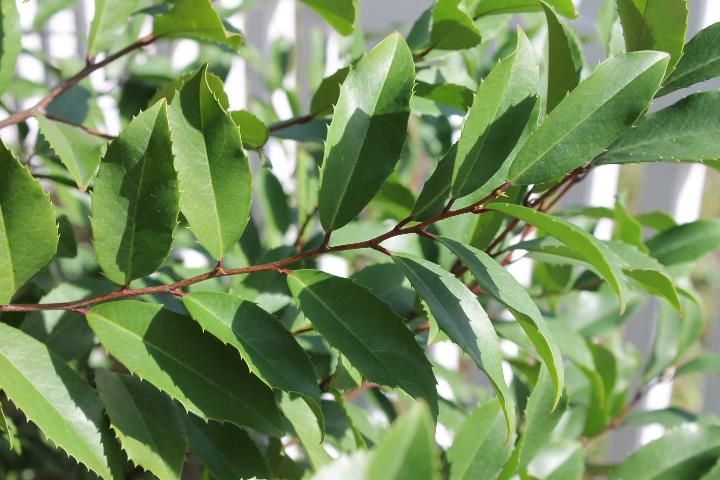
Leaf arrangement: alternate
Leaf type: simple
Leaf margin: entire, serrulate
Leaf shape: oblong, lanceolate, elliptic (oval)
Leaf venation: pinnate, brachidodrome
Leaf type and persistence: broadleaf evergreen, evergreen, fragrant
Leaf blade length: 2 - 4 inches
Leaf color: dark green and shiny on top, dull green underneath
Soil tolerances: clay; sand; loam; slightly alkaline; acidic; well drained
Drought tolerance: high
Aerosol salt tolerance: moderate
Other
Roots: not a problem
Winter interest: no
Outstanding tree: no
Ozone sensitivity: sensitive
Verticillium wilt susceptibility: susceptible
Pest resistance: resistant to pests/diseases
Use and Management
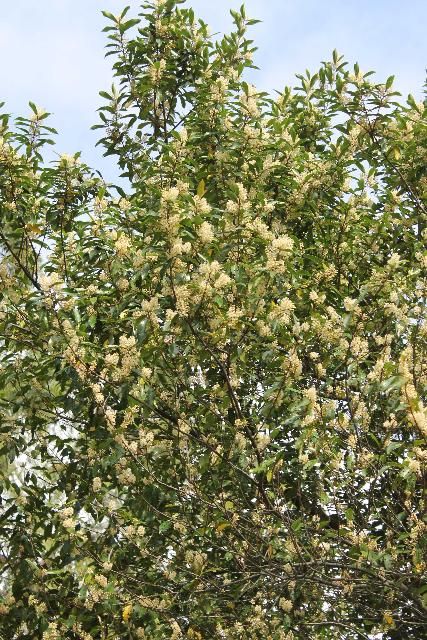
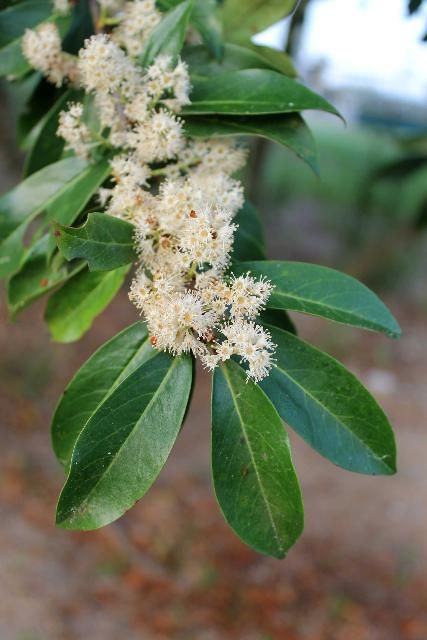
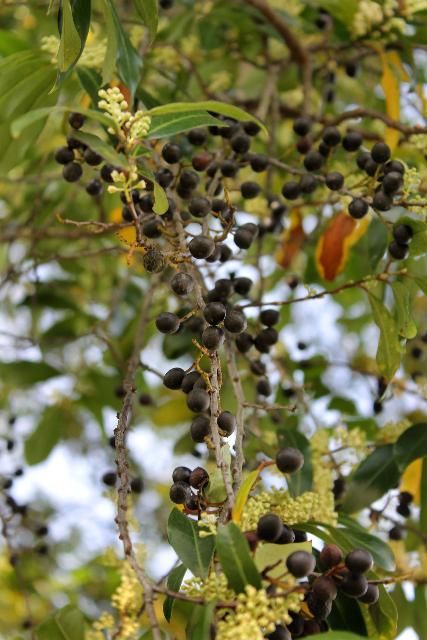
In springtime, tiny, creamy-white showy flowers appear in dense, fragrant clusters and are followed by small, shiny, black cherries, which are attractive to wildlife. The flowers attract a lot of bees. The great quantity of fruit may create a short-term litter problem if the trees are located near a patio or walkway, but the fruit is small and washes away quickly.
The quick growth and ease of maintenance makes Cherry-Laurel ideal for naturalizing and for low-maintenance gardens, except that hundreds of seedlings can be found beneath the crown each year from germinating seeds. Of course, the seedlings would not be a problem in a street tree planting or in an area such as a lawn or highway median, which is mowed regularly. Though the crushed leaves and green twigs give off a delicious maraschino cherry fragrance, they are quite bitter and possibly poisonous. Root systems are often quite shallow, but usually they are not aggressive and do not cause problems.
Preferring ample moisture while young, Cherry-Laurel is otherwise well suited to sun or shade locations on any average, well-drained soil. Once established, Cherry-Laurel is salt- and drought-tolerant, requiring little or no irrigation. Over-irrigating can cause chlorosis and death. Do not plant in wet, soggy areas. The tree adapts well to soils with high pH. Clay soil is fine as long as water doesn't stand after rain.
The Cherry-Laurel cultivar 'Compacta' has a dense, compact habit of growth, to about 20 feet tall.
Propagation is by seeds, by cuttings, or by digging seedlings, which appear in great numbers around mature plants.
Pests
Some of this tree's pests are mites, borers, and caterpillars. Borers are troublesome on stressed trees.
Diseases
Cherry-Laurel may be infected by leaf spot, fire-blight, and stem canker. It can be difficult to grow in containers due to root rot and over-irrigation.
Reference
Koeser, A. K., Hasing, G., Friedman, M. H., and Irving, R. B. 2015. Trees: North & Central Florida. University of Florida Institute of Food and Agricultural Sciences.