
Determining forage moisture is an essential procedure for estimating forage mass in pastures, determining harvesting or baling point for preserved forages, and calculating dry matter of feedstuff for total mixed rations. Target moisture for hay is between 13 and 15% (85–87% dry matter), while it ranges from 40–60% (60–40% dry matter) for baleage, and up to 65% moisture (35% dry matter) for silage. Baling or harvesting at higher moisture can lead to spoilage or spontaneous combustion in hay, or butyric fermentation in silage. However, low moisture can prevent silage from properly fermenting, resulting in slow and low pH reduction for proper storage. There are several methods and pieces of equipment available to estimate forage moisture. Electronic methods such as moisture probes are quick, but they give more variable results than a microwave or forced-air heating unit such as the Koster Tester.
A common first step for all methods is forage sampling:
- For determining herbage mass in pasture, cut forage to desirable height (normally ground level or mowing height when harvesting for hay or silage).
- When sampling in a pasture, it is important to obtain random samples that represent the general condition of the pasture. An easy way to do this is to stop every 50 steps and sample the forage immediately in front of your foot.
- You will need more samples for a larger and more heterogeneous pasture. We suggest harvesting at least 10 subsamples to compose one sample.
2. To sample forage for nutritive value analysis, harvest the forage to the grazing height by hand plucking, simulating what the animals would select.
3. For hay, get subsamples from several locations in the swath because moisture is highly variable (i.e., drier in the exposed surface compared to the center of the swath).
4. For silage, take chopped forage from the silage wagon or randomly select whole plants (cut to desired harvesting height).
For all the direct methods where the forage sample must be dried, it is important to repeat the drying process until the sample reaches constant weight (i.e., until the sample does not change weight with extra drying time). A simple kitchen scale is enough for this procedure. The following formula is used to calculate the percentage of moisture:
% Moisture = (Fresh weight - Dry weight / Fresh weight) x 100
The percentage of dry matter is 100 - % moisture.
Microwave Oven
This is often used for on-farm assessments, since it is cheap and fast. It is important to have a dedicated microwave oven, especially if dealing with fermented silage samples. However, this method should not be used if the sample is for nutrient analysis. The high temperatures can alter chemical composition, thus quality and availability, especially for protein.
Procedure
- Weigh approximately 3.5 oz (100 g) of plant material and place into a microwave-safe dish. Remember to either tare the scale to the dish weight or to record the dish weight so that it can be subtracted from the total weight.
- Put the sample in the microwave with a 10- to 16-oz glass of water to prevent sample combustion.
- Set oven to high for 2–3 minutes.
- Allow to cool to room temperature, weigh, and record sample weight.
- Change the water if boiling and put the sample back into the microwave oven for 2 more minutes. Weigh and record sample weight again.
- Repeat steps 4 and 5 until sample weight remains unchanged or scorching occurs. If scorching occurs, use previous weight.
- Subtract the plate weight from the total weight to get the sample dry weight.
For hay, the procedure takes about 10–20 minutes, depending on the initial moisture content of the sample. Silage samples take 15–25 minutes because of coarser particle sizes and grain content.
Alternatively, a kitchen oven can be used. First, place the forage samples in trays or other oven-safe containers. Do not use paper or plastic because they can burn or melt. Set the oven to the lowest possible temperature, generally around 175°F, and dry for approximately 3 hours. Let the samples cool down to reduce weighing error, then weigh and dry for an extra 30 minutes to see if weight changes. If it does, let the sample dry for another 30 minutes to 1 hour. Repeat the process until constant weight is achieved. When using a regular oven, it is possible to dry more than one sample at a time.
Forced-Air Dryers—Koster Testers and Similar Equipment
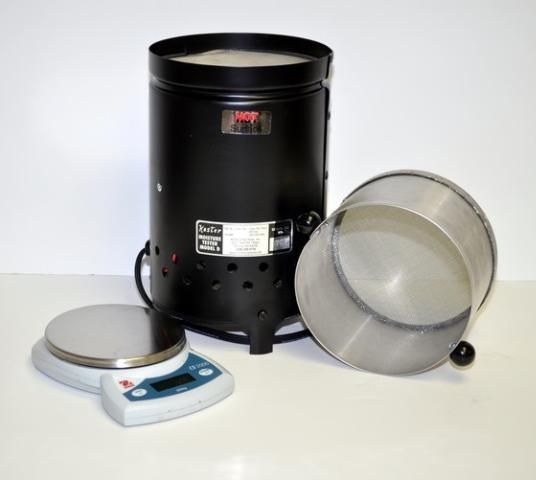
The main forced-air dryer for on-farm use is the Koster Tester (Figure 1). It is an electrical appliance equipped with a heater and a fan which blows hot air though a screen onto the sample. Drying time varies with sample size and material, but the process should take between 20 and 50 minutes. Food dehydrators are another option. Those operate with low temperature and low humidity and may take overnight to dry the sample. Similar to the Koster method, an "air fryer" can be used to dry the samples (Saverson 2019).
Credit: BuyKoster.com
- Weigh approximately 3.5 oz (100 g) of plant material and place into the container (Koster or air fryer).
- If using the air fryer, set the temperature to 250°F.
- Dry for approximately 20–30 minutes.
- Record weight of the dry sample.
- Dry for an extra 5 minutes and see if the dry weight changes. If it does, repeat the process until constant weight is achieved.
- Use the formula above to calculate moisture and dry matter.
Electronic Testers
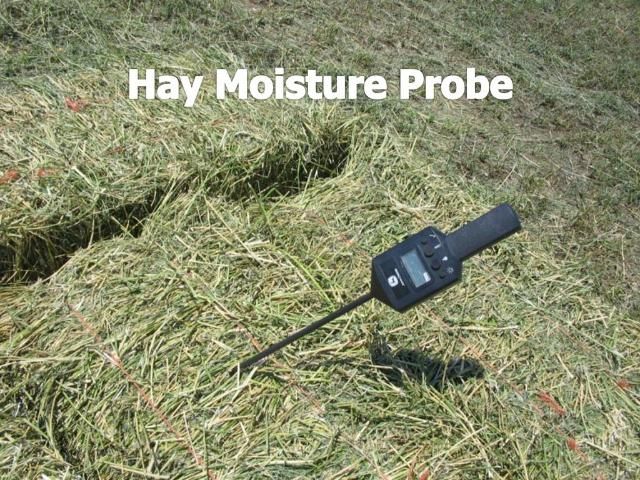
Electronic testers (Figure 2) use conductance to estimate moisture. These are normally used for hay and silage, where forage is compacted and has better contact with the probes. Despite being fast (taking a few seconds per reading), they are highly variable and dependent on the conditions of the material. Results will vary depending on the density of the bale, sample area, varying texture of the forage, and differences among species. To improve reliability, take the average of four to six readings per bale and insert probes into the uncut side of the bale at a 45° angle to the horizontal.
Credit: Dennis Hancock, UGA
The Grab Test (Squeeze Test)
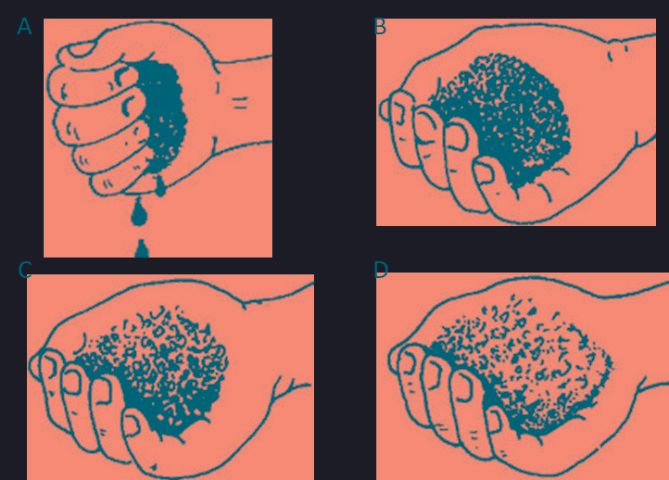
Although not precise, this is a fast and practical test that can be used in the field to show the moisture content of standing crops, hay in a swath or windrow, or chopped forage in a wagon. It should not be used alone. However, it can give a rough estimate for when approaching target moisture. It is important to follow up with one of the methods mentioned above to confirm moisture. Pick up a handful of finely chopped forage and squeeze tightly for 90 seconds. Release your grip and note the condition of the forage ball in your hand. The condition of this ball and the dampness of your hand provide an estimate of the moisture concentration (Figure 3).
Credit: Chamblee and Green (1995)
Reference
Progressive Forage. 2019. "How to use an air fryer to determine dry matter." Accessed on May 23, 2019. https://www.progressiveforage.com/forage-types/silage/how-to-use-an-air-fryer-to-determine-dry-matter
Chamblee, D. S. and J. T Green, Jr. 1995. Production and Utilization of Pasture and Forages in North Carolina, Technical Bulletin 305. Raleigh: North Carolina Agricultural Research Service, North Carolina State University.