

Use of Perennial Grasses in Peanut/Cotton Rotations for Integrated Management of Nematodes, Diseases, and Weeds
This article is intended to inform row crop farmers and related agricultural stakeholders about the use of perennial grass-based rotations to manage pests. Peanut and cotton yields are known to increase when planted after perennial grasses compared to the conventional peanut/cotton rotations. Our studies have shown peanut yields to be consistently higher in a sod-based rotation (1,000 lb/acre) compared to conventional peanut/cotton rotations. In 2014 and 2017, peanut yields of 8,000 lb/ac (double the state average yields) were achieved when strip-tilled into killed bahiagrass.
In many southern states, increases in peanut yield observed in sod-based rotations have been correlated with reduced nematodes and diseases. Further, improvements in soil conditions and a doubling of root mass are also major contributing factors for the higher yields. In several previous articles, we discussed the beneficial effects of sod-based peanut/cotton cropping systems on soil health and economics. This publication discusses the benefits of using perennial grasses in peanut/cotton rotations for integrated management of nematodes, diseases, and weeds.
Nematodes
Nematodes cause plant damage estimated at about $8 billion every year across the United States. Crop losses can exceed 80% on some fields. Nematode damage is more pronounced in Florida due to the sandy soils, but it can vary by crop, nematode species, and environmental conditions. The major nematodes affecting cotton in Florida are Meloidogyne incognita (root-knot nematode) and Rotylenchulus reniformis (reniform nematode). The major nematodes affecting peanut in Florida (Grabau and Dickson 2021) are peanut root-knot nematode (Meloidogyne arenaria), Javanese root-knot nematode (Meloidogyne javanica), and sting nematode (Belonolaimus longicaudatus). Nematodes of the Meloidogyne genus that affect cotton and peanut also interact with disease pathogens, resulting in further yield losses.
Nematode management in peanut (Grabau and Dickson 2021) and cotton (Grabau 2021) typically relies on a combination of nematicide application, non-host crop rotation, and use of resistant cultivars. Most farmers use nematicides or fumigants to control nematodes where high levels are expected. However, many nematicides and fumigants such as 1,2-dibromo-3-chloropropane (DBCP), ethylene bromide, and methyl bromide are now banned due to environmental concerns. Telone II fumigation, AgLogic 15GG, and Vydate C-LV are among the older nematicide chemistries used in cotton and peanut production (Grabau 2021; Grabau and Dickson 2021). A newer nematicide active ingredient, fluopyram, has also come on the market, which is effective as a nematicide and fungicide. For cotton and peanut, fluopyram was originally released as Velum Total (fluopyram mixed with the insecticide imidicloprid) but has since switched to a formulation with only fluopyram (Velum). Crop rotation, including sod-based rotation, can have a greater impact on yield than Velum Total. In studies comparing sod-based or conventional rotation either with or without nematicides and with and without irrigation, rotation gave the highest yield increases of about 1,000 lb/ac on peanut while irrigation resulted in a 400 lb/ac increase with a 200 lb/ac increase from use of Velum Total (Schumacher et al. 2020).
With few commercial peanut and cotton varieties resistant to root-knot nematodes and the limited availability, high costs, and environmental concerns of nematicides, crop rotation with perennial grasses, such as bahiagrass and bermudagrass, is a useful alternative practice to include in the integrated management of nematodes. Use of crop rotations as a nematode control method is more economical in field crops than in high-value horticultural crops. Perennial grasses are non-hosts to most nematodes that impact row crops. This potentially allows populations to decline between host crop plantings to below the economic threshold. Rotations with bahiagrass and bermudagrass have been shown to reduce infestations from root-knot nematodes (Meloidogyne spp.). In addition, rotation with bahiagrass or coastal bermudagrass can reduce southern blight caused by the fungus Sclerotium rolfsii in both peanut and cotton. Sclerotium rolfsii is one of the most damaging diseases of peanuts and can also augment infestation from root-knot nematodes (M. arenaria).
Diseases
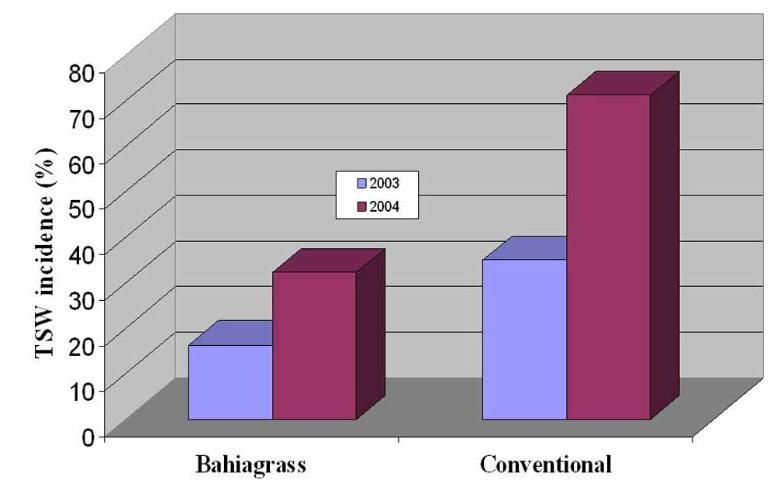
Averaged over two years, our results showed lower tomato spotted wilt virus (TSWV) (10.2%) incidence for the bahiagrass-rotated peanuts compared to the conventional peanut/cotton (21.7%) rotation using conservation tillage (Figure 1). Similarly, bahiagrass reduced severity of early leaf spot (Passalora arachidicola). We also observed lower incidences of peanut stem rot (Sclerotium rolfsii) in the sod-based rotation compared to the peanut/cotton rotation. Fungicide applications can be started 10–14 days later, saving one or more fungicide applications.
Weeds
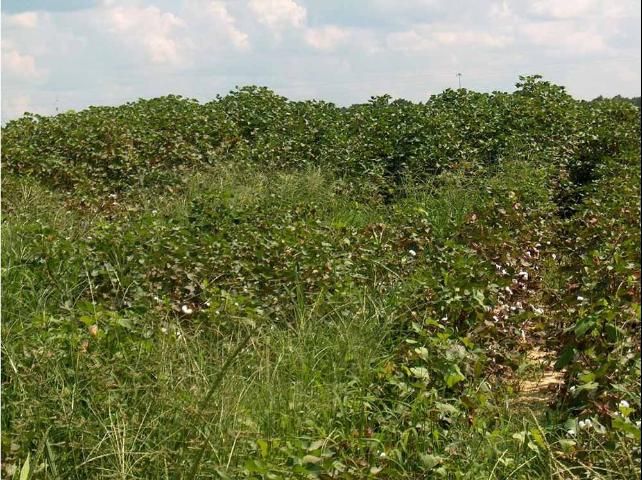
Weeds reduce plant growth and yield by competing with crops for essential resources such as moisture, nutrients, and light. Weeds also make harvesting more difficult and can stain the cotton lint during harvest, thus reducing both yield and quality. Complex multi-crop rotations are considered superior over simple rotations from a weed control perspective. Including perennial grasses in rotations allows longer intervals between crops, which can effectively break the lifecycles of weeds that are adapted to certain crops or even weeds that are adapted to certain rotations. Diverse crop rotations enable growers to also rotate with a broader spectrum of herbicides with different modes of action. This can delay and may prevent the development of herbicide-resistant weeds. Additionally, diverse rotations improve soil health and result in healthier plants that can outcompete weeds. Our studies have shown fewer weeds and weed biomass in a sod-based peanut/cotton cropping system. We also observed rapid canopy development and early-season weed suppression in cotton and peanuts after bahiagrass. Figure 2 contrasts weed densities for cotton in the traditional peanut/cotton rotation and cotton in the sod-based peanut/cotton rotation. Cotton in the sod rotation grew taller and had better weed suppression compared to cotton in the conventional rotation.
Credit: UF/IFAS
Credit: David Wright, UF/IFAS
Conclusion
A reduction in the number and amount of pesticides used in crop production is good from an environmental standpoint and can also help farmers increase their profit. The profit margin from both cotton and peanuts necessitates that all management practices that cause yield losses, including pest management, be controlled within economic constraints. Growing cotton in rotation with bahiagrass would be a cost-effective way to control pests. Complete details on the sod rotation, including the effect on soil health and economics, are available on our website (http://nfrec.ifas.ufl.edu/programs/sod_rotation.shtml) and in other publications on this website.
References
Grabau, Z. J. 2021. “Management of Plant-Parasitic Nematodes in Florida Cotton Production.” ENY-004. Gainesville: University of Florida Institute of Food and Agricultural Sciences. https://edis.ifas.ufl.edu/publication/NG015
Grabau, Z. J., and D.W. Dickson. 2021. “Management of Plant-Parasitic Nematodes in Florida Peanut Production.” ENY-069. Gainesville: University of Florida Institute of Food and Agricultural Sciences. https://edis.ifas.ufl.edu/publication/IN1199
Shumacher, L. A., Z. J. Grabau, D. L. Wright, I. M. Small, and H-.L. Liao. 2020. “Nematicide Influence on Cotton Yield and Plant-Parasitic Nematodes in Conventional and Sod-Based Crop Rotation.” Journal of Nematology 52:e2020–34. https://doi.org/10.21307/jofnem-2020-034
Wright, D. L., J. J. Marois, T. W. Katsvairo, and J. R. Rich. 2006a. “Sod/Livestock-Based Peanut/Cotton Production Systems: The Next Aeration Conservation Cropping System!” SS-AGR-126. Gainesville: University of Florida Institute of Food and Agricultural Sciences. https://edis.ifas.ufl.edu/ag258
Wright, D. L., J. J. Marois, T. W. Katsvairo, and J. R. Rich. 2006b. “Sod-Based Peanut/Cotton Rotation-Soil Health Part 1. Root Depth, Earthworms, and Soil Water Infiltration.” SS-AGR-124. Gainesville: University of Florida Institute of Food and Agricultural Sciences.
Wright, D. L., J. J. Marois, T. W. Katsvairo, and J. R. Rich. 2006c. “The Role of Livestock in Integrated Peanut/Cotton Cropping System Economics.” SS-AGR-20. Gainesville: University of Florida Institute of Food and Agricultural Sciences.