
Native to Asia, the first camellia plants were brought from Europe to America in the late 1700s. Over the last 200 years, they have proven to be dependable additions to the southern landscape, where they grow and bloom with minimal care (Figure 1). Camellias flower in the fall and winter when few other plants are blooming. The Sasanqua-type camellias (Camellia sasanqua, C. hiemalis, C. vernalis) bloom the earliest (October–December), followed by Camellia japonica types (December–March). For the remainder of the year, their glossy, evergreen foliage, interesting forms and textures, relatively slow growth, and low maintenance make camellias excellent landscape plants worthy of more use.
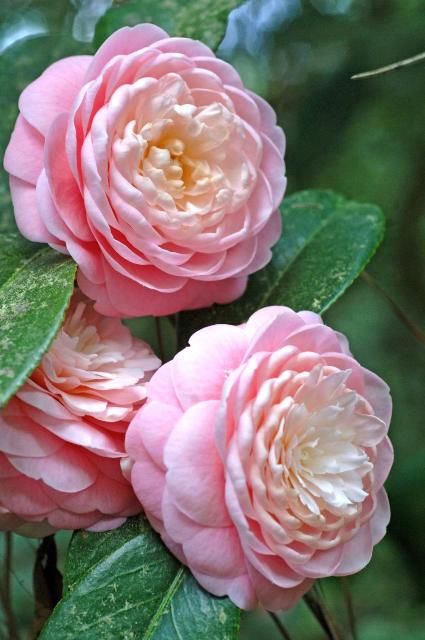
Credit: Harry P. Leu Gardens
There are numerous species of Camellia, but the types commonly grown as landscape shrubs in Florida are Camellia japonica, Camellia sasanqua, and hybrids of these. Camellia japonica typically grows larger, has bigger leaves, and more spectacular flowers. Camellia sasanqua has smaller leaves and simpler flowers, but bloom profusely. Camellia reticulata, Camellia hiemalis, Camellia vernalis, and their hybrids are less commonly used in landscapes. The young leaves of another species, Camellia sinensis, are processed for tea, one of the world's most popular drinks (see Tea Growing in the Florida Landscape at https://edis.ifas.ufl.edu/hs308).
Camellias can be grown successfully in most inland areas of north and central Florida. Their success as a landscape plant is usually determined by soil type since they demand well-drained soils with an acidic pH. Special soil modification is necessary where these conditions do not naturally exist and, in such cases, they are probably best grown in large containers. Camellias are long-lived and function well as foundation plantings, screens, accent plants, background groupings, and hedges.
Selection of Varieties
Camellias can be purchased at nurseries, garden festivals, and camellia shows. Varieties range in plant size and form from compact to large and spreading to upright. A huge assortment of flower sizes, colors, and forms also exist, and new cultivars are introduced each year. Blooms vary in color from pure white to brilliant crimson, with many color combinations and patterns. Six flower forms are commonly recognized (Figure 2).
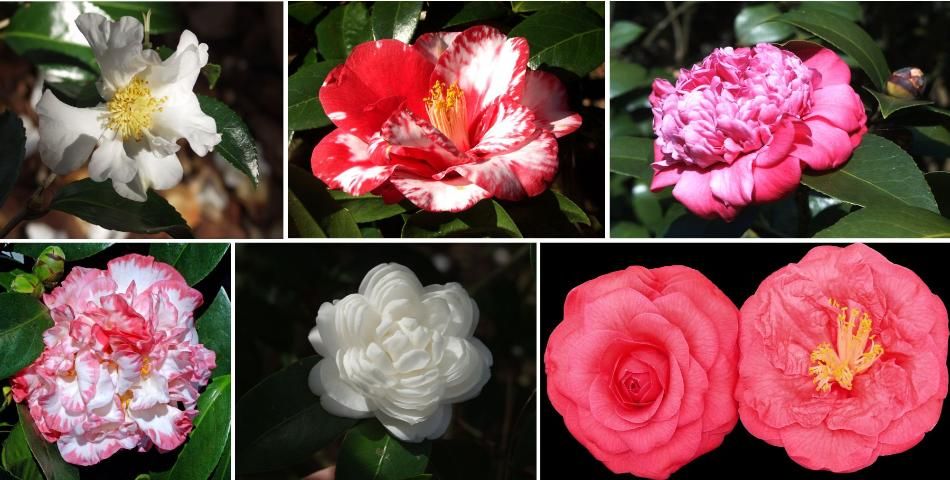
Credit: Leu Gardens. Rose form double: Sydney Park Brown
Another important characteristic of camellia flowers is their season of bloom. Midseason flowering varieties that bloom from November through January are best suited for Florida conditions. Warm fall temperatures may prevent early varieties from flowering properly. Late-blooming plants may start growing before the end of the flowering period, resulting in "bullnosing," which is characterized by flowers that do not open fully and may even drop while still tight buds.
Some good performers for Florida landscapes are listed in Table 1. Others, particularly heirloom varieties, also do well but may be difficult to find in the trade. A comprehensive list with descriptions and images is available from the American Camellia Society (https://www.americancamellias.com/care-culture-resources). Local camellia societies and their flower shows are excellent sources of information, and they often sell easy-to-grow and/or hard-to-find varieties. Noteworthy camellia collections are on display at Harry P. Leu Gardens in Orlando, Mead Botanical Garden in Winter Park, Bok Tower Gardens in Lake Wales, Gainesville’s Wilmot Botanical Gardens, the University of West Florida in Pensacola, and Alfred B. Maclay Gardens State Park near Tallahassee.
General Culture
Soils
Camellias prefer fertile, well-drained soils high in organic matter with a pH between 5.0 and 6.5. Soils that are too sandy or alkaline can be modified with soil amendments and fertilizer to make them more suitable for camellias. Another option is to grow camellias in large containers.
Exposure
Camellia japonica performs best in partially shaded locations; sasanqua camellias tolerate full sun but do best when protected from harsh afternoon sun. Deep shade may result in sparse foliage and poor flowering. Camellias are cold hardy but should be protected from cold winds.
Planting
Camellias are best planted from November to February so the roots can become established before the heat of summer. Late spring or summer planting is possible if extra care is provided. Very sandy soils should be amended by mixing 3–6 inches of organic matter into the top 12 inches of soil. The entire planting bed, rather than individual planting holes, should be amended if possible. The planting hole should be two to three times wider and slightly shallower than the root ball. When planted, the root ball should be 1–2 inches above the soil line to allow for sinking. Camellias cannot tolerate being planted too deeply. Add and maintain a 2–3-inch layer of mulch to insulate the root system and conserve moisture in the root zone. Avoid placing mulch over the root ball to allow for air exchange. Plants should be spaced according to their mature size and rate of growth, usually at least 5 feet apart.
Fertilization
Camellia enthusiasts who compete in flower shows typically fertilize their plants four times a year. However, camellias growing on a suitable site perform well with significantly less fertilizer. One or two applications a year should be adequate. Use a fertilizer containing equal amounts of nitrogen and potassium (the first and third numbers on the fertilizer tag) and low phosphorus (the middle number).
The rate should be about half a pound of 12-4-12 or 15-5-15 (or similar fertilizer) per 100 square feet of planting area in spring and/or early summer. Late summer or fall fertilization may cause tender growth, which may be injured by early cold periods. Water the plants before and after fertilizer applications. Acid-forming "Azalea & Camellia" fertilizer should only be used on camellias established in the landscape (i.e., not young or containerized plants).
Magnesium deficiency is the most common nutritional deficiency on camellia shrubs throughout Florida. Symptoms are most severe on the older leaves. Camellias growing on alkaline pH soils often appear chlorotic (yellow) because of deficiencies in micronutrients like iron, manganese, and zinc. Micronutrient sprays applied to the foliage or the soil may correct the problem temporarily.
Watering
Camellias are fairly drought tolerant but need irrigation during extended dry periods; 1 inch of water should be applied every 10 days to 2 weeks. Camellias also need 1 inch of water per week during flowering. They are sensitive to overwatering and succumb to root rot when kept too wet.
Pruning
Camellias typically need minimal pruning. Necessary grooming and shaping should be done in late winter or very early spring after blooming. Pruning in late summer or fall removes flower buds. Selective removal of dead wood and undesirable branches can be done anytime to retain a neat shape. Shearing should be avoided because it destroys the natural plant form and results in a dense outer layer of foliage that blocks light from the interior branches.
Propagation
The most common and easiest methods of propagating camellias are by cuttings and air layering. Both methods ensure that the new plant will retain the characteristics of the parent plant. Cuttings are usually taken in July from hardened spring growth.
Air layering is a simple propagation method that allows one to produce a good-sized plant in a short amount of time. A ring of bark is removed from a pencil-sized stem, and moist sphagnum moss is wrapped around the wound. Roots grow into the moss and the rooted stem can be cut from the mother plant and then potted to allow for further root growth. Once it is well-rooted in the container, it can then be planted into the landscape. Air layers should be started in April and are usually ready by August.
Grafting is used to propagate varieties that have desirable characteristics, such as exceptional flowering, but a weak root system. Grafting permits the union of the desired top (scion) with a vigorous root system (rootstock) to yield a superior plant. Seed propagation results in tremendous seedling variation with a high percentage of undesirable seedlings. Seeds should be collected as soon as they are ripe (July–September) and placed in flats or pots. Germination can be expected in 2–4 months if the seed coat is broken or scarified before sowing.
Disbudding and "Gibbing"
Camellia growers that enjoy competing in flower shows often manipulate the flower buds to achieve larger and earlier flowers. This involves removing competing flower buds and applying gibberellic acid (a plant hormone). Details on this technique can be found at the American Camellia Society website (https://www.americancamellias.com).
Pests and Diseases
For additional information and general management recommendations regarding the insects, mites, and diseases listed below, see Key Plant, Key Pests: Camellia (https://edis.ifas.ufl.edu/ep558).
Insects and Mites
Camellias are generally low-maintenance plants, but a few pests can sometimes be problematic, the most common being tea scale, aphids, and spider mites.
Tea scale (Figure 3) is the most common scale on camellia. Scales generally feed on the underside of leaves and may not be noticed until large populations have developed. Identification and management information for tea scale can be found at https://edis.ifas.ufl.edu/in522.
Aphids injure camellias by sucking juices from young leaves. Injured leaves curl and become distorted. Aphids secrete a sticky substance called honeydew, which is an excellent medium for sooty mold, a black growth that grows on the upper surface of leaves. It is mostly a cosmetic problem that can be managed by controlling the insects.
Spider mites (Figure 3) are tiny pests generally found on the underside of leaves. The tops of infested leaves soon display a rusty or reddish speckling of the green surface. Twospotted spider mite infestations usually appear during hot, dry conditions and in areas of the landscape with poor air circulation and little exposure to rainfall. See http://entnemdept.ufl.edu/creatures/orn/twospotted_mite.htm for more information. Southern Red Spider Mites thrive in the cool spring and fall weather of Florida http://entnemdept.ufl.edu/creatures/orn/shrubs/southern_red_mite.htm.
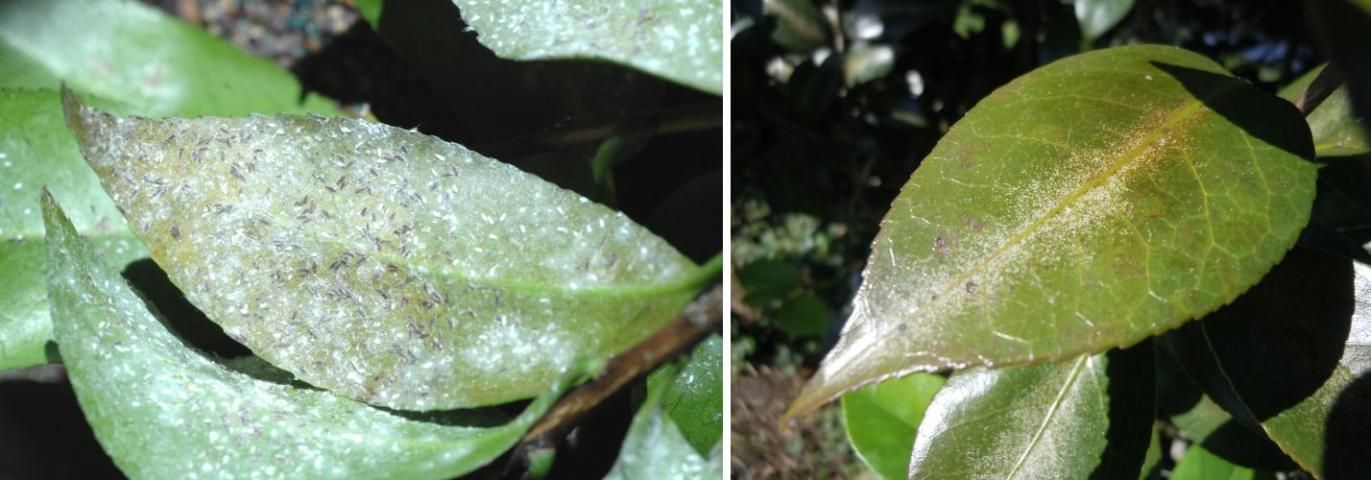
Credit: Harry P. Leu Gardens
Specific management information on the above insects can be obtained from your local UF/IFAS Extension office. For contact information, see https://sfyl.ifas.ufl.edu/find-your-local-office/.
Diseases
Camellias that are correctly planted and cared for rarely develop serious disease problems but known diseases of this plant include algal leaf spot, dieback, leaf and bud gall, and root rot. Attention should be given to improving general cultural practices if these problems appear.
Dieback is most common during the spring months and is characterized by wilting and sudden death of new twigs. Older branches can also be infected but usually die more slowly. The leaves characteristically remain on the branches for considerable lengths of time after they die.
The best dieback control is sanitation. The fungus causing this problem is inside the stem and is not satisfactorily controlled by fungicides. Diseased branches should be removed about 6 inches below the lowest visible symptoms of disease. Pruning tools must be sterilized after each cut with an antiseptic, such as 10% chlorine bleach or Lysol® solution. Removed branches should be destroyed and not recycled in the landscape.
Leaf and bud galls appear as thickened and enlarged leaves or buds during the cool spring months. One or several leaves on a single shoot may be affected. Control can be accomplished in the home garden by simply pinching off and destroying infected leaves. Disease activity usually stops with the advent of warm weather.
Camellias are occasionally attacked by root rot diseases related to poor soil drainage and overwatering. The entire plant or a section of the plant gradually weakens and dies. It is difficult, if not impossible, to correct root rot once these symptoms appear. The wisest course of action is to remove the plant.
Acknowledgments
The author wishes to thank former contributors to this publication: Gary Knox, UF faculty; Eileen Hart, former Master Gardener and member of the Tampa Bay Area Camellia Society, and Jerry Conrad. Also thanks to Robert Bowden, former director of Harry P. Leu Gardens, for photos.