
Introduction
This ground-hugging, fine-textured relative of the more common chenille plant grows no more than several inches tall. In the full sun it forms a thick canopy of tiny, serrated leaves no more than 3/4 inches long by 1/2 inches wide. Bright red, fuzzy flowers stand erect above the foliage like soldiers in a field.
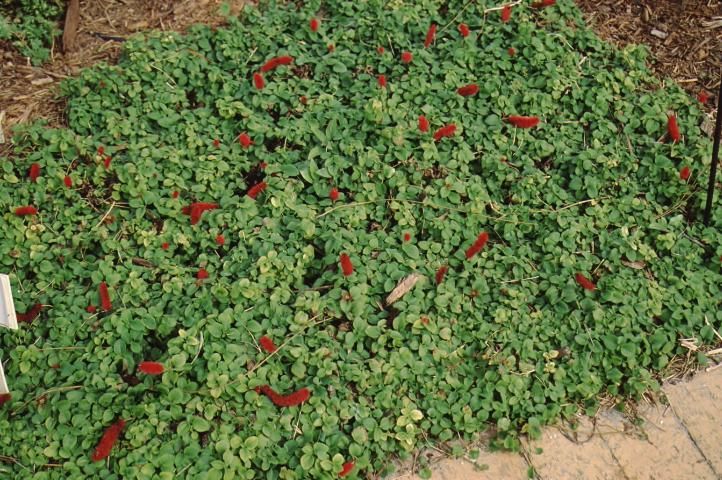
Credit: Edward F. Gilman, UF/IFAS
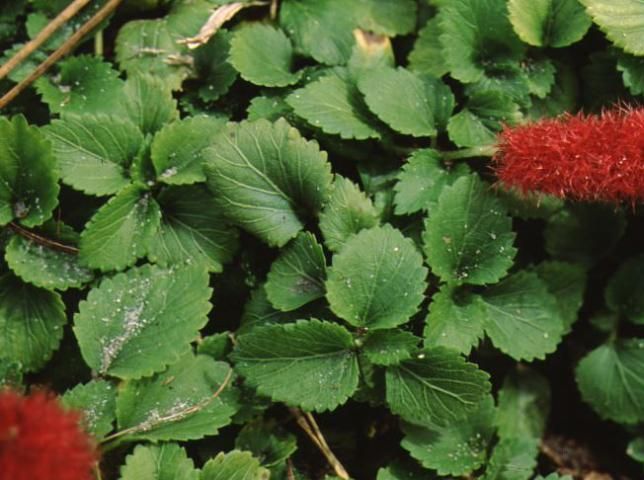
Credit: Edward F. Gilman, UF/IFAS
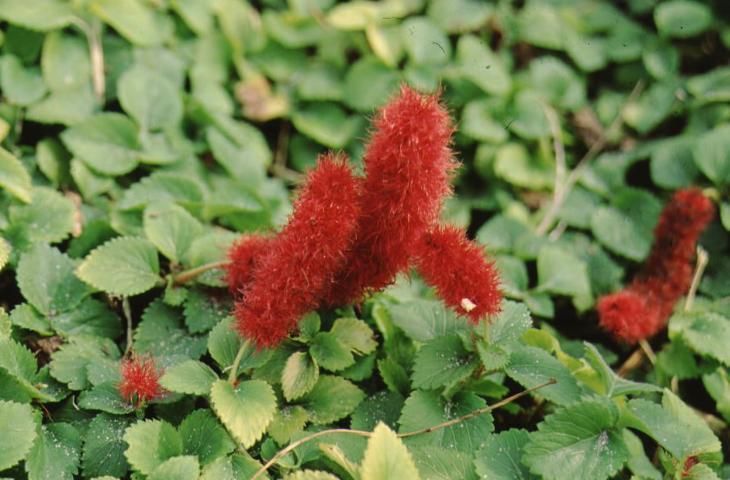
Credit: Edward F. Gilman, UF/IFAS
General Information
Scientific name: Acalypha pendula
Pronunciation: ack-uh-LIFE-uh PEN-dyoo-luh
Common name(s): dwarf chenille plant
Family: Euphorbiaceae
Plant type: ground cover
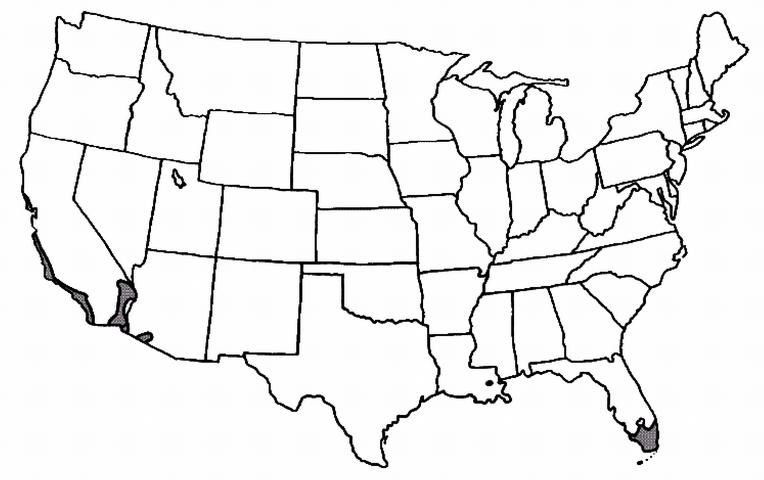
USDA hardiness zones: 10 through 11 (Figure 4)
Planting month for zone 10 and 11: year round
Origin: not native to North America
Invasive potential: not known to be invasive
Uses: hanging basket; ground cover; cascading down a wall
Availability: somewhat available, may have to go out of the region to find the plant
Description
Height: 0 to 1/2 feet
Spread: depends upon supporting structure
Plant habit: spreading
Plant density: dense
Growth rate: slow
Texture: fine
Foliage
Leaf arrangement: opposite/subopposite
Leaf type: simple
Leaf margin: serrate
Leaf shape: ovate
Leaf venation: pinnate
Leaf type and persistence: evergreen
Leaf blade length: less than 2 inches
Leaf color: green
Fall color: no fall color change
Fall characteristic: not showy
Flower
Flower color: red
Flower characteristic: year-round flowering
Fruit
Fruit shape: unknown
Fruit length: unknown
Fruit cover: unknown
Fruit color: unknown
Fruit characteristic: inconspicuous and not showy
Trunk and Branches
Trunk/bark/branches: not applicable
Current year stem/twig color: green
Current year stem/twig thickness: thin
Culture
Light requirement: plant grows in part shade/part sun
Soil tolerances: acidic; slightly alkaline; sand; loam
Drought tolerance: moderate
Soil salt tolerance: unknown
Plant spacing: 18 to 24 inches
Other
Roots: not applicable
Winter interest: no special winter interest
Outstanding plant: not particularly outstanding
Pest resistance: long-term health usually not affected by pests
Use and Management
Well suited for a hanging basket, dwarf chenille plant will cascade nicely over a wall if planted close to the edge on top of the wall. This plant makes a good ground cover provided people are kept off of it. Like ivy, it tolerates foot traffic poorly. The small stature and slow growth make it a nice addition to a rock garden or other small-scale landscape design.
Dwarf chenille plant performs well in many types of well-drained soils. It grows and flowers best in full sun, with little care other than occasional irrigation needed to maintain the plant once it is established.
Design Considerations
The short red upright flowers of the chenille plant are a striking feature that can be used to bring color to a ground cover edge. Red shows best in full or part sun when paired with other small shrubs or groundcover with white and pink flowers to make the red look more intense. Groundcover with larger dark green, glossy leaves would also contrast well with the leaves of the chenille plant. Background plants could include purple and white flowers and fine or medium textures such as grasses with narrow strap blades in a clumping form or tall spiky forms with narrow leaves.
Pests and Diseases
There are no diseases of major concern associated with dwarf chenille plants. Scales, mites and aphids may be troublesome pests in some landscapes, especially when plants are grown in partial shade.