
Introduction
'Sprengeri' Asparagus Fern is a rounded herbaceous perennial that is used in the landscape for its attractive, fine-textured foliage. This 1 to 4 foot-tall plant has true leaves that are scale-like and inconspicuous. The structures that most refer to as leaves are actually leaf-like branchlets called cladophylls. These tiny cladophylls are linear, flattened structures that are bright green in color. They occur singly or in groups of 3 or more at a node. The stems of this plant emerge directly from the ground and become woody and spiny, so be careful when handling this species. The thorns cause significant irritation to many people that handle the plant. Pretty, red, ovoid berries occur on Asparagus densiflorus throughout the year. Several birds eat and probably distribute the fruit. These fruits follow tiny, white, flowers that occur in axillary racemes; the flowers are inconspicuous for the most part but fragrant. Seeds germinate in the landscape and the plant has escaped into natural habitats in parts of Florida. It can also become a weed in your landscape.
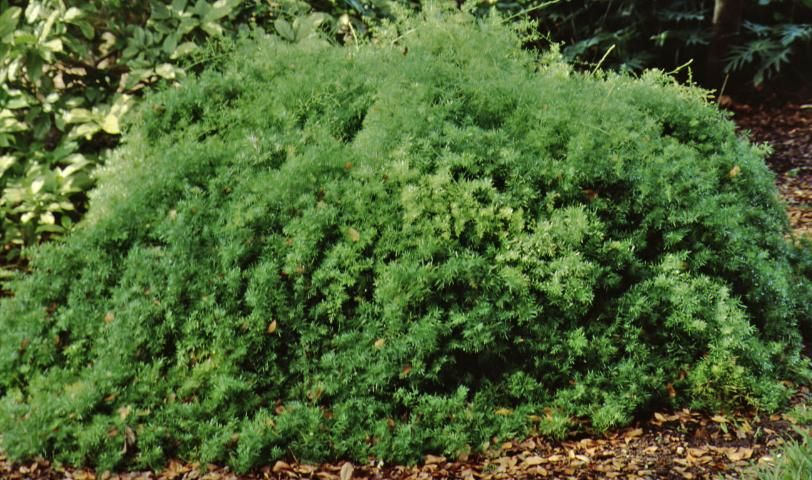
Credit: Edward F. Gilman, UF/IFAS
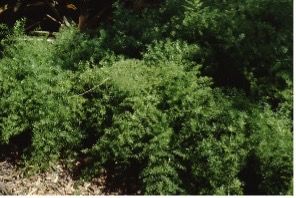
Credit: Edward F. Gilman, UF/IFAS
General Information
Scientific name: Asparagus densiflorus 'Sprengeri'
Pronunciation: ass-SPAR-uh-gus den-sif-FLOR-us
Common name(s): 'Sprengeri' asparagus fern
Family: Liliaceae
Plant type: herbaceous; perennial
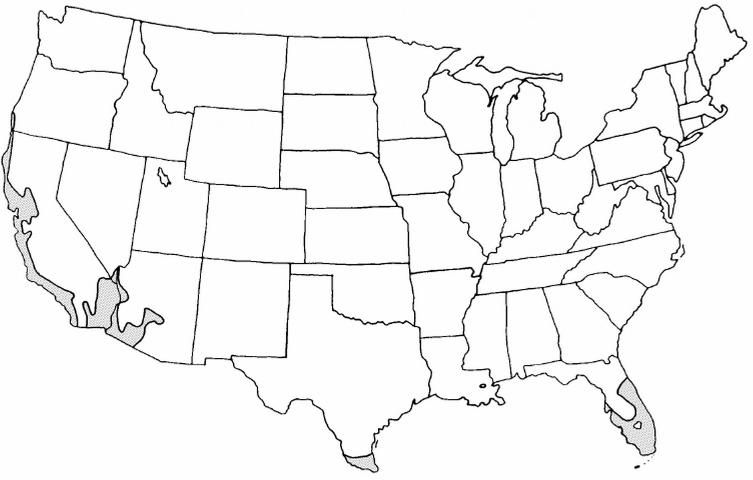
USDA hardiness zones: 9B through 11 (Figure 3)
Planting month for zone 7: year round
Planting month for zone 8: year round
Planting month for zone 9: year round
Planting month for zone 10 and 11: year round
Origin: not native to North America
Invasive potential: Caution in all zones, Cat 1 Florida Invasive Plant Council (formerly FLEPPC)
Uses: mass planting; container or above-ground planter; groundcover; border; cascading down a wall; suitable for growing indoors
Availability: generally available in many areas within its hardiness range
Description
Height: 1 to 2 feet
Spread: 3 to 4 feet
Plant habit: spreading; round
Plant density: moderate
Growth rate: fast
Texture: fine
Foliage
Leaf arrangement: alternate
Leaf type: simple
Leaf margin: entire
Leaf shape: linear
Leaf venation: none, or difficult to see
Leaf type and persistence: evergreen
Leaf blade length: less than 2 inches
Leaf color: green
Fall color: no fall color change
Fall characteristic: not showy
Flower
Flower color: white
Flower characteristic: flowers periodically throughout the year
Fruit
Fruit shape: oval
Fruit length: less than 1/2 inch
Fruit cover: fleshy
Fruit color: red
Fruit characteristic: attracts birds
Trunk and Branches
Trunk/bark/branches: typically multi-trunked or clumping stems
Current year stem/twig color: not applicable
Current year stem/twig thickness: not applicable
Culture
Light requirement: plant grows in part shade/part sun; plant grows in the shade
Soil tolerances: occasionally wet; slightly alkaline; clay; sand; acidic; loam
Drought tolerance: moderate
Soil salt tolerances: good
Plant spacing: 18 to 24 inches
Other
Roots: not applicable
Winter interest: no special winter interest
Outstanding plant: not particularly outstanding
Pest resistance: no serious pests are normally seen on the plant
Use and Management
This charming perennial can be used in the landscape as a border plant or ground cover. It can be maintained by clipping to any height up to 2 feet tall. It suits a container well and is beautiful if trained to cascade over a wall. When the root system fills the container, remove the root ball from the pot, split it apart and replant a portion of it back into the container. The rest of the root ball can be planted in other containers. One may also use asparagus fern in mixed shrub groupings.
This plant is adaptable to various well-drained soils and will flourish in full sun or partial shade. The foliage of asparagus fern is killed by frost, but the plant will recover quickly in the southern portion of hardiness zone 8. It is very drought tolerant and will survive in hot, dry locations, although it will grow slower in dry locations.
The berries of Asparagus densiflorus contain 1 or 2 black, hard seeds that can be used for propagation; the seeds germinate in 4 to 6 weeks. This plant may also be propagated by cuttings and division.
Other cultivars include 'Myers' with stiffly erect stems, dense foliage forming narrow plumes about 2 feet tall.
Design Considerations
The Sprengeri Asparagus Fern has a clumping, arching, form that resemble mounds when grown in clusters. The arching branches cascade nicely over container edges or garden walls. Use caution in planters around patios as the thorns can cause irritation. Companion plants should have large, smooth leaves to contrast with the tiny needle-like branches of the fern. Simple forms and dark green or smooth foliage of companion plants will highlight the delicate foliage. The light to medium green of the fern will work well with different flower colors, but deep or bright colors will show better than light pastels. Simple small or medium size flowers will contrast more with the tiny foliage and white, yellow, and blue flowers will complement the bright red berries.
Pest and Diseases
Except for mites, none of major concern.