
Introduction
This lovely Florida native is an evergreen shrub or small tree. It grows slowly to a height of 20 feet. The horizontally held, spreading branches are clothed with short, dark green needles that look pointed but are actually very soft to the touch. New growth is bright green, making a nice contrast to the darker, mature foliage. Insignificant flowers are produced in March on female plants and are followed by single-seeded, small, pulpy fruits, ripening to red in the fall. Both leaves and fruit of Florida yew are poisonous.
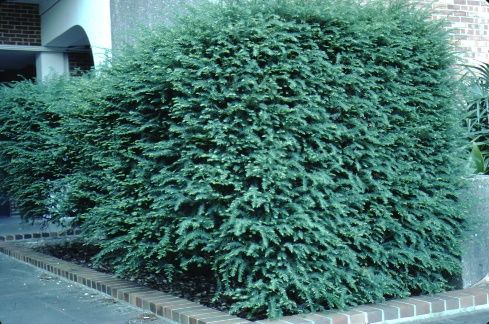
Credit: Edward F. Gilman, UF/IFAS
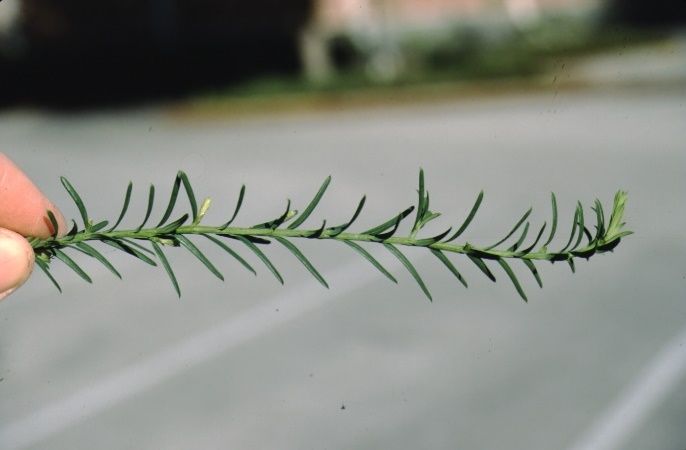
Credit: Edward F. Gilman, UF/IFAS
General Information
Scientific name: Taxus floridana
Pronunciation: TACK-suss flor-rid-DAY-nuh
Common name(s): Florida yew
Family: Taxaceae
Plant type: shrub
USDA hardiness zones: 8 through 9A (Figure 3)
Planting month for zone 8: year-round
Planting month for zone 9: year-round
Origin: native to Florida
Invasive potential: not known to be invasive
Uses: near a deck or patio; screen; attracts butterflies; superior hedge
Availability: grown in small quantities by a small number of nurseries
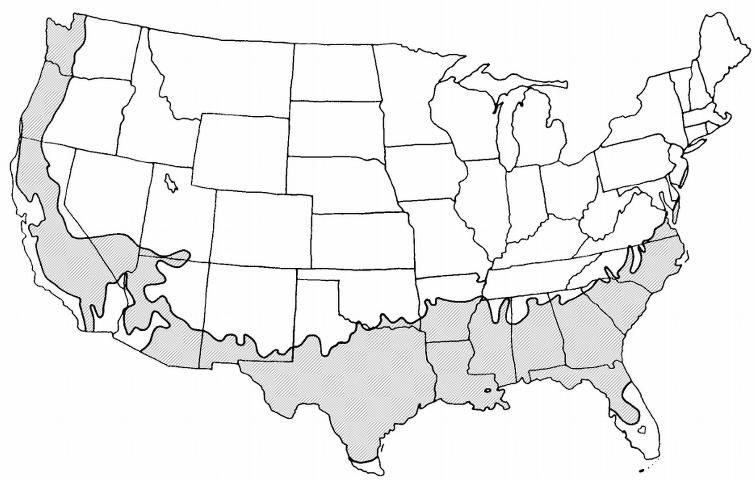
Credit:
Description
Height: 10 to 25 feet
Spread: 15 to 25 feet
Plant habit: oval; vase shape
Plant density: dense
Growth rate: slow
Texture: fine
Foliage
Leaf arrangement: spiral
Leaf type: simple
Leaf margin: entire
Leaf shape: linear
Leaf venation: parallel
Leaf type and persistence: evergreen
Leaf blade length: less than 2 inches
Leaf color: green
Fall color: no fall color change
Fall characteristic: not showy
Flower
Flower color: no flowers
Flower characteristic: no flowers
Fruit
Fruit shape: irregular
Fruit length: less than 0.5 inch
Fruit cover: fleshy
Fruit color: red
Fruit characteristic: attracts birds
Trunk and Branches
Trunk/bark/branches: showy; typically multi-trunked or clumping stems
Current year stem/twig color: green
Current year stem/twig thickness: medium
Culture
Light requirement: plant grows in part shade/part sun
Soil tolerances: sand; acidic; loam; clay
Drought tolerance: moderate
Soil salt tolerances: poor
Plant spacing: 36 to 60 inches
Other
Roots: usually not a problem
Winter interest: no special winter interest
Outstanding plant: plant has outstanding ornamental features and could be planted more
Pest resistance: long-term health usually not affected by pests
Use and Management
The dense, compact growth of Florida yew makes it ideal for use as a specimen, hedge, or foundation planting, but Florida yew is seldom seen in nurseries and should be used much more often in home landscapes to save it from extinction. In the wild, Florida yew is found only in a small section of north Florida on the eastern shore of the Apalachicola River where it will ultimately be threatened by encroaching developments.
Florida yew should be grown in conditions that can mimic its native habitat as much as possible: broken shade on rich, slightly acid, well-drained soil. Plants should be watered regularly.
Propagation is by cuttings. Mature wood cuttings taken in winter root well under mist.
Pest and Diseases
Scales.
Mushroom root-rot.