
Family
Arecaceae, palm family.
Genus
Ptychosperma means "a folded seed" and comes from two Greek words: ptycho, or "a fold," and sperma, or "seed."
Species
The species name elegans is the Latin term for "graceful" or "elegant."
Common Names
Solitaire Palm, Alexander Palm
This palm is commonly referred to as the solitaire palm because it grows with a single, solitary trunk.
Description
Solitaire palm is native to eastern Queensland, Australia where it occurs in coastal rainforests. In America, solitaire palm grows best where temperatures do not drop below 35°F because it is not very cold hardy. It prefers full sun to partial shade and can reach heights of 20 feet. The pinnately compound leaves or fronds can reach lengths of 6 to 8 feet and are attached to a 1-foot-long petiole or stem. They are dark green on the topside and gray-green on the underside. Leaflets are 2-foot-long, narrowly oblong blades that are bluntly squared and jagged at the tip. They grow opposite from one another on the rachis, displaying a "V-shaped" appearance. The slim trunk grows to a maximum diameter of 4 inches, is light gray or almost white, and has dark leaf base scars that encircle the trunk and lighten in color with age. On top of the trunk sits a two foot tall olive-green crownshaft (from which the fronds emerge). The crownshaft has a bulging base and smooth waxy surface. The heavily branched, green-yellow inflorescences are 2 to 3 feet long and appear just below the crownshaft. Inflorescences produce white male and female flowers. Fruits are bright red, about one inch in diameter, and egg shaped.
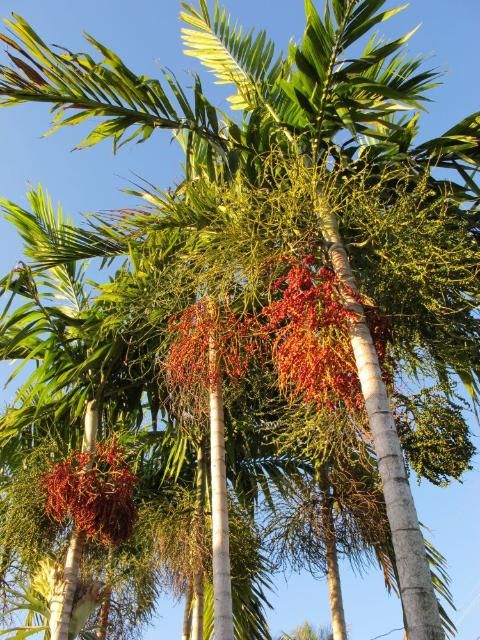
Credit: Scott Zona, CC BY 2.0
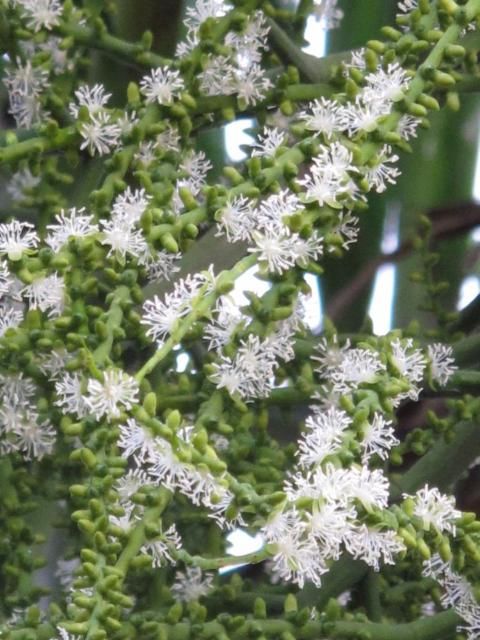
Credit: Scott Zona, CC BY 2.0
Allergen
All members of this genus are considered to be moderately to highly allergenic.
Applications
Horticultural
The solitaire palm is a good specimen to use in small residential yards because it does not require much growing space. It exhibits fair growth in well-drained soils but grows best in more organic, nutrient-laden soils. While this palm needs little maintenance, it does require regular watering. Many choose to plant this palm in multiples of varying heights to create a fuller effect and a more interesting silhouette.
References
Borror, D. J. 1988. Dictionary of root words and combining forms (2nd ed.). Mountain View, CA: Mayfield Publishing Company.
Gledhill, D. 1989. The names of plants (2nd ed.). Cambridge: Cambridge University Press.
Meerow, A. W. 2004. Betrock's guide to landscape palms (9th ed.). Hollywood, FL: Betrock Information Systems.
Ogren, T. L. 2000. Allergy-free gardening: The revolutionary guide to healthy landscaping. Berkeley, CA: Ten Speed Press.
Riffle, R. L. and P. Craft. 2003. An encyclopedia of cultivated palms. Portland, OR: Timber Press, Inc.
USDA Natural Resources Conservation Service. (n.d.). PLANTS database. Retrieved from http://plants.usda.gov/index.html