
Family
Fabaceae or Leguminosae, bean family
Genus
Cassia comes from the ancient Hebrew word “quetsi’oth,” first used by Dioscorides, a physician in Ancient Greece (40–90 AD). Linnaeus, also known as the father of taxonomy, was the first to use Cassia to signify members of this genus.
Species
The species name leptophylla is a combination of the Greek words lepto meaning “fine or slender” and phylla meaning “leaves,” which together mean “slender leaves.”
Common Name
Gold/Golden Medallion Tree
The names “gold medallion tree” or “golden medallion tree” refer to the bright yellow flowers that appear in spherical clusters thought to resemble “medallions” around the outer canopy of the tree.
Description
This semi-deciduous tree is native to southern Brazil but grows well in subtropical regions of the United States, such as Florida, Texas, and Hawaii. This tree requires well-drained soil with little threat of freezing temperatures and should be grown in direct sunlight for full flowering potential. The gold medallion tree can reach heights of 30–40 feet with proper pruning. The dark green leaves are pinnately compound and alternately arranged. Leaves are made up of 8–12 oval- to spear-shaped leaflets that are generally 2–3 inches long and ½ inch wide. The bark and new woody stems are brown and smooth. Blooms are showy, yellow flowers that appear in spherical clusters around the canopy of the tree in the summer months, and fruits are foot-long dry pods.
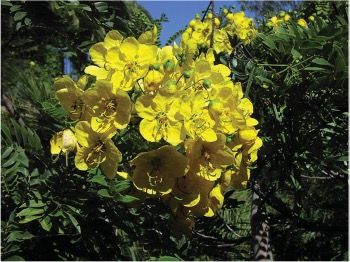
Credit: Abraxas3d, CC BY-NC 2.0, http://flic.kr/p/ZmkC
Allergen
Members of the Cassia genus are moderately allergenic. Oil from the pods may cause skin irritation to some individuals.
Applications
Horticultural
The gold medallion tree is planted primarily as a shade tree or as a decorative specimen for the yard or street. Many people like this tree because of its fast growth rate and showy, bright yellow clusters of flowers that bloom in the summer months. This tree loses its leaves for a very short period each year, but leaves are quickly replaced. Pruning the tree to one main leading stem from which major branches are attached can help increase its strength and sturdiness against strong wind events. The golden medal- lion tree is also naturally pest resistant, and as long as it is grown in areas where the temperature does not drop below freezing, it is an easy tree to care for.
Additional References
Gilman, E.F. (1997). Trees for Urban and Suburban Landscapes. Albany, NY: Delmar Publishers.
Stebbins, M. K. (1999). Flowering Trees of Florida. Sarasota, FL: Pineapple Press.
University of Florida (2011). Landscape Plants: Cassia leptophyllia, Golden Medallion Tree. Retrieved from https://hort.ifas.ufl.edu/woody/Pages/caslep/caslep.shtml.